

Makers have always stood at the vanguard of new technology, acting as both brilliant inventors and restless innovators. From their humble commercial beginnings in the early twentieth century to their absolute ubiquity in the modern era, Light Emitting Diodes—better known as LEDs—have continually captured the imagination of makers, engineers, and creative technologists alike. While some makers are initially drawn to their exceptional energy-saving capabilities, others find themselves utterly captivated by the sheer brilliance of the illumination and the boundless possibilities of integrating them with microcontrollers, sensors, and diverse electronic hardware.
This vibrant intersection of technology and artistry takes center stage at the upcoming Maker Faire Bay Area, where organizers celebrate the imaginative creators diving deep into LED technology and its endless creative applications. The showcase finds its ultimate expression within the event’s dedicated "Dark Room," a specially curated space designed to let complex light projects show off their absolute best visual effects. Attendees looking to experience this sensory wonderland can head over to Mare Island from September 25th through 27th to witness firsthand what today’s most inventive makers are crafting with light.
Voice, Code, and the Natural World
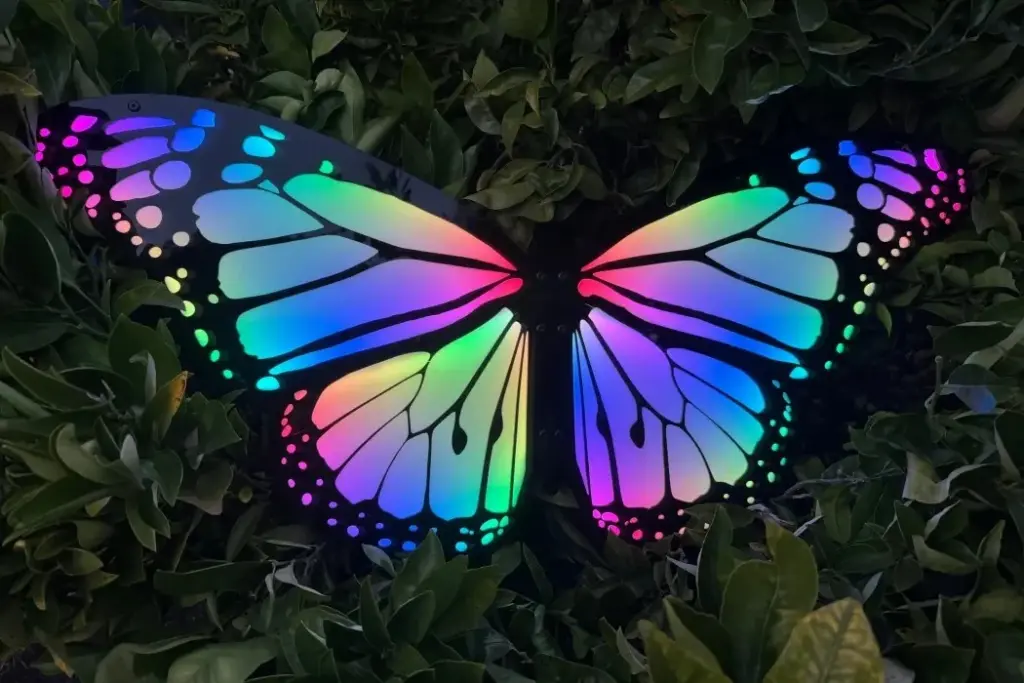
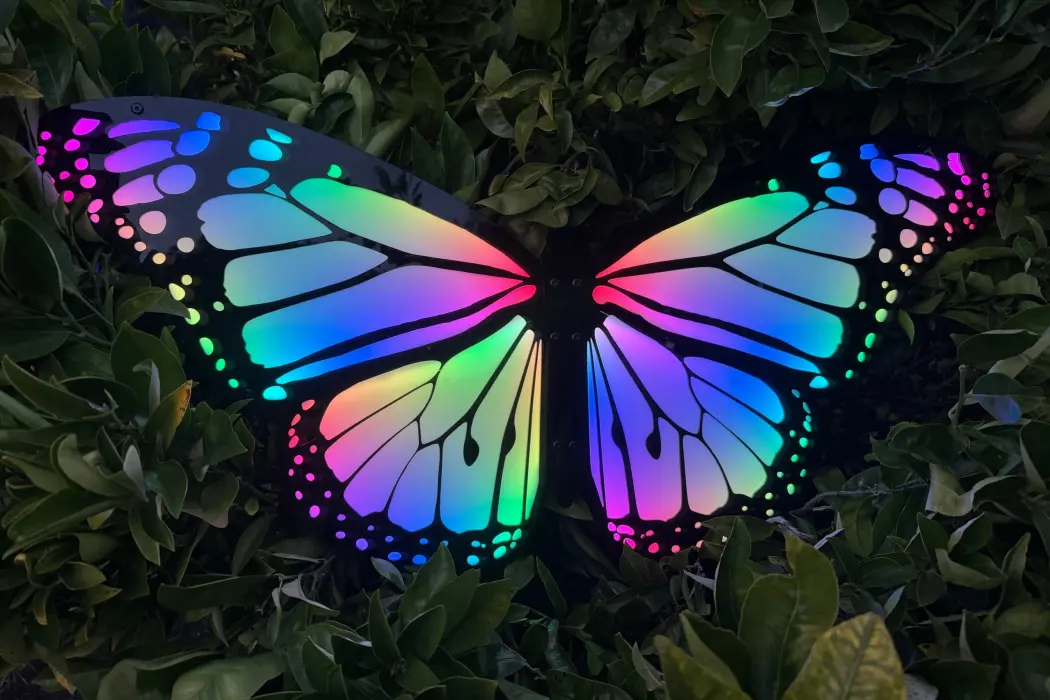
Among the standout pieces featured in the Dark Room is the event’s striking cover installation, Lepidoptera Imaginaria, created by Grant Patterson. This interactive light sculpture draws its core inspiration from the endangered migratory monarch butterfly, bridging the gap between fragile organic life and complex digital engineering. Patterson, a Stanford-trained computer scientist boasting decades of hands-on experience across hardware, software, and Internet of Things (IoT) systems, utilizes 570 full-color LEDs to physically translate human speech directly into shimmering waves of light.
To activate the piece, festival participants step up and speak into a vintage microphone. Behind the scenes, a Large Language Model (LLM) generates custom code completely on the fly, instantly translating the spoken voice into perpetually shifting, dynamic light patterns. The artwork serves a fascinating conceptual purpose, making AI-generated "code slop" entirely visible to the naked eye while simultaneously allowing anyone to become a software creator instantly, requiring zero prior programming experience. Yet, the installation carries a clever catch that particularly fascinates the technologists in the room: without being able to see the underlying code being generated in real time, participants cannot truly understand, debug, or alter what they have just created.

The Intersection of Light and Sound
A major thematic thread weaving through many of the Dark Room exhibits this year is an intricate musical component. Numerous installations incorporate advanced hardware devices or custom printed circuit boards (PCBs) specifically engineered to synchronize complex visual lighting effects seamlessly with live audio signals, ambient music, or external MIDI inputs.
One prominent example of this audio-visual synergy is Night Canopy, a room-sized musical instrument created by Bay Area maker, DJ, and software engineer Jenia Varavva. The piece features a dense cluster of hanging strands that respond instantly to physical touch by producing rich auditory loops and short acoustic soundscapes. Visitors are invited to step inside the installation, gently brush against a strand, and immediately hear their interaction join the unfolding musical composition. Above, fluorescent strands glow brilliantly under ultraviolet light beneath a reflective ceiling, inviting festival-goers to play, listen, and create together in an immersive environment.

The exploration of the complex interplay between light, sound, and physical space continues with several other experimental pieces, including an agentic VJ system and specialized theatrical lighting hardware designed to transform traditional stage performances.
Generative AI and Theatrical Innovation
Vrch.io, a specialized art-tech studio founded by an architect-turned-computational artist and an AI engineer, focuses on building real-time generative AI systems capable of translating sound, gesture, and emotion into fully immersive spatial experiences. Operating on the belief that latent space represents an entirely new artistic medium, the studio argues that exploring novel—and revisiting older—modes of control and human interaction remains essential for contemporary media artists.

This philosophy of cross-medium collaboration is equally evident in Chromolume, a dynamic light-art piece crafted by Bay Area artist Sydney Parcell for a production of the musical Sunday in the Park with George, presented by the Shotgun Players Theater in Berkeley. Designed to physically spin and cast an intricate ballet of light and shadows across its surrounding space, the sculpture is fully controllable via DMX protocols. This technical integration allowed the theater’s professional sound and light designers to collaborate directly with the physical art piece during performances.
Another striking manifestation of light-audio interaction is found in The Morphoresonator, a monumental nine-foot chandelier. Visitors walking into the dark room are greeted by a glowing, humming structure featuring luminous organic forms hand-sculpted from cellophane and packing tape layered over internal illumination. The piece serves as a physical proof of concept that living light does not require an industrial foundry to come into existence. When a visitor makes a sound—whether through a simple clap, a hum, a spoken word, or a musical note—the chandelier answers back; the light shifts in intensity and color, and the embedded generative music system absorbs the input, processes it, and plays it back transformed.

Similarly, Dynamandala offers an immersive, participatory light and sound installation that takes real-time audience input and transforms it into evolving visual patterns and spatial soundscapes. Featuring a custom sculptural controller, the installation empowers visitors to become active collaborators, actively shaping a living audiovisual environment through play, movement, and tactile exploration. By combining creative coding, real-time 3D technology, and deep sensory immersion, the project investigates the fundamental relationships connecting human input, sensory perception, and shared community experiences.
Traveling Light and Immersive Art
The Dark Room will also host a prominent contingent of makers traveling down from Portland, Oregon, many of whom are celebrated participants in the Pacific Northwest city’s renowned winter light art festivals. Bringing brand-new and heavily upgraded installations to Mare Island, the creative partnership known as Twisty Maurice—comprising Misty Post and Therese Gietler, with significant guidance from Andy Batt—is presenting several major works.

Among their featured creations is Oscillara, which returns this year equipped with a brand-new interactive console. Attendees are invited to place their hands near or directly inside the smaller console unit and watch as their physical movements ripple outward in real time across the larger, brilliantly illuminated main structure.
Another highlight from the collective is Samyra Drift, a four-foot-long sculptural octopus meticulously constructed from individually addressed LEDs and folded paper. Floating gracefully among surrounding sea stars and urchin forms that appear to breathe in sync with her movements, the octopus showcases an astonishing level of craftsmanship. Observing her glowing chromatophores reveals the staggering amount of tiny paper components required to achieve such a delicate, organic luminescence.

Visitors will also encounter Luxtriplicata, an interactive installation designed by Swedish light artist Johan Fredrik Källman. Working professionally at the fascinating intersection of art, science, and public interaction, Källman transforms the hard science of optics and natural phenomena—including reflection, refraction, and color dispersion—into a hands-on experience appropriate for visitors of all ages. At the physical center of the installation sits a rotatable plate embedded with glass prisms, illuminated by a concentrated beam of white light. By manually rotating the plate and physically rearranging the prisms, participants actively manipulate how the light bends, reflects, and shatters into vibrant, sweeping spectrums of color.
Burning Man Roots and Mobile Art
The influence of Burning Man—an annual event that has heavily pioneered both LED-rich sculpture and mobile installations like customized "art cars" while championing participatory and interactive art—is strongly felt throughout the exhibition space.

While various mobile exhibits will roam the Mare Island esplanade throughout the weekend, a few monumental pieces find a permanent home inside the Dark Room itself. Attendees can visit Sepia Lux, featuring the massive 35-foot-long animatronic inflatable cuttlefish art car accompanied by Flash the Tortoise, a similarly illuminated mobile companion constructed from custom-formed high-density polyethylene (HDPE) panels. Festival-goers are even invited to step up and literally play the lights using integrated musical instruments positioned within the dark room environment.
With significant advancements in LED technology—particularly regarding sequenced, dynamic color-shifting and responsive real-time interaction—creators have unlocked unprecedented potential to merge engineering and spectacle.

The Maker Faire Bay Area Dark Room will be open inside Building 101 on Mare Island from September 25th through 27th. Those wishing to learn more about the schedule, exhibitors, or ticket availability can visit the official Maker Faire website.