


The stock market has once again found a way to surprise investors. As valuations climb to historic heights, fueled by a sweeping frenzy over Artificial Intelligence, a familiar wave of anxiety has gripped the financial world. When markets crash, investors panic over shrinking retirement accounts; when markets surge to record peaks, the anxiety returns in anticipation of an even bigger fall. This cyclical dread is particularly acute today, as observers draw parallels between the current AI boom and the dot-com mania of the early 2000s.
For early retirees and long-term investors, the central question is whether the current AI bubble will ultimately devastate retirement security. To put this fear into perspective, it is helpful to look back twenty years. A retrospective look at market psychology reveals that while the specific triggers of economic anxiety constantly evolve, the underlying fear of an impending apocalypse remains remarkably consistent.

Will the AI Bubble Ruin Our Retirement?
Financial independence and early retirement come with unique psychological hurdles. Long-term retirees often face probing questions from anxious observers asking how anyone can sleep at night given the state of the world. In the modern news cycle, those worries typically center on volatile geopolitical leaders, rising inflation, the massive U.S. national debt, ongoing international conflicts, and the looming threat of an AI-driven economic collapse.
Yet, this brand of anxiety is far from new. Similar conversations dominated dinner tables and financial forums back in 2006. Two decades ago, investors worried about different political leaders, wars in the Middle East, surging national debt, high inflation, and an overvalued housing market. Back then, the existential fear regarding employment was not that AI would take office jobs, but that globalization would lead to massive outsourcing to India and China. There was even widespread panic over "Peak Oil"—the theory that fossil fuel supplies would inevitably plummet while demand skyrocketed, spelling doom for industrial civilization.

What actually followed those 2006 anxieties was the Great Financial Crisis, triggered by a toxic mix of housing market exuberance and high-risk financial leverage. It was the most severe economic downturn since the Great Depression. Yet, viewed through the lens of a twenty-year horizon, even that historic crisis appears as a temporary dip in a massive upward trajectory. A standard index investment made back then weathered both the 2008 crash and the 2020 pandemic volatility to grow significantly over the long term.
At the same time, global living conditions improved dramatically. Extreme poverty rates dropped significantly over the span of two decades, and infant mortality rates were cut in half. Clean energy expanded rapidly as solar panel manufacturing costs plummeted, allowing solar power to account for the vast majority of new energy generation today. Electric vehicle adoption similarly transitioned from a theoretical concept into a major global market share.

These historical shifts highlight a fundamental truth about long-term investing: prosperity is not ultimately driven by financial systems or stock market ticker numbers, which are simply abstractions tracked on computers. True economic prosperity is rooted in productivity.
Productivity, Prosperity, and the Illusion of Fear
Capitalism is inherently volatile, prone to cyclical booms and panics. However, beneath the surface waves of the financial system, human beings continue to perform real work, invent new tools, and solve practical problems. The modern financial economy is a human construct; if an old system fails or collapses under the weight of excessive speculation, societies have historically rewritten the rules, adjusted the metrics, and returned to productive work.

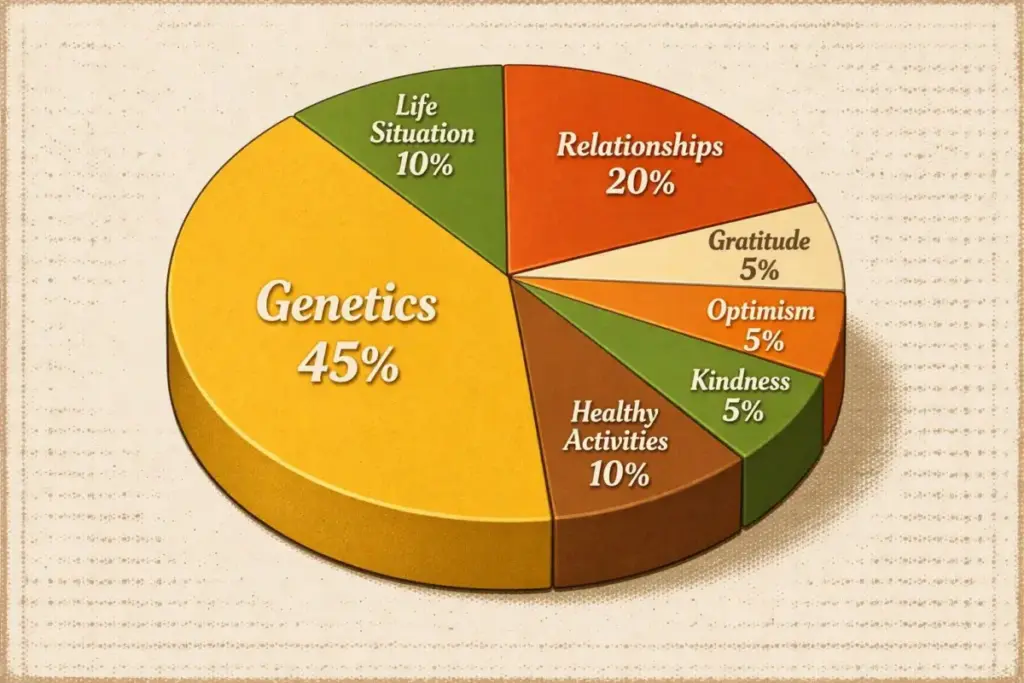
Standard of living, economic growth, and the viability of early retirement all stem directly from productivity enhancements. Once a society achieves a certain baseline standard of living, human happiness tends to plateau regarding material wealth. Beyond that threshold, psychological well-being is largely driven by non-monetary factors, such as strong personal relationships, purposeful daily routines, and physical health.
Despite historical evidence showing that markets and human societies continually adapt, widespread financial anxiety persists. This pervasive background fear is largely an evolutionary trait. Human beings evolved as sophisticated danger-detection machines designed to protect against immediate physical threats, predators, and food scarcity.

Once modern societies successfully mitigate those fundamental biological dangers, the human brain simply shifts its focus to new targets. When basic survival is secured, people begin worrying about social standing, relative wealth comparisons, and complex financial logistics. In advanced stages of wealth accumulation, anxieties shift toward tax strategies, estate planning, and managing government-mandated retirement account distributions.
Fighting this ingrained fear requires active self-awareness and rational evaluation. Examining personal history often reveals that financial anxieties stem from childhood scarcity mindsets or past trauma rather than an objective assessment of present reality. By identifying specific worst-case scenarios and recognizing that severe financial ruin is statistically rare for disciplined savers, investors can replace passive worry with purposeful action.

Treating Economic Shifts as Experiments
Taking concrete steps to manage finances and improve daily habits helps demystify uncertainty and build long-term resilience. Successfully navigating major life transitions—whether changing careers, moving to a new home, or stepping away from traditional employment into early retirement—becomes easier when adopting an experimental mindset. Rather than viewing every economic shift as an existential threat, treating life changes as manageable experiments allows individuals to test new environments without debilitating panic.
This experimental perspective applies directly to the current Artificial Intelligence boom. While rapid technological disruption naturally generates anxiety, viewing AI simply as a cognitive productivity tool reframes the narrative. Much like the invention of the internet or the mobile phone, AI acts as a powerful efficiency multiplier.

While productivity-enhancing technologies inevitably displace certain traditional roles, particularly in entry-level administrative and technical sectors, they simultaneously reduce the cost of goods and services while spawning entirely new industries. Historically, the primary beneficiaries of these transitions have been the broader economy and productive enterprises, lifting long-term living standards even as the labor market adapts.
Ultimately, artificial intelligence represents another major technological evolution that offers choices rather than guarantees of doom. By understanding the root causes of financial fear, tuning out sensationalized daily headlines, and focusing on real-world productivity and personal resilience, investors can navigate market bubbles and economic shifts with clarity and confidence. Everything valuable on the path to financial independence and personal fulfillment lies on the other side of managed fear.