

A beneficial bacterial probiotic is restoring hope for mitigating disease spread in corals off the coast of Florida, offering a potential new weapon in the ongoing battle to preserve fragile marine ecosystems. In a new study, scientists have investigated the effectiveness of a specialized compound produced by the probiotic strain MCH1-7 for combating stony coral tissue loss disease (SCTLD), a relentless and often fatal affliction that has devastated coral populations throughout the Caribbean and Florida Reef Tract.
The bacterial strain MCH1-7 was first uncovered by scientists from the Smithsonian Marine Station in 2018. Researchers initially identified the beneficial bacteria on a coral colony that had naturally and remarkably resisted a severe outbreak of stony coral tissue loss disease. Following that discovery, marine biologists began exploring whether isolating and applying the protective elements of this strain could artificially confer similar resistance to other vulnerable corals.
While scientists have previously tested the bacterial probiotic on adult corals in various controlled settings, they have now published new research in the journal Frontiers in Marine Science detailing how this probiotic could limit disease spread in young corals as well. Specifically, researchers are investigating a compound known as tetrabromopyrrole (TPB), which is naturally produced by the bacteria, and how it may protect entire colonies from contracting or succumbing to the disease.
The ecological implications of the compound extend beyond disease mitigation alone. "If TBP is a natural settlement cue, and if bacteria that also produce this compound protect corals from disease, it makes sense that larvae would settle where those compounds are being produced," Jennifer Sneed, a biologist at the Smithsonian Marine Station, said in a statement. "More of them would survive to be able to recognize the compound."
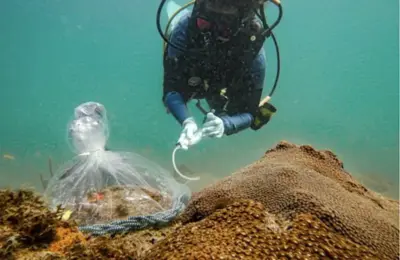
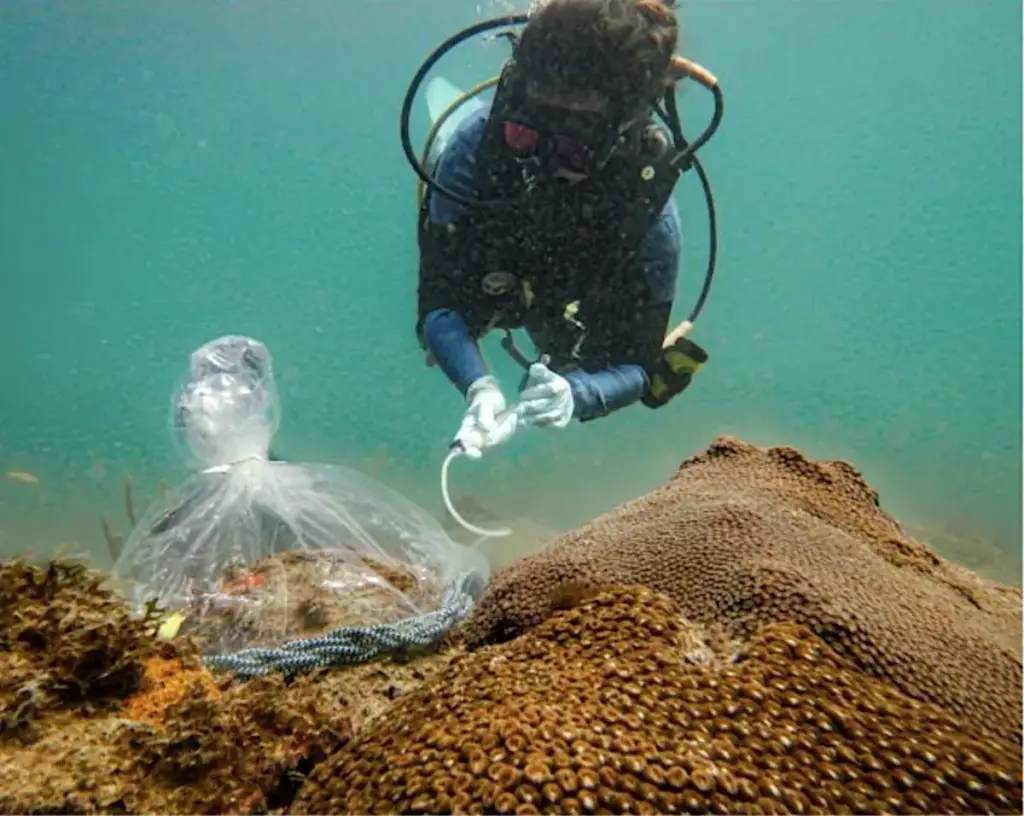
To rigorously test the protective capabilities of the compound, researchers applied the probiotic to great star coral (Montastraea cavernosa) using two distinct experimental methods. The first method involved injecting the probiotic into seawater inside a weighted, enclosed bag placed temporarily around the coral colony. The second method relied on a paste applied directly to disease-related lesions on the coral surface.
While the lesion-focused paste offered a localized approach, the bagged seawater method allowed observers to test for whole-colony treatment effectiveness, ensuring that the entire structure of the coral was exposed to the beneficial bacteria. Following these applications, the research team closely monitored the corals and tested coral samples for an extended period of 2.5 years after the initial treatment to gauge long-term efficacy.

The findings, which were also reported by Mongabay News, revealed a stark contrast between the two application techniques. The corals treated via the whole-colony bagging method lost only about 7% of their tissue from the disease over the monitoring period. By comparison, untreated control corals lost an alarming 35% of their tissue on average to stony coral tissue loss disease. These protective results persisted over the course of the multi-year research timeline, demonstrating that the probiotic treatment successfully slowed disease spread for 2.5 years after a single application.
Conversely, the direct paste application to individual lesions did not yield the same level of sustained effectiveness, prompting researchers to rethink how treatments should be deployed in a marine environment.
Building on these insights, the research team determined a practical way to apply the whole-colony probiotics to corals via scuba diving. They also confirmed through field observations that the method would not disrupt other healthy Caribbean coral species, marking a crucial step toward developing a safe and useful SCTLD treatment for full coral colonies in the natural marine environment.
"While the whole-colony bagging method does involve more material transport by divers and more time for deployment and retrieval, its performance at treating SCTLD and promoting long-term resistance outweigh these costs and is therefore the recommended application method of those we tested for probiotic treatments such as the MCH1-7 strain," the authors wrote in the study.
Despite the encouraging results, the study’s authors stressed that a significant amount of additional research is required before this potential treatment can become a widespread reality. They noted that further studies must be conducted to uncover additional treatments capable of addressing the wide variety of coral species affected by the deadly stony coral tissue loss disease, as different species may react differently to bacterial interventions.
"It’s important to understand that this is the very beginning," Kelly Pitts, lead author of the study and a researcher at the Smithsonian Marine Station, told Mongabay News. "This is definitely not a cure-all, but we’re definitely moving in the right direction."