


Marine scientists are reporting a significant breakthrough in the ongoing battle to protect Florida’s fragile coral reefs from a devastating and fast-moving affliction. In a new study, researchers have investigated the real-world effectiveness of a specific compound produced by a beneficial bacterial probiotic strain known as MCH1-7, offering a potential new line of defense against the relentless spread of stony coral tissue loss disease.
Stony coral tissue loss disease, frequently abbreviated as SCTLD, has emerged as one of the most destructive marine plagues in modern history, decimating reef ecosystems off the coast of Florida and throughout the wider Caribbean region. The disease is characterized by rapid tissue degradation, leaving behind stark white skeletons of dead coral and quickly reducing once-vibrant underwater habitats into barren environments. As marine biologists race to find viable interventions, biological treatments such as probiotics have risen to the forefront of conservation science, aiming to harness nature’s own defenses to halt the mortality rates sweeping through regional waters.
The probiotic strain at the center of this research, MCH1-7, was first discovered back in 2018 by dedicated scientists operating out of the Smithsonian Marine Station. The strain was initially identified on a remarkable coral colony that had managed to naturally resist a severe local outbreak of stony coral tissue loss disease, surviving unscathed while neighboring colonies perished. This natural resilience caught the attention of researchers, who hypothesized that the bacteria associated with the survivor coral might hold the biochemical key to protection.
While previous scientific trials involving the bacterial probiotic focused primarily on evaluating its effects on adult corals, a newly published study in the peer-reviewed journal Frontiers in Marine Science has expanded the scope of investigation. Researchers are now closely examining how this probiotic might limit disease spread in younger corals and protect full colonies. At the heart of this inquiry is a specific compound produced by the bacteria known as tetrabromopyrrole, or TBP.
Scientists studying the dynamics of reef ecosystems believe that the presence of TBP serves a dual purpose in the marine environment. Beyond its apparent protective qualities against disease pathogens, TBP is also suspected of acting as a natural settlement cue for coral larvae. In a public statement regarding the research, Jennifer Sneed, a biologist at the Smithsonian Marine Station, explained the evolutionary logic connecting the compound to coral survival and reproduction.
"If TBP is a natural settlement cue, and if bacteria that also produce this compound protect corals from disease, it makes sense that larvae would settle where those compounds are being produced," Sneed said. "More of them would survive to be able to recognize the compound."
To rigorously test the efficacy of the bacterial compound, researchers designed a field-based experiment utilizing great star coral, scientifically known as Montastraea cavernosa, which is a prominent reef-building species in the Caribbean and Atlantic waters. The research team deployed two distinct methods of applying the probiotic treatment to determine which approach offered superior protection against the ravages of stony coral tissue loss disease.
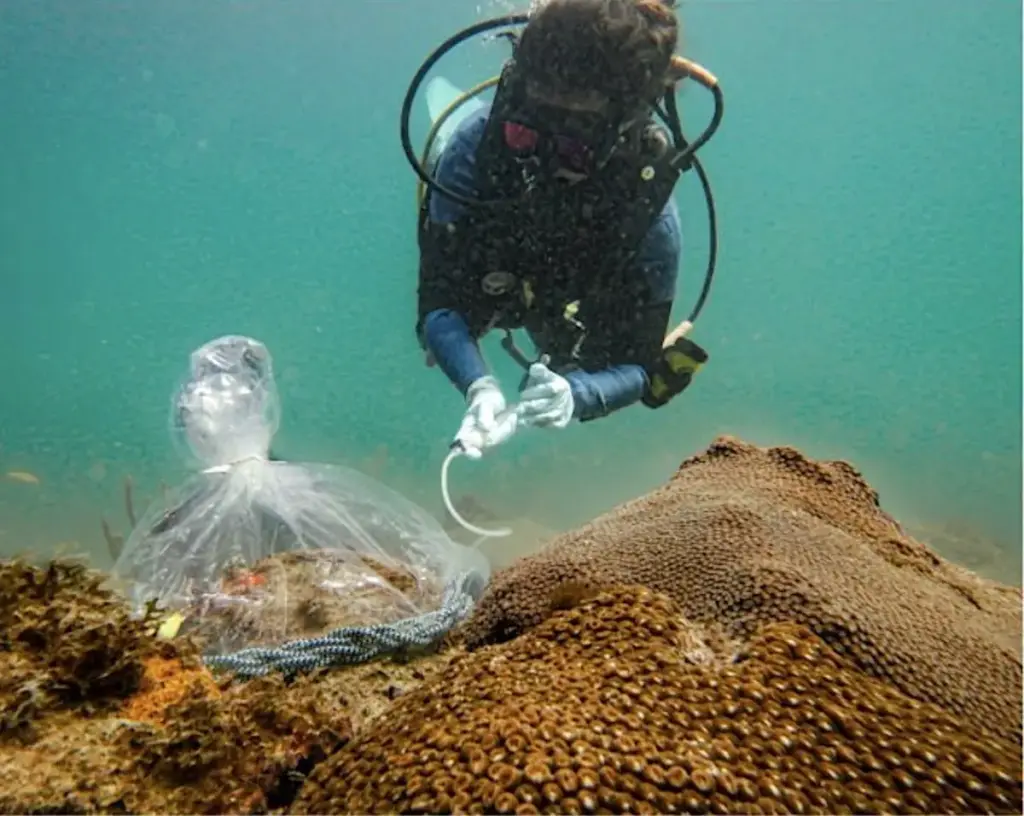
The first testing method involved injecting the probiotic directly into seawater contained within a weighted, flexible bag placed securely around an entire coral colony. This technique allowed the scientific observers to evaluate the effectiveness of a whole-colony treatment approach, ensuring that every part of the submerged structure was exposed to the beneficial bacterial compound simultaneously. The second method utilized a specialized paste containing the probiotic, which researchers applied directly onto localized disease-related lesions on the coral surfaces, targeting specific areas of infection rather than the entire organism.

Following the initial applications, the research team closely monitored the treated corals and periodically tested coral tissue samples over an extensive monitoring period lasting two and a half years. This prolonged observation window was critical for determining whether the probiotic intervention provided only temporary relief or established long-term resistance against stony coral tissue loss disease.
The findings, which were also covered by Mongabay News, revealed a striking contrast between the two application techniques. Corals that received the whole-colony bagging treatment experienced a remarkably low tissue loss of only about 7% as a result of the disease. In stark contrast, untreated control corals monitored during the research lost an average of 35% of their total tissue to stony coral tissue loss disease over the same timeframe. Furthermore, these protective results demonstrated impressive persistence, with the whole-colony probiotic treatment successfully slowing the relentless spread of the disease for the full two and a half years following the initial application.
However, the localized paste application directed at individual lesions did not yield similarly encouraging results, proving far less effective at arresting the broader progression of the disease across the coral structures.
Armed with this data, the researchers turned their attention to the logistical challenges of scaling up the whole-colony treatment for field operations. They successfully engineered and refined a practical deployment procedure allowing scuba divers to execute the bagging technique underwater. Additionally, the team confirmed through environmental assessments that this method would not negatively disrupt or harm other healthy Caribbean coral species co-existing in the same marine ecosystems, opening the door for a potentially viable and safe SCTLD treatment strategy for entire coral colonies in the future.
Reflecting on the trade-offs involved in the preferred application method, the study’s authors highlighted the operational realities of marine conservation work.
"While the whole-colony bagging method does involve more material transport by divers and more time for deployment and retrieval, its performance at treating SCTLD and promoting long-term resistance outweigh these costs and is therefore the recommended application method of those we tested for probiotic treatments such as the McH1–7 strain," the authors wrote in the published study.
Despite the highly promising outcomes observed over the two-and-a-half-year monitoring period, the researchers were careful to temper public expectations. The study’s authors strongly emphasized that a tremendous amount of additional scientific research remains necessary before this experimental treatment can be widely deployed as a standard management tool. They noted that future studies must be conducted to explore supplementary treatments tailored to the diverse array of other vulnerable coral species that are also currently being devastated by stony coral tissue loss disease across regional waters.
Kelly Pitts, a researcher at the Smithsonian Marine Station and lead author of the study, reiterated the preliminary nature of the findings in comments to Mongabay News, underscoring that while science is advancing, the journey to ecosystem recovery is just beginning.
"It’s important to understand that this is the very beginning," Pitts told Mongabay News. "This is definitely not a cure-all, but we’re definitely moving in the right direction."