

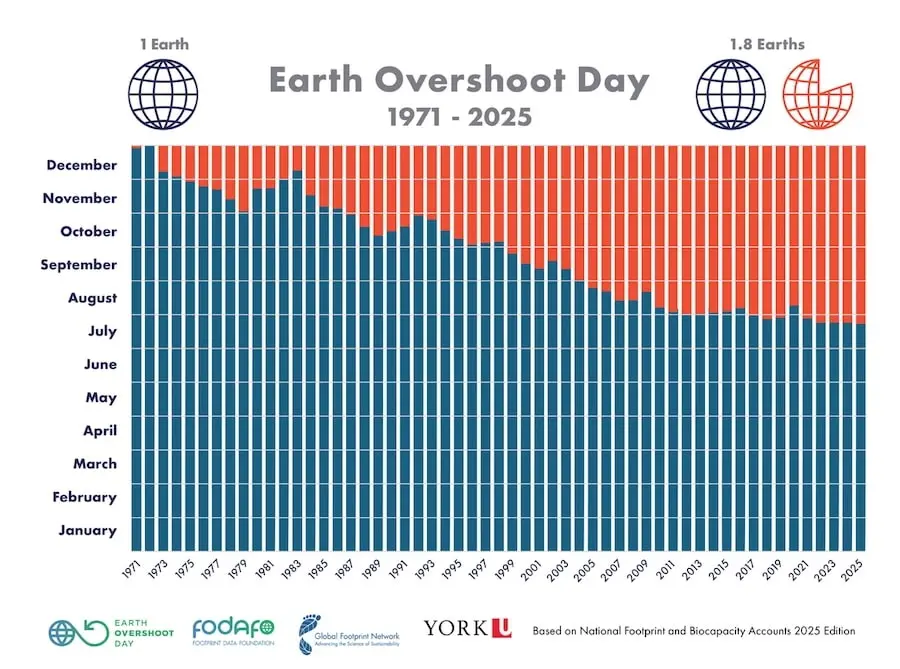
Humanity has officially crossed another sobering threshold in its relationship with the natural world. For the year 2025, Earth Overshoot Day fell on July 24, marking the earliest date the critical milestone has been recorded since calculations first began in 2006. The date signifies the exact moment in the calendar year when human demand for ecological resources and services exceeds what Earth’s ecosystems can naturally regenerate within a full twelve-month period.
According to calculations compiled by the Global Footprint Network, the global population is currently consuming natural resources—including timber, freshwater, and seafood—at a rate 1.8 times faster than the planet can replenish them. Furthermore, human societies are emitting greenhouse gases far in excess of what forests, oceans, and soils can absorb, driving cumulative ecological deficits that continue to mount year after year.
The concept of Earth Overshoot Day was first established in 2006 by Andrew Simms, an author, political economist, and campaigner, working in collaboration with the Global Footprint Network. Since its inception, the date has been calculated and announced annually, serving as a stark indicator of how rapidly human consumption patterns are accelerating and stripping the planet of its finite wealth. In conjunction with this year’s announcement, the Global Footprint Network undertook a comprehensive recalculation of historical data, extending even prior to 2006, to ensure greater precision and consistency in tracking long-term trends.
The historical trajectory of Earth Overshoot Day paints a vivid picture of accelerating resource extraction over the past several decades. Based on the latest refined calculations, Earth Overshoot Day fell as late as December 31 in 1972, meaning humanity lived essentially within the ecological budget of a single Earth for most of that year. However, as industrialization, globalization, and population pressures intensified, the date crept progressively earlier, reaching November 3 by 1979.

Although a brief economic slowdown and policy shifts caused the date to recede slightly into early December during the early 1980s, the respite was short-lived. By 1989, the date had advanced to October 12. It hovered throughout the month of October for a decade before crossing into September in 1999, when it landed on September 25. By 2006, when the metric was officially formalized and publicized, the revised calculations placed the event on August 22.
The relentless downward trend continued into the twenty-first century, crossing into the month of July for the first time in history in 2018. While pandemic-related disruptions briefly pushed the date back to August in 2020, consumption patterns quickly rebounded, anchoring Earth Overshoot Day firmly in the month of July ever since. The previous earliest record was set on July 25, a mark reached in both 2022 and 2023. The arrival of Earth Overshoot Day on July 24 this year underscores a grim reality: humanity’s metabolic demands on the biosphere have outstripped the physical capacity of nature to keep pace.
The implications of this persistent ecological deficit extend far beyond annual bookkeeping. As the Global Footprint Network has repeatedly emphasized, the consequences of resource depletion are cumulative. Even if the calendar date of Overshoot Day were to remain steady from one year to the next, the ongoing mismatch between consumption and replenishment steadily erodes the resilience of global ecosystems. This mounting pressure has already brought humanity dangerously close to breaching critical planetary boundaries, having nearly exceeded seven of the nine scientifically defined limits that maintain Earth in a state suitable for human civilization.
Lewis Akenji, a board member of the Global Footprint Network, addressed the severity of the situation in a recent public statement following the release of the 2025 data. He noted that humanity is testing the absolute limits of ecological tolerance, warning that the debt accumulated over decades requires an unprecedented level of corrective action.
Akenji stated that society is stretching the limits of ecological damage and noted that the world owes the planet at least 22 years of ecological regeneration, even if all further damage were to cease immediately. He added that if humanity wishes to maintain a habitable home on Earth, the current scale of overshoot demands an ambition in climate adaptation and mitigation that dwarfs any historical investments made thus far.

Despite the gravity of the data, experts insist that it is not too late to alter course and steer society toward a sustainable future. The Global Footprint Network has outlined a series of concrete, scalable interventions through an initiative known as the Power of Possibility campaign, demonstrating that moving the date of Earth Overshoot Day back into the calendar year is entirely achievable through concerted global action.
Among the most impactful strategies identified by researchers is the reduction of global carbon emissions. Cutting global carbon emissions by 50 percent alone would shift Earth Overshoot Day farther into the year by approximately three months, effectively altering the global trajectory of climate change and resource strain.
Other targeted interventions offer measurable improvements in ecological budgeting. Reducing global food waste by half would push the date back by 13 days, alleviating immense pressure on agricultural land, water supplies, and energy grids. Furthermore, establishing a Green New Deal framework on a global scale could advance the date by 42 days, while generating at least 75 percent of the world’s electricity from renewable energy sources would push the date back by 26 days.
Mathis Wackernagel, co-founder and board member of the Global Footprint Network, underscored the inescapable laws of physics governing resource use and planetary limits. He emphasized that ecological overshoot cannot continue indefinitely and will inevitably conclude either through deliberate, proactive design or through severe, unmanaged disasters. Wackernagel pointed out that choosing a sustainable path should not be difficult, particularly given the wide array of viable solutions currently available to policymakers, industries, and communities worldwide.