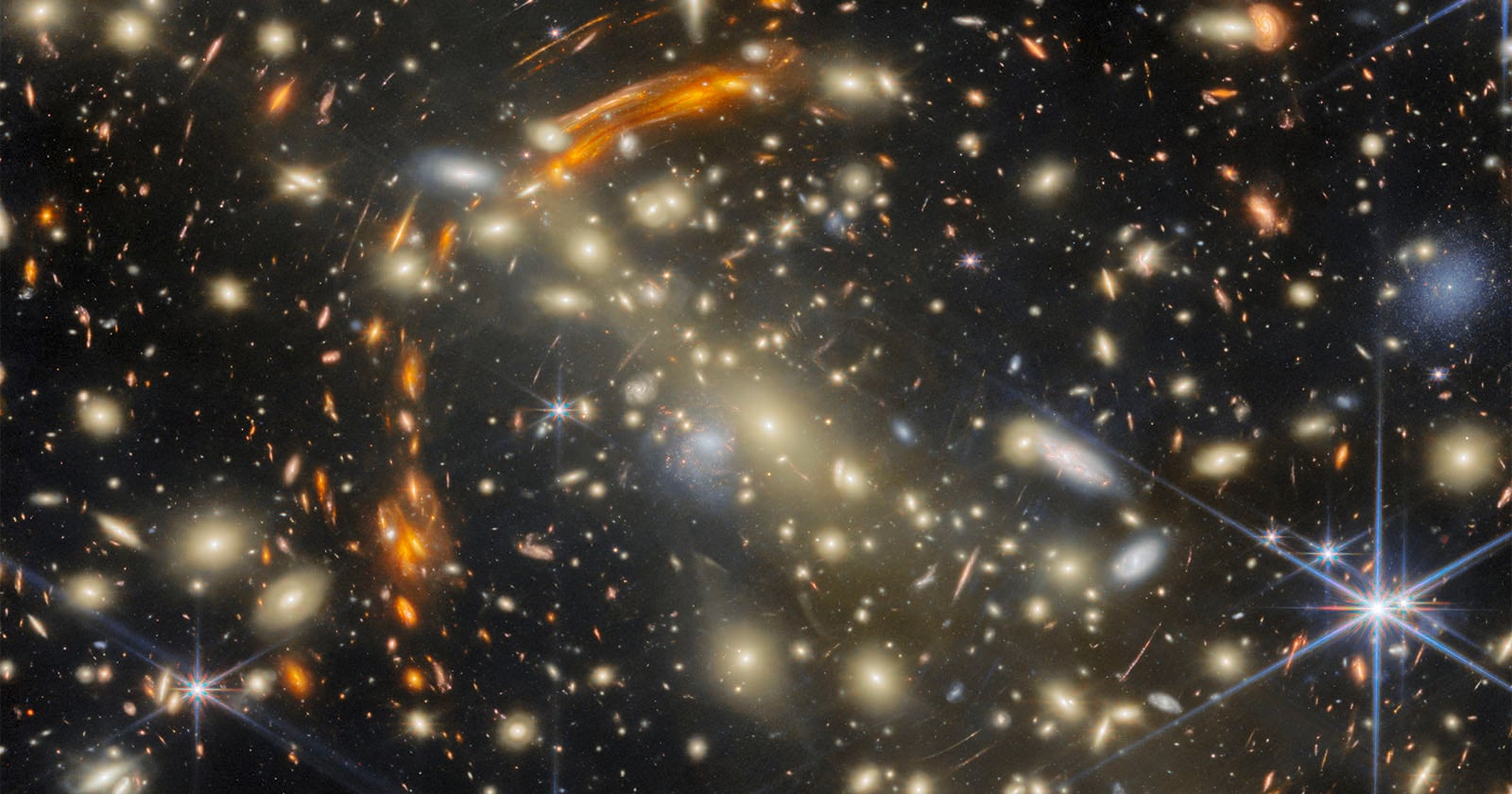
The newest NASA, European Space Agency (ESA), and Canadian Space Agency (CSA) James Webb Space Telescope (JWST) Picture of the Month showcases one of the most breathtaking, powerful, and scientifically revealing examples of gravitational lensing ever observed by humanity.
Described by ESA Webb as a "cosmic house of mirrors," the remarkable image reveals distant galaxies that have been dramatically warped, stretched, and multiplied, as though they were caught inside a galactic carnival attraction. At the center of this optical phenomenon is the massive galaxy cluster MACS J0454.1-0300. Located roughly five billion light-years from Earth, this colossal cluster sits between our planet and a backdrop of even more distant galaxies, including striking orange galaxies that reside on the far side of the cluster. Because light takes time to travel across the vast expanse of the cosmos, the galaxies captured in Webb’s photograph are being viewed as they existed when the Universe was a mere eight billion years old. In essence, the telescope is acting as a cosmic time machine, allowing astronomers to peer deep into the history and evolution of space.
Space telescopes like JWST and its predecessor, the Hubble Space Telescope, rely heavily on gravitational lensing to observe the ultra-distant Universe. In fact, without this natural phenomenon, many of the faintest and most remote objects in existence would remain entirely invisible to us. Gravitational lensing occurs when a celestial body possessing immense mass—such as a massive galaxy cluster—exerts a gravitational pull so strong that it literally bends the path of light traveling from behind it relative to the perspective of an observer on Earth.
According to Albert Einstein’s general theory of relativity, time and space are fused together into a unified four-dimensional fabric known as spacetime. Within the framework of this theory, massive objects cause spacetime to curve, and gravity is understood simply as the geometric curvature of spacetime. As light travels through the cosmos, the theory predicts that the trajectory of that light will be bent by an object’s mass. Gravitational lensing provides one of the most dramatic and readily observable proofs of Einstein’s theory in action. Extremely massive celestial bodies, such as clustered galaxies, cause spacetime to curve so significantly that they function effectively as giant gravitational lenses.
Crucially, a gravitational lens does much more than simply bend light; it also acts as a cosmic magnifying glass. By concentrating and focusing light from objects positioned far behind them, these lenses make it possible for astronomers to photograph celestial bodies that would otherwise be far too distant and faint to detect. Scientists have utilized this phenomenon to great effect with advanced observatories like the James Webb Space Telescope. Paired with Webb’s massive 6.5-meter primary optical mirror, researchers utilizing JWST have consistently broken and set new records for discovering the most distant galaxies ever observed. This capability fundamentally translates to humanity being able to see farther back into the chronological history of the Universe than ever before.
In Webb’s latest Picture of the Month, another fascinating and rare optical phenomenon is displayed in striking detail. Under specific physical conditions, gravitational lensing is capable of creating multiple distinct projections of the exact same background galaxy, producing double, triple, or even quadruple images.
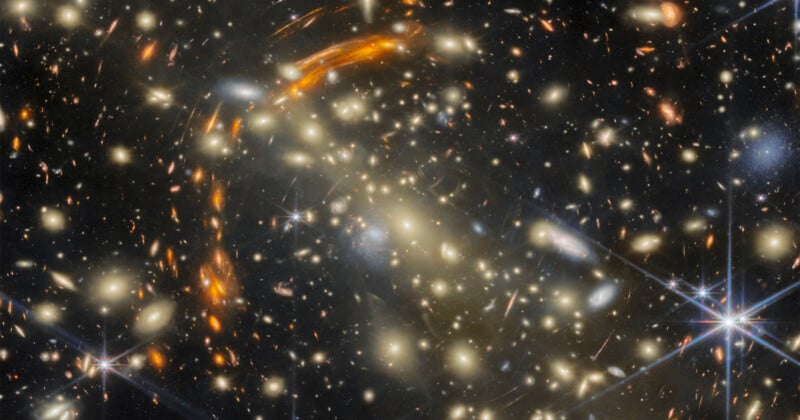
According to ESA Webb, it is remarkably rare to observe four or more distinct images of a single background galaxy. Such an occurrence requires a precise alignment, demanding that the exact position of the background object and the mass distribution and shape of the foreground gravitational lens line up in a very specific way. Because these physical requirements are so particular and demanding, this rare quadruple-imaging configuration is typically observed in only 10 to 20 percent of massive galaxy clusters.
In this new photograph from the James Webb Space Telescope, this rare configuration is visibly present twice. This marks a monumental milestone, representing the first time such a double-occurrence has ever been documented within a single galaxy cluster. Furthermore, the telescope’s data reveals that certain locations within these gravitationally lensed regions have been magnified by a staggering factor of 300, amplifying the light of ancient galaxies to unprecedented levels of clarity.
Despite the groundbreaking nature of the new image, the James Webb Space Telescope is not the first observatory to turn its instruments toward MACS J0454.1-0300. Twelve years prior, the Hubble Space Telescope captured an image of the exact same celestial region. Comparing the two historical records illustrates just how far space observation technology has advanced, as the two photographs present views that could hardly look more different from one another.
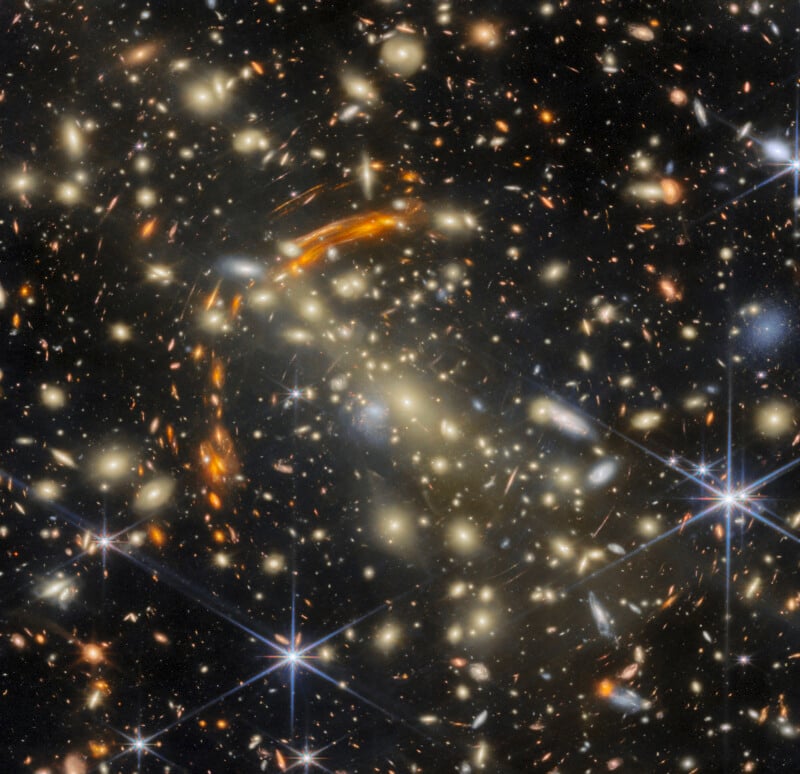
The newly released Webb image successfully reveals hundreds of individual galaxies that were entirely missing from Hubble’s earlier photograph. While these ancient galaxies were present behind the cluster all along, Hubble lacked the necessary technical sensitivity to capture them clearly. Webb’s advanced infrared instruments make it significantly more sensitive to the much redder light emitted by these extremely distant and ancient stellar systems, peeling back another layer of cosmic history and offering astronomers a richer, more detailed understanding of the early Universe.