




The stock market has a persistent habit of surprising investors, leaving financial commentators scrambling to dust off familiar phrases as major indexes scale unprecedented heights. When equities suffer sharp downturns, public anxiety spikes as retirement portfolios visibly shrink. Yet, market booms and record-breaking valuations generate their own unique brand of unease. Such lofty milestones frequently prompt a lingering fear that an even larger economic correction is just around the corner, especially when the current market rally is fueled by the breathless momentum of the artificial intelligence boom.

For observers who have tuned out financial headlines to focus on everyday life, this steady stream of anxiety may seem distant. However, the broader economic narrative surrounding artificial intelligence generally centers on a few prominent themes: rapid technological breakthroughs, massive corporate and venture capital investments pouring into infrastructure, and an intense debate over how quickly these tools will transform the global workforce. Investors continually weigh whether this technological revolution represents a monumental shift in human productivity or an unsustainable mania destined to trigger a modern echo of the early 2000s dot-com crash.

This dynamic carries a familiar resonance for early retirement advocates who navigated the turn-of-the-century tech boom, an era that initially accelerated careers before the subsequent market correction threatened job security and personal immigration standing. As questions mount regarding the durability of the current investment cycle, financial commentators are actively addressing these concerns on the conference circuit, engaging audiences at events like Camp FI Midwest and preparing further discussions for upcoming financial symposia.

Will the AI Bubble Ruin Our Retirement?
Achieving long-term financial independence and spending over two decades in retirement creates a certain level of comfort with market volatility. Yet, even seasoned retirees occasionally encounter stark questions from concerned peers regarding how anyone can sleep soundly amid constant geopolitical and economic turbulence. A casual review of contemporary news cycles reveals no shortage of alarming subjects: escalating tensions involving global political figures, persistent inflation eroding purchasing power, towering national debt levels, and active conflicts across multiple regions that threaten broader stability.

Interestingly, these anxieties mirror concerns voiced more than two decades ago. During the mid-2000s, public discourse was dominated by fears of different leaders, alternative geopolitical conflicts in the Middle East, escalating national debt, and worries about inflation. At that time, overvalued real estate replaced artificial intelligence as the primary suspect behind fears of a looming stock market bubble, while widespread anxiety focused on domestic job outsourcing to rapidly growing economies overseas rather than automated disruption. Debates also raged over peak oil theories, warning that rising fossil fuel consumption would inevitably outstrip dwindling global supplies—a prediction ultimately upended by subsequent technological and extraction advancements.

The decades following those mid-2000s worries ultimately included the Great Financial Crisis, an unprecedented economic downturn triggered by unbridled optimism in housing markets coupled with complex financial leverage. Widely recognized as the most severe contraction since the Great Depression, that crisis nevertheless represents a minor dip when viewed across a long-term investment horizon. Historical market data demonstrates that a diversified portfolio weathered those storms and continued to compound significantly over time, absorbing subsequent shocks such as the pandemic-induced market correction of 2020.

Beyond financial markets, broader global metrics over the past twenty years reveal remarkable structural improvements. The proportion of the global population living in extreme poverty declined substantially, while infant mortality rates were cut in half. Clean energy adoption surged as the cost of solar technology dropped dramatically, establishing solar generation as the dominant source of new electrical capacity worldwide. Simultaneously, pure electric vehicle adoption expanded from negligible levels to claim a substantial share of global automotive sales. These developments suggest that focusing energy on long-term human progress often yields a more accurate perspective than yielding to short-term pessimism.

The Core of Prosperity and the Trap of Fear
Financial media outlets frequently construct compelling narratives centered on impending economic doom, whether driven by mounting government debt, technological displacement, or market bubbles. However, these pessimistic outlooks often overlook a fundamental economic principle: true societal prosperity is fundamentally rooted in productivity rather than financial market valuations, which ultimately reflect numerical transactions recorded within computer systems.

Economic frameworks and capital markets are human inventions. If a financial system undergoes a severe correction due to shifting valuations, societies have repeatedly demonstrated the capacity to reset metrics and resume productive labor, as occurred following the 2008 financial crisis and prior historical downturns. The underlying tools that drive human productivity, standard of living, and economic growth remain intact regardless of short-term market fluctuations.

Furthermore, once societies achieve a baseline standard of living, human happiness ceases to scale proportionally with additional wealth accumulation. Psychological and sociological research indicates that long-term well-being is heavily influenced by non-financial factors, including personal disposition, strong social relationships, lifelong optimism, and regular physical activity in healthy environments.

Despite these reassuring realities, underlying financial anxiety persists even among experienced investors. This phenomenon stems largely from human evolutionary biology. Humans evolved as sophisticated threat-detection mechanisms designed to identify danger and secure basic survival needs. Once immediate physical threats are mitigated, the human brain tends to shift its focus toward new worries, moving goalposts from physical survival to resource scarcity, social acceptance, and eventually abstract financial concerns.

This pervasive background fear can be addressed through self-awareness and rational analysis. Examining personal history often reveals the root causes of financial anxiety, which may stem from family upbringing during periods of economic hardship or past personal trauma. By identifying specific fears and evaluating realistic worst-case scenarios, individuals can recognize that extreme financial destitution is frequently an irrational concern rather than a probable outcome.

Taking deliberate action serves as an effective antidote to fear, transforming the unfamiliar into the manageable and building personal resilience. Individuals who consciously curate their mental environments by reducing exposure to sensationalized daily news and focusing instead on productive behaviors, continuous learning, and supportive social communities often find that financial and existential worries recede significantly. Adopting an experimental mindset toward major life transitions—whether changing careers, adjusting living arrangements, or stepping away from traditional employment—helps reframe uncertainty as an opportunity for engagement rather than a source of dread.

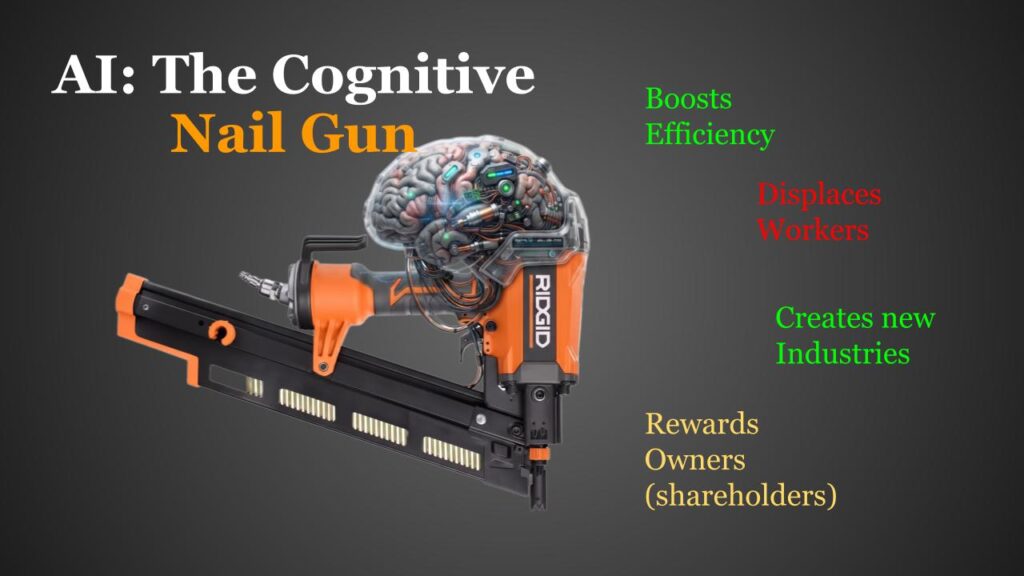
Viewing the artificial intelligence era through this experimental lens helps neutralize panic. Rather than succumbing to doomsday headlines, examining the underlying technology reveals both significant potential and genuine disruption. AI functions as a powerful cognitive amplifier, capable of boosting overall efficiency and productivity in a manner analogous to historical technological milestones. While automation inevitably displaces specific job categories and concentrates economic rewards among platform owners and shareholders, it simultaneously lowers service costs and fosters the creation of entirely new industries, mirroring the long-term trajectory of the internet and mobile computing.
Ultimately, artificial intelligence represents another chapter in ongoing technological evolution, offering an opportunity for active adaptation rather than passive apprehension. By understanding the psychological roots of fear and focusing on constructive engagement, individuals can better navigate market transitions and focus on building meaningful, resilient lives.