

Stephen King movie adaptations have a long-standing, peculiar habit of growing larger than the literary works that inspired them. While literary purists often demand absolute fidelity, cinematic history proves that some of the greatest translations of King’s work come from filmmakers willing to tear down the source material and rebuild it from the ground up. Frank Darabont achieved this masterclass of adaptation twice with The Shawshank Redemption and The Green Mile, translating King’s prose into universally beloved cinematic pillars. Meanwhile, directors like Stanley Kubrick with The Shining, Rob Reiner with Misery, and Mike Flanagan’s interpretations of Carrie have permanently cemented themselves as foundational elements of horror cinema.
Yet, King adaptations are equally notorious for taking staggering liberties that infuriate both the author and audiences alike. The most famous historical friction remains Kubrick’s The Shining, a film Stephen King has publicly criticized for nearly half a century due to its departure from the psychological arc of Jack Torrance. However, no cinematic divergence in horror history has proven more devastating, shocking, and emotionally destructive than the final few moments of Frank Darabont’s 2007 adaptation of The Mist.
Based on King’s 1980 novella published in the Dark Forces anthology, Darabont’s film initially masquerades as a conventional, high-concept monster movie infused with atmospheric elements reminiscent of psychological survival horror like Silent Hill. The narrative establishes its terrifying premise following a violent, inexplicable midnight storm that severely damages the lakeside home of commercial artist David Drayton, played by Thomas Jane. Seeking to assess the damage and acquire essential supplies, David, his young son Billy, and their contentious neighbor Brent Norton decide to drive into their small Maine town the following morning.
Upon arriving at the local supermarket—already crowded with anxious local residents seeking provisions and shelter—an unnaturally thick, eerie mist rolls in from the surrounding lake, rapidly swallowing the town and plunging the outside world into a blinding white smog. Almost immediately, The Mist establishes that its central atmospheric phenomenon is concealing ancient, predatory horrors.

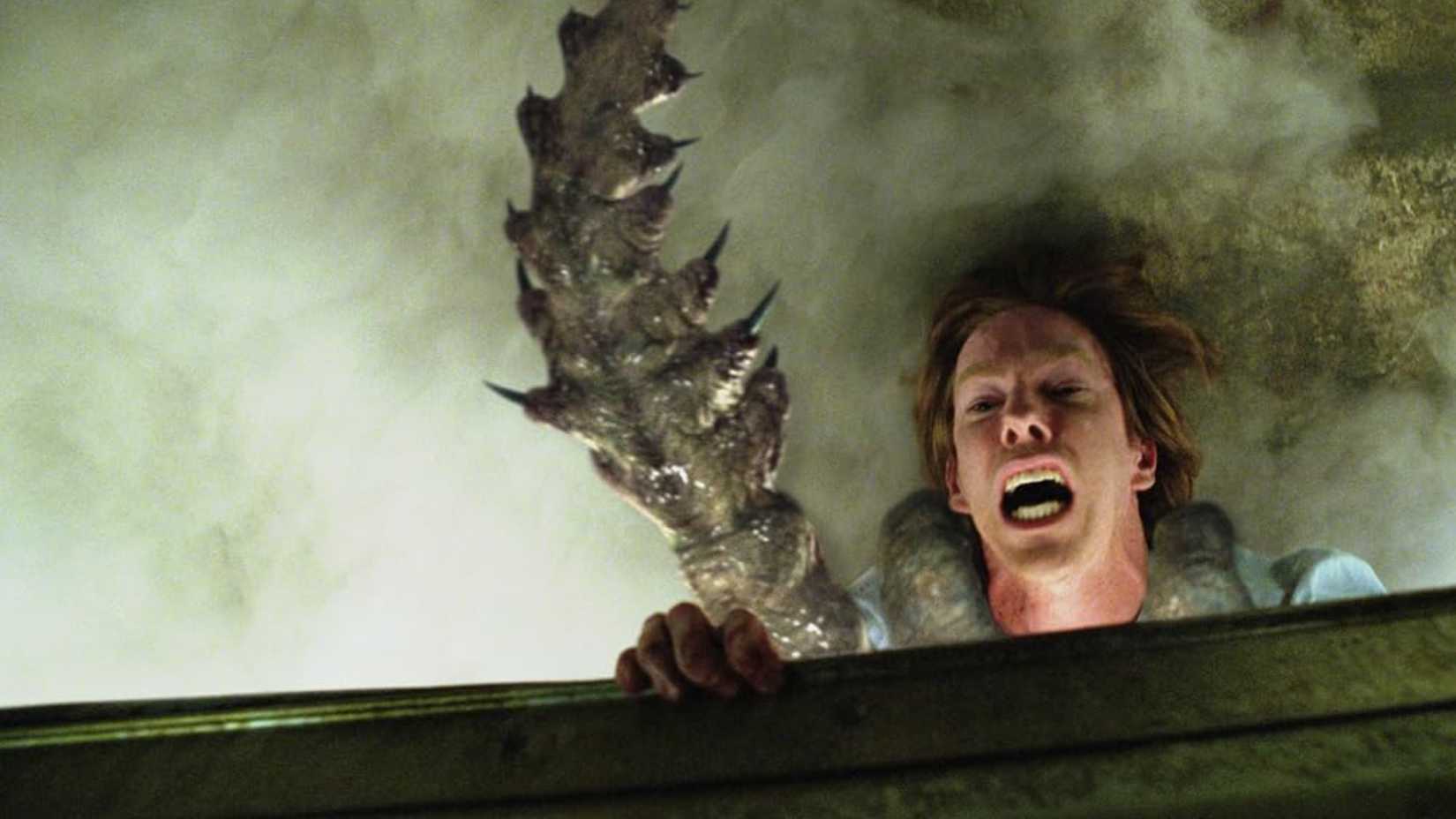
One of the film’s most visceral sequences unfolds early in the runtime when David and a small group of brave men investigate the supermarket’s loading bay, hoping to fix a broken exhaust fan. Instead, they discover several massive, otherworldly tentacles probing through the loading dock doors. Norm, a young stock clerk played by Chris Owen, becomes the first human casualty in a sequence of unmitigated brutality. The creature wraps its rubbery, muscular appendages around the young man, its limbs lined with razor-sharp bone spurs that slice through human flesh effortlessly. David, Ollie Weeks, and the remaining men desperately fight to pull Norm back inside, but the entity’s strength proves overwhelmingly superior. The young clerk is dragged screaming into the swirling white fog in a horrific display of gore and violence, leaving the surviving men paralyzed by shock and helplessness.
This brutal encounter serves as a masterclass in tension-building, introducing the audience to a menagerie of Lovecraftian entities whose designs are frequently rendered more terrifying precisely because Darabont refuses to fully reveal them. Rather than relying on sweeping, brightly lit creature reveals, the director utilizes frantic camera pans, muffled screams, spurting blood, and those looming tentacles to let the audience’s imagination do the heavy lifting. Within a remarkably short span, the supermarket transforms from a temporary sanctuary into an inescapable cage. The trapped survivors realize they have no definitive understanding of what is lurking in the fog, and the false sense of security provided by the store’s broad front glass windows rapidly begins to disintegrate.
As the hours tick away inside the market, The Mist pivots from a traditional creature feature into a harrowing psychological study of human deterioration. The true terror of the film eventually shifts away from the eldritch horrors outside and onto the frightened people trapped within. Panic and isolation systematically erode every vestige of community and civility among the townsfolk.
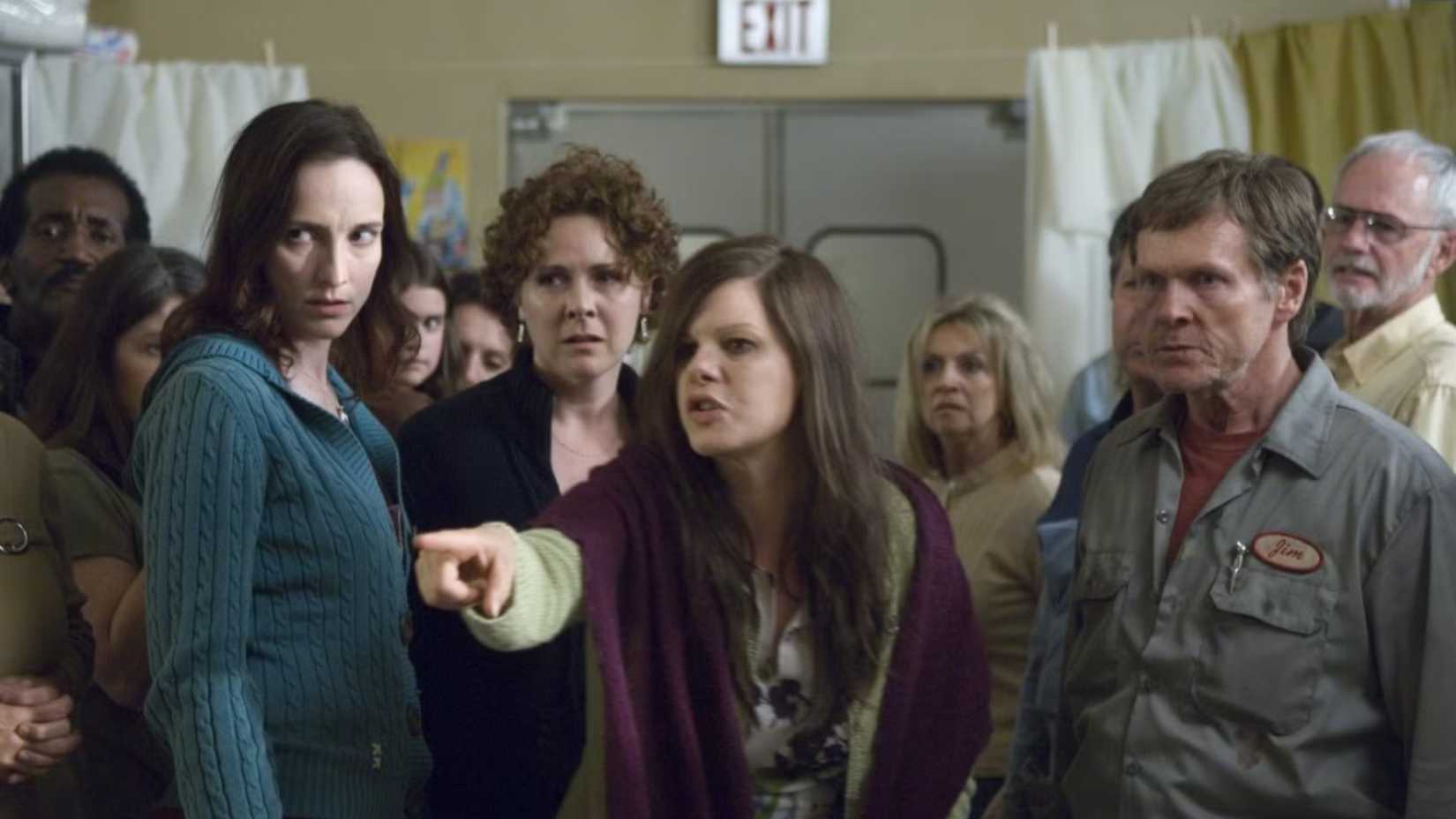
Mrs. Carmody, brilliantly portrayed by Marcia Gay Harden, emerges as the primary human antagonist of the narrative. Growing increasingly unhinged and leaning heavily into religious fundamentalism, she begins preaching that the mist and its monstrous inhabitants represent divine retribution for humanity’s sins. While rational survivors like David struggle to maintain order and understand the scientific or supernatural reality of their situation, Carmody’s charismatic, terrifying fanaticism slowly poisons the minds of the desperate townspeople. She successfully rallies a frightened faction into believing that blood sacrifices are required to appease whatever gods have unleashed the apocalypse.

The film’s theatrical marketing summarized this thematic descent with the tagline: "Fear changes everything." Although the line is never explicitly spoken by any character in the film—nor does it appear in King’s original novella, having been fabricated entirely for the promotional campaign—it serves as the undeniable thesis statement for everything The Mist attempts to convey. Watching civilized neighbors argue over whether the monsters are real is deeply unsettling, but watching Carmody weaponize that primal terror into a murderous religious cult is infinitely more devastating. Darabont taps into a chilling psychological truth: humanity’s desperate, frantic need to assign meaning to senseless catastrophe can often be far more horrifying than any towering Lovecraftian entity hiding in the white void.
Despite its narrative brilliance, the film bears the visible scars of its production realities. Neither King’s tight plotting nor Darabont’s astute direction could entirely mask the limitations of the film’s computer-generated imagery, a byproduct of both mid-2000s technological limitations and an exceptionally tight budget. Produced on an estimated budget between $13 million and $18 million, The Mist frequently looks rough around the edges.
The supermarket loading dock sequence perfectly illustrates this friction. The Lovecraftian tentacles that drag away young Norm often appear flat and texturally unconvincing, lacking the complex shadow integration and subsurface scattering required to firmly anchor digital objects into a physical, live-action environment. The ambient lighting reflecting off the appendages frequently clashes with the harsh fluorescent glare of the garage. Much of the creature design and digital effects work looked dated even upon the film’s theatrical release in 2007.
Yet, this aesthetic jankiness arguably adds an oddly enduring, gritty appeal to the final product. Darabont has spoken openly in interviews about having to shoot the film under a severely restricted budget and an unforgiving production schedule, which forced his team to constantly triage where to allocate their limited visual effects resources. While the remainder of the digital menagerie fares little better than the opening tentacles, the lack of polished, seamless CGI inadvertently grants the feature an aggressive, uncompromising B-movie energy. Furthermore, these dated visual elements are easy to overlook when the dramatic weight of the film is continually elevated by powerhouse lead performances from Thomas Jane, Marcia Gay Harden, and Toby Jones.
The single most defining element separating Darabont’s cinematic adaptation from King’s original novella, however, is the climax. For the vast majority of its runtime, the filmmaker adheres closely to the source material, preserving the supermarket containment, the grotesque creature attacks, the dangerous religious fanaticism spearheaded by Mrs. Carmody, and David’s desperate, high-stakes attempt to rescue his son.
However, rather than adopting King’s ambiguous, open-ended literary conclusion—where the survivors simply drive away into the fog with an uncertain fate—Darabont elected to give the cinematic narrative a definitive, devastating point of closure. The filmmaker had harbored the concept for this alternate ending for years and fought passionately to preserve it during financing discussions. Ultimately, Stephen King gave the change his absolute blessing, with Darabont later recalling that the author admitted he wished he had conceived the ending himself.
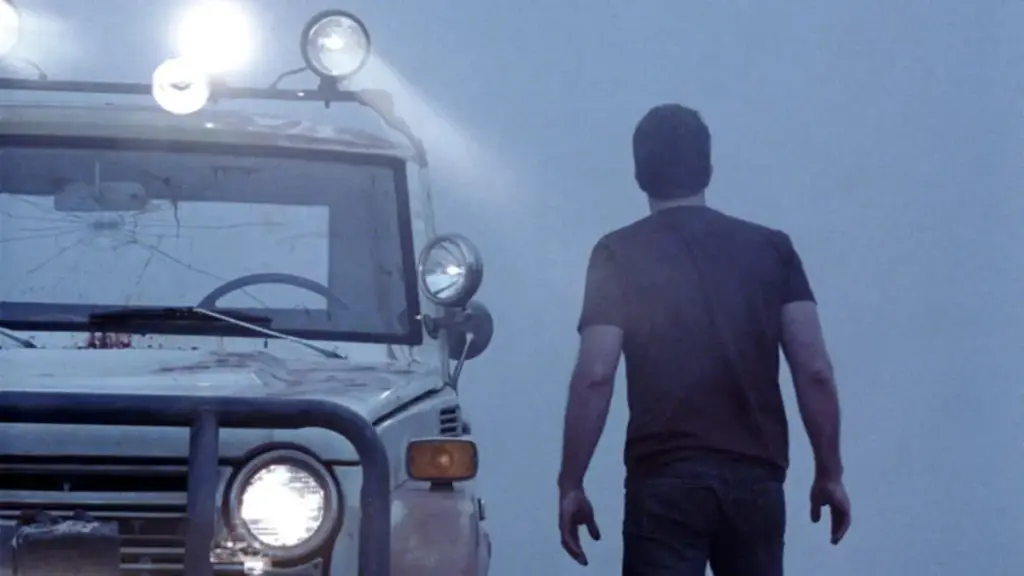
In the film’s final harrowing moments, David Drayton, his son Billy, and a small group of trusted companions finally make a desperate break from the supermarket. They board an SUV and drive continuously until the vehicle completely runs out of fuel, leaving them stranded in the middle of a desolate landscape utterly consumed by the mist. With no remaining escape routes, no shelter, and no indication of where the mist might end, David makes what he believes is a merciful, agonizing final choice. Having scavenged only four bullets, he resolves to spare his companions and his son from a torturous death at the hands of the monsters lurking just outside the car windows.
David systematically shoots his remaining companions, leaving his young son Billy for last. The boy’s death carries a crushing emotional weight, as David has spent the entirety of the narrative fighting tooth and nail to protect his child from the horrors of the outside world, only to become the executioner himself.
Following the tragic act, a devastated David climbs out of the vehicle, screaming into the swirling fog in absolute psychological agony, demanding that the monsters take him as well. But what finally emerges from the unknown expanse is not a monstrous entity, but a heavily armored military convoy consisting of tanks, transport trucks, and surviving refugees.
As the mist rapidly dissipates around them, David watches in stunned, absolute horror as the military vehicles roll past, carrying weeping survivors and children to safety. In the span of a few horrifying seconds, he realizes that rescue and salvation were merely moments away, rendering his preemptive slaughter entirely meaningless.
Those devastating closing moments are the primary reason The Mist has maintained such a profound and haunting legacy nearly two decades after its release. While the digital creatures may occasionally resemble video game assets from a bygone era, and the single-location setting grows claustrophobically intense, those technical flaws fade entirely behind the sheer emotional devastation of the film’s final frame. Frank Darabont successfully transformed a pulp monster story into a timeless, nihilistic meditation on the catastrophic lengths to which human beings will go when they are stripped of hope.
The Mist is currently available to stream on Roku.