


At Wilka’s Sports Bar in lower Manhattan, a crowd of mostly LGBTQ+ fans was fired up during a high-stakes WNBA playoff game between the New York Liberty and the Atlanta Dream. The atmosphere crackled with the familiar electric energy of postseason basketball. When the Liberty’s standout forward Jonquel Jones blocked the Dream’s star forward Angel Reese at the basket and then chest-bumped her—a physical exchange that led teammates to quickly step in and separate them—the bar erupted into a roar of cheers and laughter. Amid the jubilation, one fan quietly joked, “Now kiss!”
The vibrant scene at Wilka’s, where a sign reading “trans people belong in sports” hangs prominently behind the bar, exemplifies much of the WNBA fanbase. Like the league itself, the audience is heavily queer, rooted in decades of community-building and inclusive spaces. But many casual observers would not know that from reading recent headlines. Over the past several months, the WNBA has unexpectedly become the prime target of right-wing activists pushing a coordinated political agenda to ban transgender women and girls from participating in sports. The irony, sports analysts note, is that the league has no explicit rule either barring or permitting trans women, and there are currently no trans women playing in the WNBA.
In response to the sudden influx of political hostility, many of the league’s players and passionate fans have made it clear that they do not align with anti-trans rhetoric. Several prominent players, including the Chicago Sky’s Natasha Cloud and the Golden State Valkyries’ Gabby Williams, have publicly voiced their steadfast support for the trans community. Williams made waves in May when she stated during an interview that she would “welcome” a trans teammate anytime, setting a tone of inclusion that resonates deeply within the locker rooms.
Fans have similarly pushed back with remarkable visibility, organizing rallies, bringing bold signs into arenas, and even fiercely defending their local sports bars—which have long served as safe havens for women and LGBTQ+ sports enthusiasts—from outside aggression and harassment. As the WNBA finals between the Atlanta Dream and the Golden State Valkyries tip off on Saturday, this pro-trans, pro-Black, and pro-queer fanbase wants to remind the broader public of the original, foundational ethos of women’s sports: radical inclusion and tight-knit community.
“It’s not about protecting women’s sports,” said Allie, another Liberty fan at Wilka’s who asked to go by their first name to protect their privacy, reflecting on the intense anti-trans backlash facing the league. “And I feel better knowing the fact that the majority of the fanbase is standing up, saying, ‘No, this isn’t right.’”
Why the anti-trans backlash took off
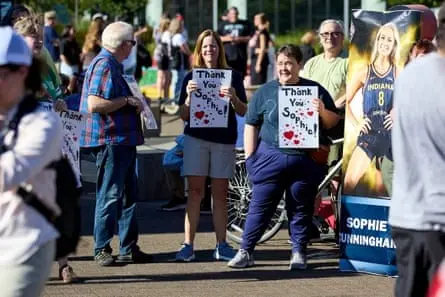
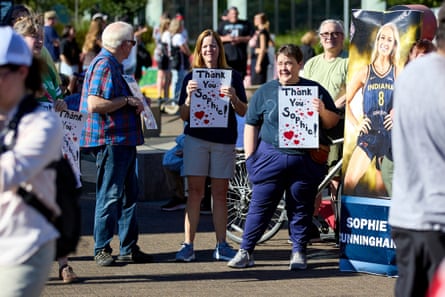
The fierce anti-trans fury surrounding the WNBA took off in July, transforming a sports league into a daily fixture of cable news culture wars. The inflection point arrived when Sophie Cunningham, a backup guard for the Indiana Fever, said in an interview with ESPN that she wanted to “protect young girls in a locker room, or young girls in sport who shouldn’t have to go against biological men”—using a common anti-trans dog-whistle that critics note misgenders trans women.
Shortly after Cunningham’s remarks, two former NBA players publicly declared their intention to enter the WNBA draft. The league swiftly clarified that they were entirely ineligible and publicly condemned the stunt. Even so, the situation triggered a massive media frenzy. Fox News alone aired more than 200 segments about the WNBA over the course of July, with the vast majority focusing heavily on Cunningham’s comments and the fabricated controversy.
Capitalizing on the media wave, the sportswear company XX-XY—an organization that lobbies women’s sports leagues and state legislatures to exclude players based strictly on biological sex assigned at birth—stepped into the spotlight. Its shirts, bearing the brand’s name as a reference to biological sex chromosomes, quickly became recognizable markers of an anti-trans statement at games and sporting events. In August, the company’s founder was photographed courtside wearing XX-XY merchandise alongside Cunningham and conservative anti-trans commentator Riley Gaines. Furthermore, XX-XY supporters and political influencers began gathering outside Fever games holding signs calling to “protect girls sports.” The company did not respond to requests for comment from reporters.
“We know that this is really about trying to rile up a base of folks who already show some sort of anti-gender ideology,” said Anna Castro, deputy communications director at the Transgender Law Center, defining the term as opposition to the basic rights of women and LGBTQ+ individuals.

What is happening in the WNBA is deeply representative of a broader right-wing political push to roll back rights, healthcare, and legal protections for transgender people across the United States. In June, the conservative-majority Supreme Court upheld the constitutionality of state laws banning trans girls from participating in school sports. Ahead of the November elections, several state ballot initiatives framed around “protecting girls” from “biological males” in sports have effectively sought to bar trans students from competing entirely. A ballot measure in Washington State, for instance, would require all girls to “verify” their identity through a doctor.
Yet, these restrictive policies frequently clash with broader public opinion. A June poll conducted by the National Women’s Law Center revealed that voters generally do not support the Supreme Court setting official national policy for trans athletes’ participation in sports, nor are they in favor of overturning existing state-level protections for trans student-athletes.
Resistance to the political intrusion has routinely played out directly inside basketball arenas. When the Indiana Fever played the Seattle Storm in late July, Storm co-owner Celeste Keaton confronted two XX-XY-sponsored attendees sitting courtside. According to one of the attendees, Keaton told them “Jesus loves everyone” and to “stop pulling this shit.” In response to the altercation, the WNBA swiftly fined and suspended Keaton.
Similar confrontations have occurred away from the court. When a group of individuals wearing XX-XY shirts arrived at The Sports Bra, a pioneering women’s sports bar in Portland, Oregon, in September, management promptly asked them to leave in accordance with the establishment’s policy of barring anyone wearing messaging that targets marginalized communities within their space.
“At The Sports Bra, our mission is simple: support, promote, and empower ALL girls and women in sports,” the bar’s owners posted on Instagram. “To be clear: trans girls are girls, and trans women are women.”
When a different group of right-wing anti-trans protesters returned to the perimeter of The Sports Bra two weeks later, neighborhood residents and regular patrons turned out in force to defend the bar and its community. The confrontation escalated when the right-wing protesters sprayed the counter-protesters with bear spray, highlighting the volatile tensions that have spilled over from online rhetoric into physical spaces.
For many fans, the escalating anti-trans harassment has created an intimidating environment, with some admitting they feel scared to attend games alone. At the same time, they take solace and find safety in knowing that queer and trans fans are actively organizing to take a stand and look out for one another.
Simultaneously, WNBA players have struggled to feel adequately protected against an alarming rise in racism and harassment from online viewers and in-arena attendees. Last season, male trolls initiated a bizarre trend of throwing sex toys onto the court during live games, a stunt instigated by cryptocurrency investors. This season, the behavior continued, with crypto influencers explicitly citing the ongoing public conversation around trans women and the WNBA as their primary motivation.
Furthermore, Black players, such as the Fever’s Kelsey Mitchell, have reported facing relentless racist invective and abuse on social media platforms. Both players and viewers have sharply criticized league leadership for failing to do more to combat this toxic environment. The WNBA did not respond to requests for comment regarding the harassment.
Castro noted that racist and anti-trans forms of harassment are frequently deeply intertwined. “The trans youth and cis youth that get targeted with sports bans are trans girls of color, and particularly Black girls,” she explained. “I think that it’s incredible that there have been fans that have said so vehemently: ‘This is not what we’re about.’”
How fans are pushing back
In August, the conservative organization Turning Point USA planned a high-profile pro-Cunningham rally just outside the Barclays Center in Brooklyn ahead of a game between the Fever and the Liberty. In direct response, a coalition of grassroots organizers planned a counter-rally to celebrate women’s sports and affirm trans rights. Before tip-off, volunteers distributed signs and T-shirts provided by the Transgender Law Center bearing the simple, powerful message: “Trans people belong here.” The gathering quickly transformed into a joyful block party featuring music and dancing.
Across the Bay Area over the past three months, parents of transgender children have organized poster distributions outside Golden State Valkyries games, handing out signs thanking players like Gabby Williams and head coach Natalie Nakase for their vocal support of the trans community. Supporters have used these same signs to form protective circles around anti-trans protesters whenever they appear outside the arenas.
According to Arne Johnson of Rainbow Families Action, the group’s community efforts to support trans youth in sports initially began in defense of AB Hernandez, a transgender high school track star who was subjected to an intense, coordinated harassment campaign—a teenager who has since become a personal hero to Johnson’s own trans daughter. Johnson noted that holding joyful rallies outside basketball games has proven to be a much more uplifting experience than testifying at state legislative hearings, where anti-trans advocates frequently direct cruel rhetoric straight at the faces of transgender children. He added that he barely needed to recruit fans to take a stand; the community stepped up organically.
“They have a visceral understanding of what this is about,” Johnson said. “That really crystallized what this WNBA fandom means: they were out there to protect each other.”
He was especially moved by how adult WNBA fans embraced trans youth as an essential, undeniable part of their broader community. Inspired by these actions, his group has since coordinated with Minnesota Lynx fans to provide signs and merchandise. During a Lynx game against the Fever in August, head coach Cheryl Reeve made headlines by wearing a “Trans Kids Belong” T-shirt on the sidelines.
As the WNBA finals unfold between the Valkyries and the Dream, organizers from California and Washington are hosting coordinated rallies outside the arenas in San Francisco and at prominent women’s sports bars across both states. They are using the massive national platform of the finals to draw critical attention to looming ballot measures, such as the one in Washington State, that seek to exclude transgender girls from participating on K-12 girls’ sports teams.
For young athletes caught in the center of the political storm, the solidarity from the sports community means everything. High schooler Jules, a trans athlete, shared that during rallies outside Valkyries games, passing strangers frequently approach her to ask for signs, T-shirts, or even photos, while she proudly wears a cape fashioned from a transgender pride flag. For her, the experience captures the very essence of what she loves most about competitive sports: genuine community.
“If we got completely destroyed in a game, I would not care,” Jules said. “But if someone was being mean or being unsportsmanlike or something like that, it breaks the community of it.”