



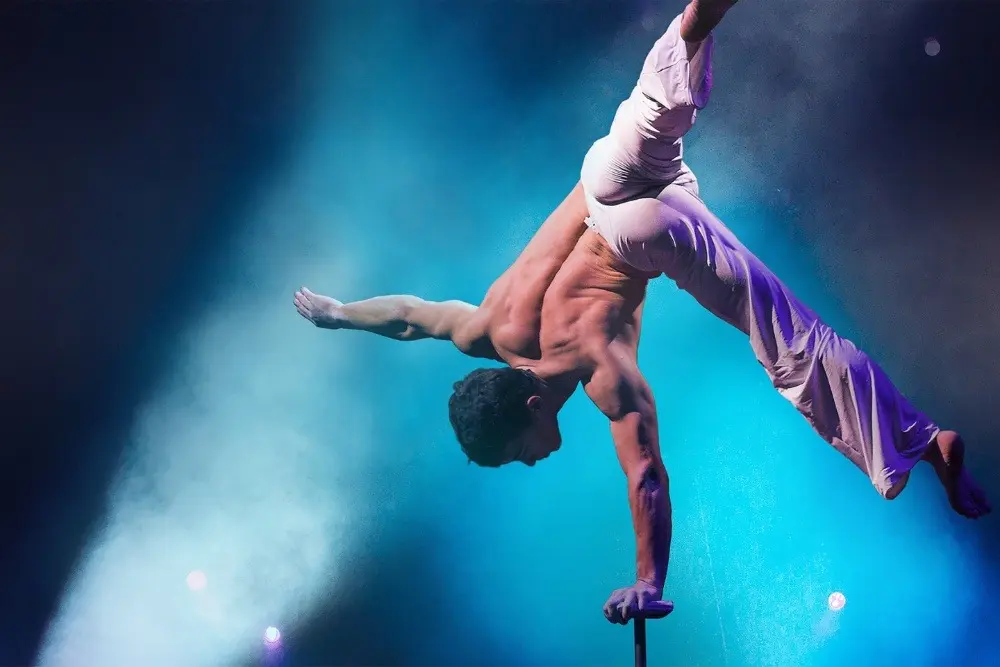
Structured deliberately in three distinct chapters modeled on the Father, the Son, and the Holy Spirit, “Trinity” follows Johnny, a charismatic pastor originally from Taiwan. Johnny’s impassioned sermons have successfully cultivated a massive, devoted following in Singapore at a prominent and popular megachurch. Beyond traditional preaching, the faithful turn out in massive numbers for elaborate, high-flying acrobatic shows that Johnny stages for his congregation, drawing clear aesthetic and practical comparisons to the breathtaking productions of Cirque du Soleil.
Although Johnny is publicly celebrated and known for maintaining a staunchly conservative stance on moral and spiritual matters, his personal life begins to unravel behind the scenes. He grows dangerously infatuated with Yang, a newcomer who has recently joined his intensive training program. Johnny’s increasingly obvious preferential treatment of the young newcomer does not go unnoticed. The blatant favoritism quickly unsettles his wife, Ruth, as well as David, who serves as Johnny’s leading disciple and is engaged to be married to the pastor’s daughter. Together, Ruth and David share vital administrative and operational responsibilities in running the sprawling church, making them immediate witnesses to the pastor’s ethical and emotional drift.
The narrative takes a dark and suspenseful turn when Yang suddenly vanishes without a trace. A frantic Johnny initiates his own private inquiry to locate the missing young man. As he digs deeper, the mounting clues begin pointing directly toward individuals within his closest inner circle, ultimately culminating in tragic and irreversible results. In the aftermath of the crisis, Johnny and Ruth relocate far away from the glaring lights of the megachurch, moving to rural Taiwan. There, they attempt to keep a remarkably low profile, quietly worshipping at a modest local congregation. However, their quiet life of penance is disrupted when Johnny glimpses an enigmatic stranger who may yet bring the troubled couple a renewed sense of divine grace.
Discussing the thematic underpinnings of his latest cinematic venture, Boo explained that the project stems from a deeply rooted artistic curiosity. He noted that he has always been very interested in the subject of sexuality and faith, adding that he wanted to make a film that dives deep into the complex psyche of these characters operating within the intense environment of a church.
Boo is widely recognized as one of Singapore’s most prominent contemporary filmmakers. He made his feature film directorial debut with “Sandcastle” in 2010, a momentous achievement that marked the first time a film from Singapore was officially selected for the prestigious Critics’ Week section at the Cannes Film Festival. His compelling follow-up feature, the capital punishment drama “Apprentice,” earned further international acclaim when it played in the Un Certain Regard section at Cannes in 2016. Beyond his narrative film work, Boo has maintained a prominent cultural footprint in his home country, serving as the creative director for Singapore’s National Day Parade, including the landmark 2025 edition marking the nation’s 60th anniversary. He also currently serves as the chair of the Singapore International Film Festival.
The development and execution of “Trinity” has been a collaborative international effort, heavily anchored by producer Raymond Phathanavirangoon. Phathanavirangoon, whose impressive producing credits include Boo’s “Apprentice,” Pen-ek Ratanaruang’s “Headshot,” Ron Howard’s high-stakes rescue drama “Thirteen Lives,” and Pang Ho-Cheung’s gritty features “Dream Home” and “Aberdeen,” co-wrote the screenplay for “Trinity” alongside Boo. Phathanavirangoon has been intimately involved with the project since the very beginning, watching the idea take shape from its earliest conceptual stages.
His extensive background in the international film industry also includes former stints working as an international programmer for the Toronto International Film Festival and a program delegate for Cannes Critics’ Week, alongside co-founding the Southeast Asia Fiction Film Lab, known as SEAFIC. Reflecting on the personal resonance of the project, Phathanavirangoon noted that he has personally witnessed people close to him convert to Christianity due to aggressive evangelism, yet he observed that this specific socio-cultural phenomenon is rarely explored authentically in Asian cinema.
Phathanavirangoon further emphasized that what truly sets the story apart is the remarkable way some modern Asian churches incorporate massive theatrical spectacles into their religious services. While some audiences might express surprise that houses of worship can host Cirque du Soleil-style acrobatic performances akin to the ones depicted in the film, the producer pointed to real-world precedents. He noted that just earlier this year in South Korea, a dramatic stunt featuring a man dressed as Jesus being hoisted into the sky went viral across global internet platforms, demonstrating the very real intersection of contemporary entertainment and religious worship that the film explores.
As “Trinity” currently sits in post-production, Boo and Phathanavirangoon are bringing the project to the Tokyo Gap-Financing Market with a specific goal in mind. The filmmaking team is looking to close a small, remaining gap in its overall financing structure before the film can be officially completed and prepared for festival submission and theatrical distribution. Despite exploring heavy, dark themes and institutional hypocrisy, Boo expressed a clear emotional hope for how audiences will receive the movie. He stated that he hopes people will ultimately empathize with the characters on screen, despite them being deeply flawed human beings caught in extraordinary circumstances.
The ambitious international production is backed by a coalition of production companies, including Peanut Pictures, Filmagic Pictures, and Gaïjin. The film stands out for its unprecedented global footprint as a co-production spanning an extraordinary eleven distinct countries: Taiwan, France, Singapore, Poland, Greece, Japan, Germany, Brazil, South Korea, Indonesia, and the Philippines.
The presentation of “Trinity” at the Tokyo Gap-Financing Market takes place as part of TIFFCOM, the prominent content market attached directly to the Tokyo International Film Festival, where industry professionals gather to support finishing funds for selected cinematic projects from around the globe.