



By Sara Goldstein | Updated Oct. 30, 2026

When clinical psychologist Dr. Becky Kennedy’s daughter went away to summer camp, she wrote home with a very specific list of demands. Alongside asking for more bikinis, the young camper requested a high-end, expensive brand that her friends were wearing. Just a few days later, during a scheduled phone call between mother and daughter, the topic vanished entirely. When Kennedy casually prompted her about the swimwear, her daughter brushed it off, stating she didn’t need them and that everything was fine.

For Kennedy, the founder and CEO of the parenting platform Good Inside and the author of three New York Times bestsellers, that brief camp anecdote encapsulates a profound modern challenge. At a time when digital convenience allows parents to solve nearly any minor discomfort or social panic with a tap of a smartphone screen, that brief delay in communication allowed panic to subside. It provided the necessary space for the child’s acute urge to fade on its own.

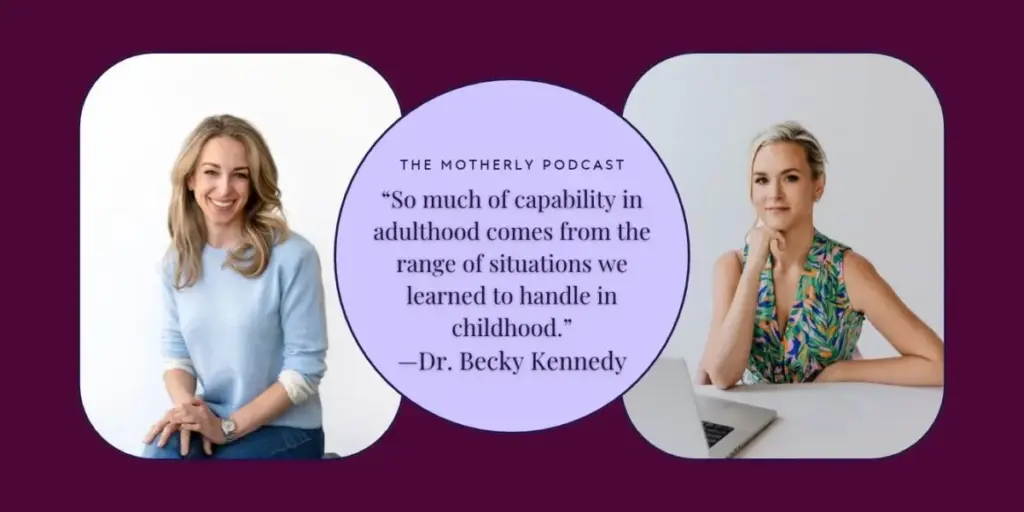
Appearing as a guest on The Motherly Podcast alongside host Liz Tenety, Kennedy discussed the mechanics of raising resilient kids, the core responsibilities of modern parenting, and why the perennial parental mantra—“I just want my kid to be happy”—might actually be setting children up for future anxiety and fragility.

Rethinking Parental Confidence and the Core Job Description
Opening the conversation, Tenety asked Kennedy what makes her feel confident as a mother, given her extensive professional background in child psychology. Rather than pointing to innate parenting instincts or the illusion of having all the answers, Kennedy emphasized a framework of structured thinking over the search for a singular correct response.

"I don’t ever assume I have the right answer," Kennedy explained. "I’m very attached to having a way to think through problems. It makes me think about the difference in the question ‘What do I do? What am I gonna say?’ versus ‘What’s really going on here? What’s my job?’ Those are very different questions."

According to Kennedy, parental confidence stems from having a repeatable, reliable way to analyze difficult situations rather than feeling as though every meltdown or crisis requires starting from scratch. That clarity begins with understanding the fundamental job description of a parent, which she argues consists of two distinct responsibilities: setting firm boundaries and maintaining emotional connection.

"I think a parent has two jobs, almost always," Kennedy said. "One job is to set boundaries. It’s the piece that we’re missing in modern-day parenting. We’ve over-corrected. Boundaries are decisions I make with my kid that almost inherently they don’t like today, but are actually good for the type of person they need to become tomorrow."

Kennedy notes that parents frequently mistake requests for boundaries. Telling a child to stop jumping on a couch or ordering them not to hit a sibling are verbal requests, not boundaries. True boundaries represent an assertion of appropriate parental authority over what the adult will do, requiring nothing from the child in the immediate moment. The second half of the job involves staying connected and validating feelings—not by agreeing with the child’s behavior or letting emotions dictate household rules, but by acknowledging those feelings as real and valid. Together, these two practices answer the fundamental questions children unconsciously ask themselves every day: Am I safe, and am I real?

Redefining Confidence and Navigating Modern Convenience
Reflecting on her own childhood, Kennedy revealed that she was not a naturally self-assured child. Instead of possessing deep self-trust, she identified as a perfectionist who relied heavily on external validation, such as high grades and athletic achievements. While external success often works temporarily during youth, she warns that it frequently catches up to individuals later in life, resulting in a shrinking comfort zone where people become afraid to try anything unless they are guaranteed to excel.

"I think confidence is self-trust," Kennedy said. "I always tell parents it’s actually not feeling like the best. It’s trusting it’s okay to be you when you’re not the best, ironically. When we think about kids who are so just oriented towards success, in a way, we’re setting them up to have a shrinking life. I want my kids to have a wide range of situations. I want them to say, ‘Yeah, I’m trying out for that team. Sure, I might not make it, but let’s see.’ That’s confidence."

This challenge has been magnified by the unique landscape of modern parenthood. Kennedy points out that it has never been easier for adults to instantly soothe, rescue, or accommodate their children’s every desire. When a child sees someone else with a particular item or experiences a momentary social slight, modern logistics and e-commerce allow parents to eliminate that discomfort instantly.

"We are doing such an insane disservice to our kids by pairing what happens to be the peak urge with the ability to get the thing in the moment," Kennedy noted, recalling how the lack of immediate intervention allowed her daughter’s camp anxiety to dissipate naturally. "Because it’s never been easier to remove those things, it has never been harder to raise an actually capable, confident, resilient kid."

Challenging the Pursuit of Happiness
One of the most deeply ingrained cultural aspirations for parents across generations is the simple desire to see their children happy. However, Kennedy challenges this conventional wisdom, arguing that an obsessive focus on shielding children from negative emotions undermines their long-term emotional development.

"People will say this in passing… ‘I just want my kid to be happy,’" Kennedy said. "I don’t think our job is to make our kids happy. I actually would say that if you’re operating even unconsciously as if that is your job, you’re setting your kid up not for happiness, but… for a ton of anxiety and fragility. Because so much of capability in adulthood comes from the range of situations we learned to handle in childhood."

To illustrate her point, Kennedy reflected on childhood slights, such as not being invited to the same second-grade class as her friends. While a forty-year-old adult will not care about school placements, experiencing that early exclusion builds the emotional circuitry needed to handle professional disappointments, such as being passed over for a promotion, or social exclusions later in life. Emotional resilience requires navigating jealousy, sadness, and rejection so that happiness has room to exist alongside the full spectrum of human experience.

Applying One Foot In, One Foot Out During Crises
When children face real academic or social hurdles—such as a middle school student discovering a zero recorded in their grade book—the parental instinct is often to rush in with immediate reassurance, telling the child not to worry and promising to fix the problem together. Kennedy acknowledges that watching a child struggle feels deeply uncomfortable, but warns against swinging between the extremes of total abandonment and complete over-involvement.

Instead, she advocates for a balanced approach she describes as having "one foot in and one foot out."

"One foot in would be saying, ‘Ugh, you weren’t expecting that. You didn’t want that to happen. Well, that’s a bummer on this Thursday car ride,’" Kennedy explained. The "one foot out" approach, which is typically introduced after time has passed for emotions to settle, involves providing perspective: "All right. This is recoverable. One number doesn’t change anything about you. You’re the same smart, awesome, responsible kid before the zero as you were after the zero."

Even with infants, building foundational resilience begins with allowing minor discomforts while offering steady comfort rather than trying to make every moment entirely comfortable. Referencing early developmental milestones like tummy time, Kennedy emphasized that a parent’s role is to provide a reassuring presence while a baby works through frustration, rather than eliminating every moment of physical effort.

The Limitation of Scripts
While Kennedy has popularized specific phrasing and communication tools for parents through her books and the Good Inside platform, she is quick to remind families that she is not fundamentally a "script person." Programs like the Childhood Confidence Project, which she recently launched in partnership with Carter’s, are designed to give parents frameworks rather than rigid dialogue templates.

Recalling an anecdote about parents asking themselves "WWDBD"—What would Dr. Becky do?—during family crises, Kennedy noted that the true value of such mental exercises lies in empowering parents to trust their own internal voice and methodology.

"That actually has nothing to do with me," Kennedy said. "If you’re in a hard situation and you say, ‘What would Dr. Becky do?’ That’s not my voice. I’m literally not there with you. That is your voice. Having a method, having a way of thinking through something. And that, to me, more than a perfect script, that is the most confidence-building thing as a parent."