



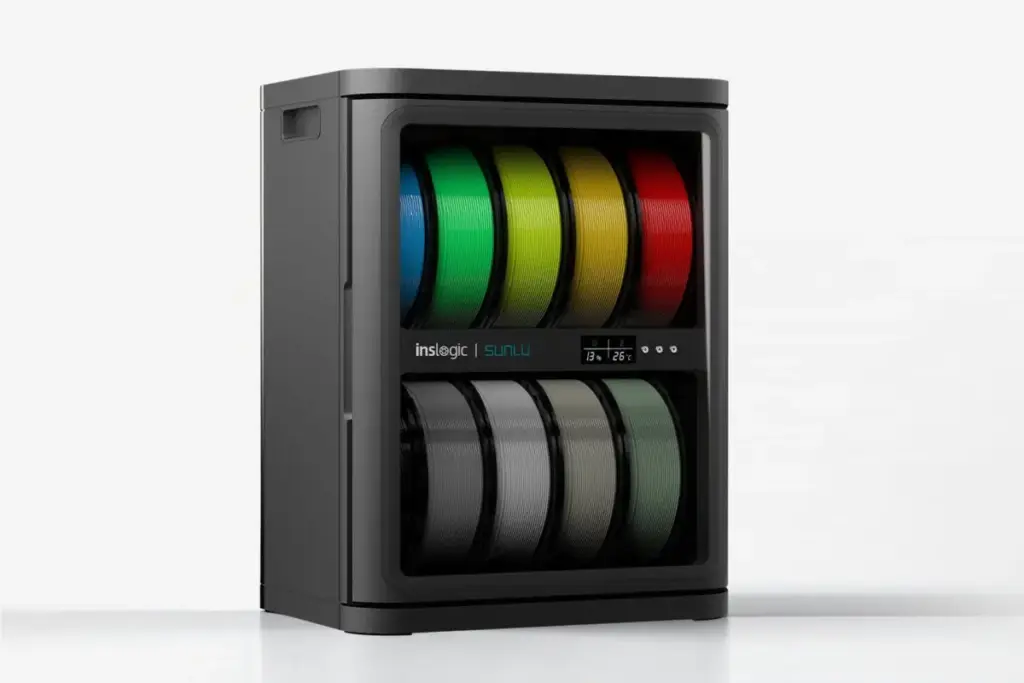
The 3D printing community has a new tool at its disposal for tackling the perennial challenge of moisture management with the launch of the FilaDC i10 filament dehumidifying cabinet, a collaborative product from Inslogic and Sunlu priced at $199. Designed to protect delicate thermoplastic materials from the degrading effects of humidity, the cabinet takes a distinct approach to material care by utilizing passive drying methods and advanced material science rather than the traditional high-heat systems commonly found in standard filament dryers on the market.
Moisture is one of the most common silent adversaries for 3D printing hobbyists and professionals alike. Hygroscopic filaments such as Nylon, PETG, TPU, and even standard PLA readily absorb water vapor from the ambient air. When heated inside a 3D printer nozzle, trapped moisture instantly vaporizes, leading to bubbles, popping sounds, inconsistent extrusion, surface blemishes, and the notorious stringing that can ruin an otherwise successful print. Traditional remediation methods typically involve desktop spool dryers that rely on heated air circulating around the plastic. While effective to a degree, prolonged exposure to elevated temperatures can sometimes warp spools, degrade specific polymer chains, or consume continuous electrical power over days of storage.
Addressing these limitations, the FilaDC i10 introduces a PTC and molecular sieve dual-effect dehumidification technology. According to the manufacturer, this system enables room-temperature, non-damaging drying. By avoiding the aggressive heat cycles of traditional hot-air drying solutions, the cabinet is gentler on a wide variety of filaments while drawing significantly less power than an active heating element running continuously.
Beyond its drying mechanism, the cabinet serves as a high-capacity storage solution capable of holding up to ten standard 3D printer filament spools simultaneously. This makes it an appealing option for makers who maintain an extensive inventory of materials and need to keep them ready for immediate use without degradation.

Initial hands-on impressions of the hardware highlight a straightforward, user-friendly experience from the moment of unboxing. The unit arrives securely packaged and requires minimal effort to get running. Installation is essentially a matter of plugging the power cord into the rear of the cabinet and flipping the power switch. Accompanying documentation is described as clear, thorough, and well-designed, providing comprehensive details regarding filament dehydration principles and including a practical reference table outlining optimal humidity levels for various materials and items.
Operationally, the cabinet allows users to easily configure their desired humidity percentage via an integrated control interface. In practical testing with five spools of filament that showed signs of moisture contamination, the device actively drew down the internal humidity to the targeted threshold within a remarkably short timeframe. The functional impact on print quality was immediately noticeable. Prior issues with stringing and surface imperfections that plagued prints produced with the damp filament disappeared entirely after the spools spent time conditioning inside the FilaDC i10.
The unit also incorporates smart automation features designed for efficiency and convenience. Once the internal environment reaches the user-defined humidity percentage, the primary dehumidification system powers down. Rather than remaining completely idle, the unit periodically restarts its cycle as needed to actively maintain the specified humidity band, ensuring that stored filaments do not slip back into a compromised state over prolonged periods. Furthermore, the internal mechanics operate with a low noise profile, running quietly in the background without causing a disturbance in a workshop or office environment.
For 3D printer owners looking to safeguard their filament inventory and improve print reliability without relying on power-hungry heat dryers, the FilaDC i10 presents a compelling, high-capacity alternative. Combining room-temperature molecular sieve technology with quiet operation, ample spool storage, and straightforward controls, the Inslogic and Sunlu cabinet offers a practical solution for maintaining optimal material conditions in any printing workflow.