


Artificial intelligence continues to break new ground outside digital spaces, expanding rapidly into the physical realm of robotics. Among the most promising methodologies driving this transition is reinforcement learning, a subfield of AI that trains computer programs to master complex tasks through trial and error. Rather than attempting to manually write rigid control code for every conceivable physical scenario, developers are increasingly turning to neural networks that learn optimal physical behaviors dynamically. A recent project published by instructor and developer Shawn Hymel demonstrates this shift by walking makers through the complete pipeline of training an autonomous, self-balancing two-wheeled robot using a physics simulator and deploying the resulting intelligence onto real-world hardware.
The core mechanism of reinforcement learning centers on an agent—a decision-making software program—that observes its environment, evaluates its current state, and determines the next action to take according to a guiding rule known as a policy. As the agent interacts with its surroundings, it receives numerical feedback in the form of rewards or penalties. Whether it is earning points in a video game, scoring a victory in chess, or successfully maintaining an upright posture on a two-wheeled chassis, the agent utilizes this feedback to iteratively refine its policy over time.

While classical control schemes such as proportional-integral-derivative loops, linear-quadratic regulators, and model predictive control have long served as the industry standard for stable robotic movement, reinforcement learning offers remarkable resilience against environmental variations. Instead of mathematically encoding every physics variable and potential disturbance, an agent trained via machine learning adapts to broad distributions of scenarios, equipping it to handle unpredictable real-world challenges.
The roots of this technology stretch back to the 1950s, drawing heavily from Richard Bellman’s work in dynamic programming and early computational experiments in trial-and-error learning. For decades, reinforcement learning was largely confined to scenarios with manageable mathematical models. However, the deep learning revolution of the early 2010s transformed the field. Breakthroughs such as DeepMind’s Deep Q-Network playing Atari games from raw pixels in 2013 and AlphaGo defeating professional Go player Lee Sedol in 2016 shattered previous limitations. By the late 2010s and early 2020s, deep reinforcement learning expanded past board games and digital environments into advanced robotics, influencing Boston Dynamics’ Spot locomotion controllers and Disney Research’s expressive BDX droids, alongside modern large language models like ChatGPT and Claude.

To bridge the gap between abstract AI theory and practical robotics, the training process relies on a continuous feedback loop. An agent receives sensory observations from the environment, processes them, and outputs specific actions. In the context of a self-balancing robot, the environment encompasses the physical chassis, motors, sensors, and the surrounding world, while the observation data stems from an inertial measurement unit and motor encoders. The agent’s output dictates the speed and direction of the drive motors, causing the robot to tilt, move, or correct its balance. Supporting software then evaluates the resulting physical reactions, generating a numerical reward that drives the learning algorithm to favor actions maximizing cumulative success over time.
Because training directly on physical hardware can be slow, risky, and physically destructive during early trial phases, developers frequently turn to physics simulators like MuJoCo. Simulation allows engineers to accelerate physics calculations beyond real-time speeds, reset the robot instantly whenever it falls, and run multiple parallel training environments simultaneously. Once training is complete, the resulting policy can be extracted and ported to physical microcontrollers.

A major challenge in deploying simulated AI to physical hardware is bridging the sim-to-real gap, which accounts for discrepancies in battery voltage, motor latency, sensor noise, and surface friction. To overcome these hurdles, developers employ domain randomization during the simulation phase. Instead of striving for a flawless digital twin of the real world, the training pipeline intentionally varies physical parameters—such as mass, friction, and external pushes—forcing the agent to learn robust control strategies capable of absorbing real-world imperfections. Furthermore, developers utilize curriculum learning, a technique that progressively increases task difficulty across distinct training phases, ensuring the agent gradually masters stability before confronting complex environmental randomization.
The underlying algorithm powering many of these modern robotic control tasks is Proximal Policy Optimization, an actor-critic method introduced by OpenAI researchers in 2017. PPO utilizes two separate neural networks: a critic that estimates the cumulative future rewards expected from a given state, and an actor that suggests the specific actions required to achieve those rewards. By utilizing an advantage metric to evaluate whether outcomes exceeded or fell short of expectations, the actor fine-tunes its probability distributions to favor successful behaviors. To prevent unstable updates from ruining the learning process, PPO introduces a mathematical clipping mechanism that acts as a speed limit on how drastically the policy can change in a single step.

The practical implementation of this workflow involves utilizing cloud-based development environments like Google Colab to handle the heavy computational lifting of training the neural networks. By setting up parallel simulation environments and running hundreds of thousands of timesteps, the agent steadily optimizes its balancing capabilities. TensorBoard visualization toolkits allow developers to monitor episodic returns, ensuring the model successfully converges on maximum reward thresholds.
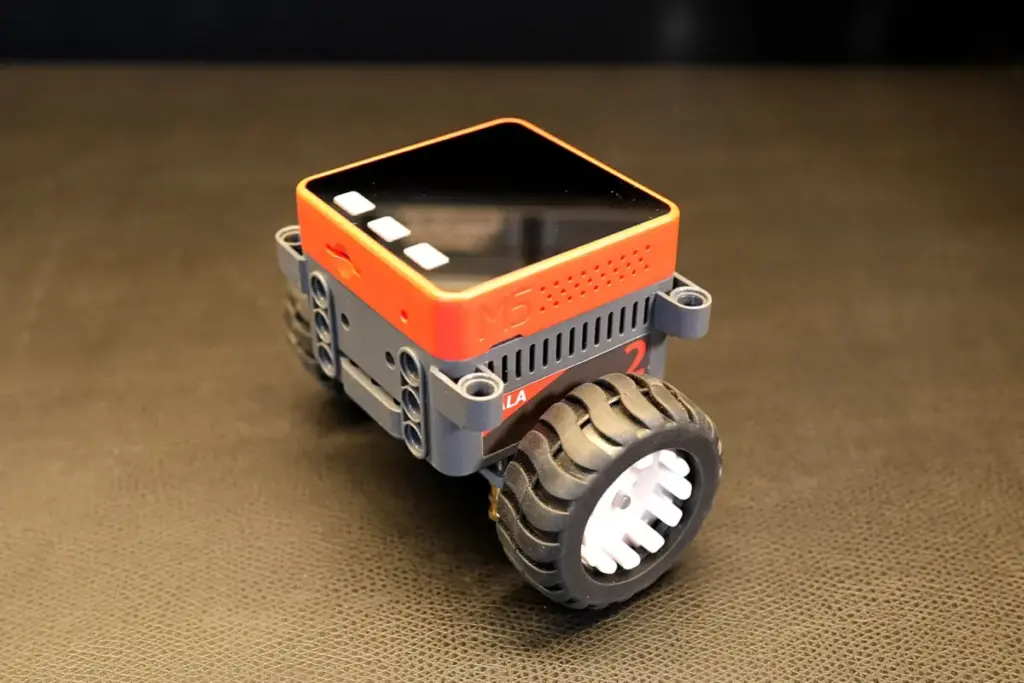
Once simulation training and domain randomization phases conclude, the trained agent is condensed for deployment. Because the critic network is exclusively required during the training phase to evaluate states, it is stripped away alongside the standard deviation parameters, leaving solely the actor network to interpret sensor inputs as deterministic actions. The trained policy is then exported as a C header file containing the lightweight neural network architecture, ready to be flashed onto microcontrollers like the ESP32 powering self-balancing hardware kits such as the M5Stack Bala2-Fire.

When integrated into physical hardware, the microcontroller reads live sensor data at high frequencies, processes the observation vector through the embedded neural network forward function, and translates the resulting outputs into pulse-width modulation signals for the motor drivers. Without relying on complex manual tuning of classical control loops, the robot autonomously reacts to physical disturbances, demonstrating how deep reinforcement learning can successfully transition from abstract digital simulation into tangible, real-world robotic control.