



A comprehensive evaluation of canine supplements requires looking beyond attractive packaging and examining what the product details actually reveal. In evaluating Pup Labs, a pet wellness brand offering a range of dietary supplements, three distinct formulas stand out: K9 Belly Bliss, targeted at digestive health; Freedom Joint Drops, formulated for joint support; and ProDenta, designed for daily oral hygiene routines.
An assessment of these products reveals a versatile product line featuring both powder and liquid formats. However, turning initial interest into a sound purchasing decision requires a close examination of label details, including full ingredient lists, exact serving directions, and the true cost per day relative to a dog’s weight and needs.
Having multiple application formats within a single product lineup provides practical advantages for pet owners. A liquid drop may appeal to those whose dogs dislike chews, while a meal-topping powder can seamlessly blend into daily feeding routines. Nevertheless, evaluating each supplement demands reading labels on their own specific terms. A scoop’s weight, a bottle’s total liquid volume, and the advertised number of servings answer distinct questions. Understanding how to interpret these figures allows dog owners to select products that align with their care goals and budget.
Evaluating the Pup Labs Supplement Lineup
Pup Labs markets individual supplements designed around specific wellness goals rather than offering single, broad-spectrum formulas. K9 Belly Bliss and ProDenta are presented as meal-topping powders, whereas Freedom Joint Drops utilizes a liquid dropper delivery system. This variety allows pet owners to choose an administration method suited to their feeding routine rather than settling for a delivery method their dog might refuse.
Evaluating these products relies on published manufacturer data, visible Product Facts panels, and standard packaging details. While initial product handling provides a sense of packaging quality and ease of use, evaluating long-term health outcomes requires looking closely at ingredient profiles, clear daily administration schedules, and verified packaging metrics. Pet owners should begin by determining their dog’s specific care goals, checking the complete ingredient statement, and confirming weight-based serving sizes before making cost comparisons.
When comparing product reviews, buyers should keep in mind that each product serves a distinct purpose. A consumer discussing a digestive powder is evaluating an entirely different formula than one reviewing a dental topper or a liquid joint supplement. Matching the exact product name, package labeling, and ingredient breakdown ensures that consumer feedback is applied appropriately before buying.
An informative analysis must go beyond repeating highlighted marketing terms. The most valuable evaluation checks whether a formula matches its stated purpose, whether daily usage directions are clear and practical, and whether the ongoing expense can be evaluated on an equal, daily basis.
Deciphering the Powder Formulas: K9 Belly Bliss and ProDenta
K9 Belly Bliss: Formula Composition and Digestive Role
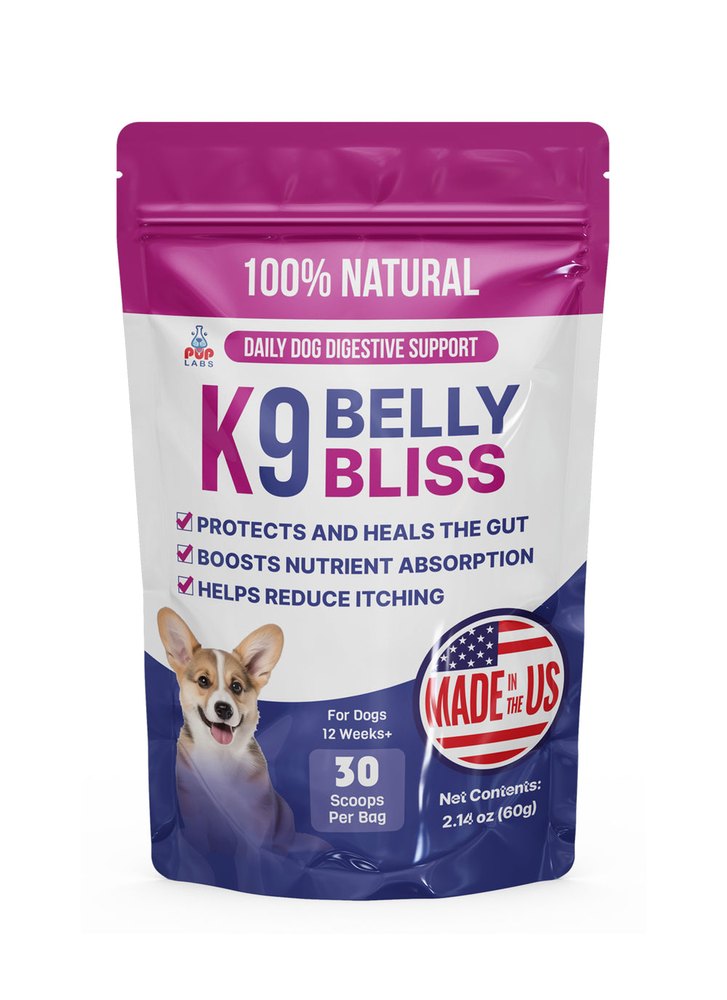
K9 Belly Bliss is formulated as a powder designed to be mixed directly into standard dog food to support general digestive function. According to company specifications, key highlighted components include L-glutamine, N-acetyl D-glucosamine, and a blend of functional mushroom extracts, specifically reishi, lion’s mane, turkey tail, and Cordyceps.
This composition sets K9 Belly Bliss apart from typical canine digestive supplements that rely primarily on direct bacterial cultures or strains. Highlighting amino acids and functional mushrooms places the formula in a distinct category within digestive aids.
When reviewing consumer experiences with K9 Belly Bliss, it is essential to distinguish between the identity of the formula and reported individual observations. Ingredient lists show what compounds are included in the product, but they do not automatically specify the exact dosage delivered in a given daily serving. Calculating that dose requires looking at the explicit Product Facts label and matching it with current package directions.
Front-of-package labeling on K9 Belly Bliss lists a net weight of 60 grams and notes 30 scoops per container. These numbers establish total package capacity, but they do not mean every dog will use exactly one scoop per day or that a single bag will automatically last 30 days. Required daily intake depends on an individual dog’s body weight. Pet owners should always consult the specific feeding instructions on the back panel rather than assuming container scoop counts represent a fixed monthly supply.
ProDenta: Reading the Product Facts Label
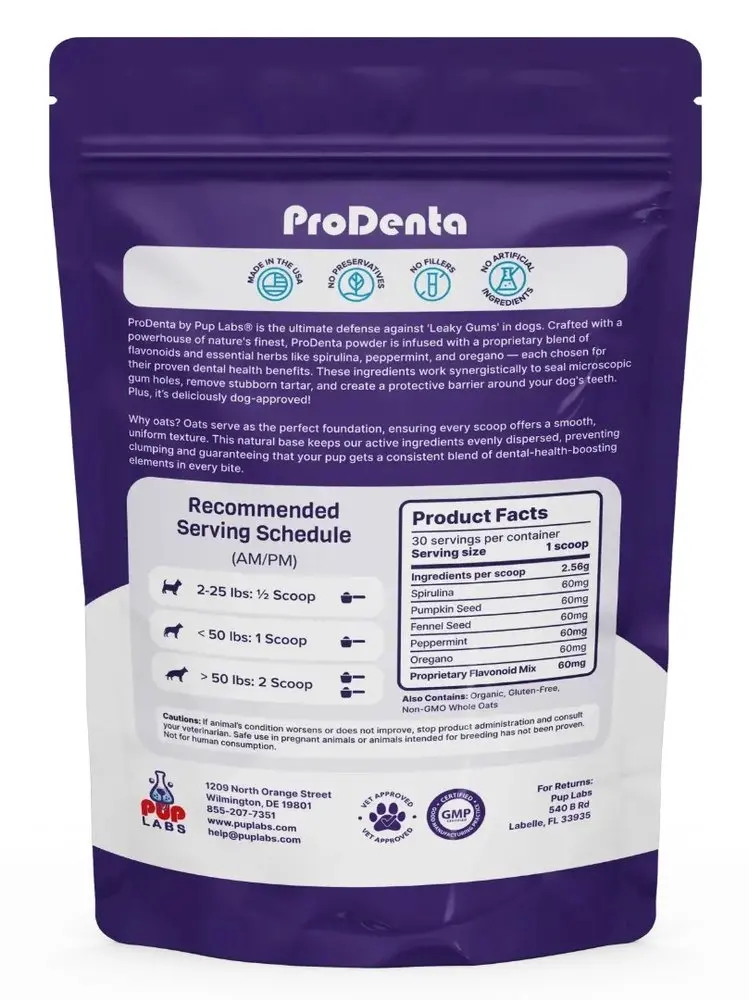
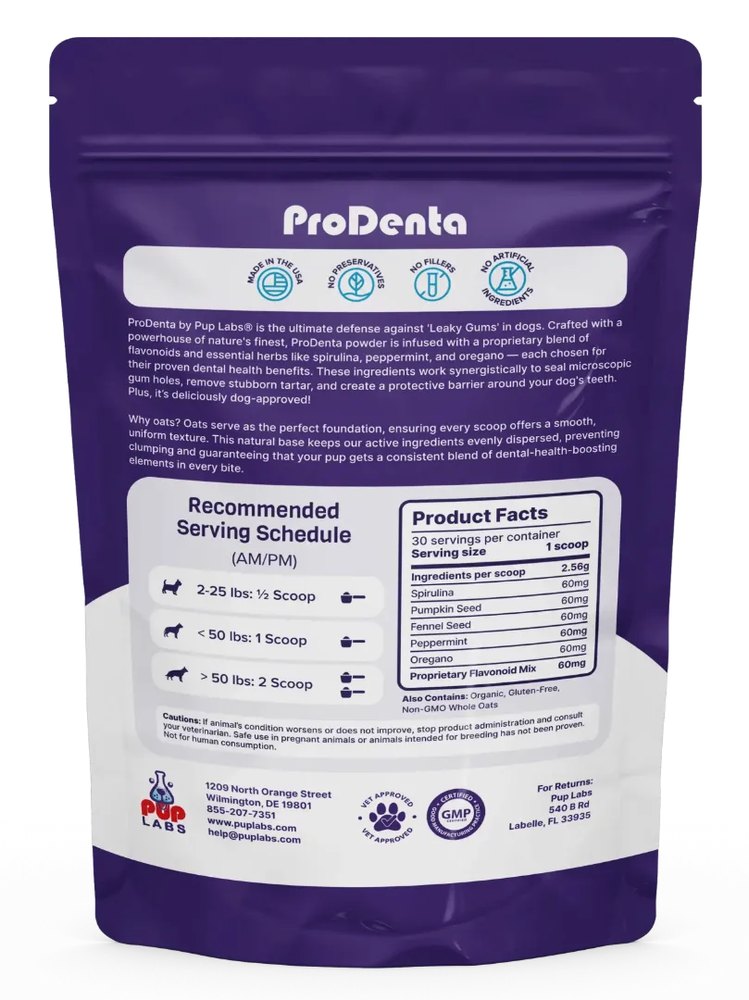
ProDenta serves as an informative example of standard supplement labeling practices. The product features a visible Product Facts panel that defines active ingredients based on a standard single-scoop measurement of 2.56 grams. Within this scoop weight, the label highlights six primary ingredients, each included at 60 milligrams: spirulina, pumpkin seed, fennel seed, peppermint, oregano, and a proprietary flavonoid mix. Whole oats are also included within the base formula.
This detailed breakdown helps owners evaluate what their pet is actually receiving. The six active ingredients at 60 milligrams each sum up to 360 milligrams of total active compounds per scoop. The remainder of the 2.56-gram scoop weight represents carrier ingredients, such as whole oats, which give the powder its volume and texture. Understanding this distinction prevents owners from mistaking the total scoop weight for the total mass of the highlighted active ingredients alone.
For dogs with known dietary sensitivities or strict ingredient restrictions, carrier ingredients require equal attention. The presence of non-active components or base grains is relevant context for dogs on limited-ingredient diets. Having the complete label accessible is essential when discussing any new dietary addition with a veterinarian.
The explicit quantities listed on the ProDenta label also allow owners to distinguish individual ingredients from proprietary blends. For instance, peppermint is listed individually at 60 milligrams, whereas the proprietary flavonoid mix is listed as a collective 60-milligram total for the entire blend. This clarity ensures owners know whether a figure describes a single component or a combination of ingredients.
Contextualizing Dental Powders Within Canine Oral Care
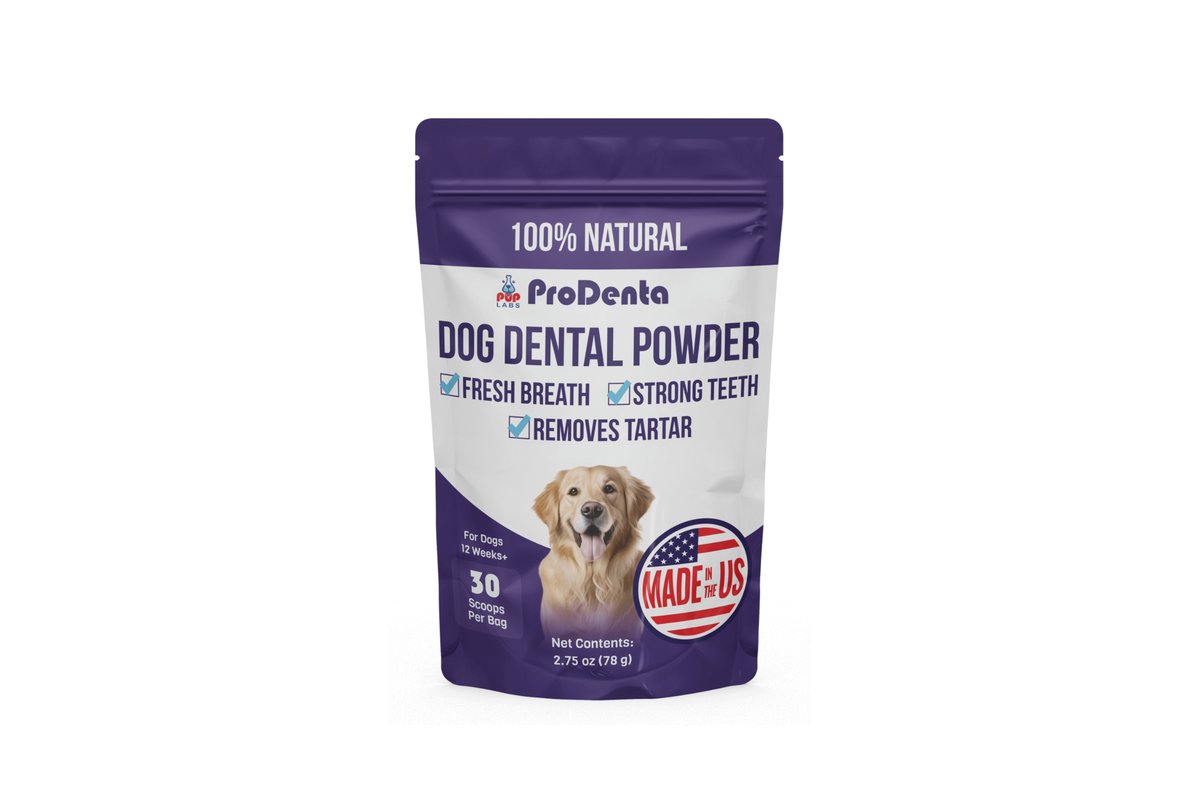
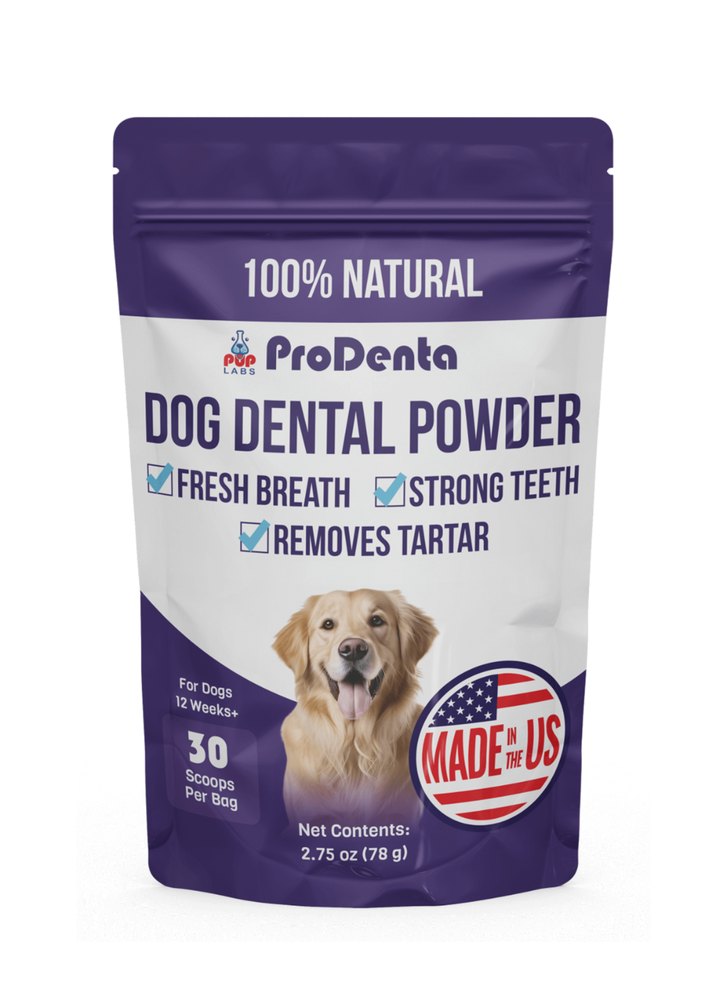
ProDenta is designed as an edible dental powder intended for convenient mealtime administration. While a powder format offers a low-stress alternative to direct dental intervention, assessing its overall effectiveness requires understanding its role within a broader oral care plan. Evaluating oral health products involves examining evidence for targeted outcomes, such as plaque control, rather than treating ingredient weight as a direct measure of tartar removal.
Dietary oral supplements should be viewed as one component of a broader hygiene routine. Veterinary recommendations from organizations like the American Animal Hospital Association (AAHA) highlight that mechanical brushing remains the gold standard for breaking down soft plaque before it mineralizes into hard calculus. For products making explicit claims regarding plaque and tartar reduction, benchmarks established by the Veterinary Oral Health Council (VOHC) provide an objective reference for verified efficacy.
While mealtime powders like ProDenta offer a practical option for daily routines, maintain realistic expectations. Supplementing food with daily powders can support oral freshness, but it works best alongside regular physical brushing and routine professional veterinary checkups.
Freedom Joint Drops: Liquid Supplementation, Ingredients, and Dosing
Freedom Joint Drops serves as the primary liquid joint support option in the Pup Labs product lineup. A liquid format with an included dropper offers an effective solution for pet owners whose dogs resist chews or tablets, as drops can easily be administered directly or mixed into food or drinking water.
As with powder supplements, reviewing liquid ingredients requires assessing the official product labeling. Manufacturer information highlights components such as hyaluronic acid, a proprietary flavonoid blend, MSM, vitamin B12, and magnesium, while container packaging notes the inclusion of glucosamine and chondroitin. To obtain an precise view of the formula, owners should rely on the comprehensive Product Facts label on the physical bottle rather than piecing together highlights from online marketing materials.
Package Volume, Liquid Measurement, and Daily Administration
Freedom Joint Drops is packaged in a 30-milliliter dropper bottle. While this figure defines the total liquid volume in the container, it does not reveal the concentration of active ingredients per dose, the volume capacity of a full dropper, or the required daily amount for a dog of a specific weight.
Before calculating how long a bottle will last or comparing it to alternative joint supplements, pet owners should confirm several practical details:
- The precise volume delivered by a single dropper filling.
- The required daily volume, measured in milliliters, based on the dog’s body weight.
- Whether the daily total should be given all at once or divided into morning and evening feedings.
Establishing these baseline metrics ensures accurate administration across all household members. Clear measuring instructions remove guesswork, allow for reliable recording, and provide accurate details when consulting a veterinarian.
Consumer Feedback and Veterinary Context for Joint Health
Customer reviews for Freedom Joint Drops frequently mention improvements in pet mobility and willingness to maintain daily administration. While user feedback highlights general consumer satisfaction, individual accounts reflect specific experiences rather than guaranteed timelines for every dog.
For these reasons, objective evaluation focuses on verified physical parameters: liquid volume, clear labeling, precise serving schedules, and total cost per daily portion. While positive reviews can highlight practical usability, a dog’s joint management plan should rely on established veterinary guidelines.
Comprehensive joint management requires a multi-faceted approach. Frameworks such as the AAHA Pain Management Guidelines emphasize tailored protocols that combine dietary management, controlled exercise, weight monitoring, and medical care when appropriate. Liquid joint supplements can play a helpful supportive role within this broader structure, but they should be viewed as one part of a complete mobility care strategy.
Calculating True Daily Value, Serving Schedules, and Cost Comparison
Evaluating the value of any pet supplement requires calculating the actual daily cost rather than relying on container pricing or general package claims. The clearest evaluation comes from determining the required daily intake for a dog’s specific weight, calculating the total lifespan of a single package under those directions, and dividing the purchase price by that number of days.
Accurate cost comparisons rely on three key factors:
- The exact container volume or net weight (such as 60 grams, 78 grams, or 30 milliliters).
- The specific daily dose required based on the dog’s body weight band.
- The total purchase price, accounting for any extra costs like shipping or multi-pack discounts.
When reading dosage instructions, note both the serving amount and administration frequency. Directions expressed per individual feeding must be multiplied by the total feedings per day to establish the true daily intake. Conversely, a total daily requirement should not be duplicated across multiple meals. If a schedule outlines morning and evening split feedings, clarify whether the stated measurement represents the single-feeding dose or the entire day’s total.
With ProDenta, for example, the Product Facts panel lists ingredient values per single 2.56-gram scoop, while the feeding guidelines detail varying scoop counts across different dog weight categories. Evaluating daily cost requires referencing the weight-specific feeding chart rather than assuming every dog uses a single scoop per day. The same rule applies to liquid formulas: confirm the daily milliliter volume required for your dog’s size before projecting how long a 30-milliliter bottle will last.
To illustrate this math, consider a hypothetical $60 supplement container holding 60 measured portions. If a dog requires one portion per day, the package lasts 60 days, resulting in a daily cost of $1.00. If a larger dog requires two portions daily to meet feeding guidelines, that same container will last 30 days, doubling the daily cost to $2.00.
This calculation becomes even more important in multi-dog households. Each dog’s daily requirement should be calculated individually based on weight before combining totals. Sharing a single package between two dogs doubles total daily consumption, reducing package duration by half.
Buyers should also evaluate ordering options, including single purchases versus auto-ship subscriptions, package bundles, and potential shipping fees. Multi-unit bundles often lower the price per bottle, but pet owners should ensure the total quantity aligns with their calculated usage timeline to avoid product expiration. For initial trial purchases, flexibility and confirming that a product suits a dog’s palate may outweigh the bulk savings of larger orders.
Ultimately, value comes down to how easily a supplement fits into a daily care routine. A powder that mixes effortlessly into kibble or a liquid that simplifies administration offers practical benefits. Pup Labs provides clear format choices for distinct care goals, allowing pet owners to choose options that suit both their feeding routines and household budgets.
Key Insights on Pup Labs Formulations and Consumer Guidance
Understanding how to read pet supplement labels, dosing schedules, and brand specifications helps clarify common consumer questions regarding Pup Labs and its product range.
Brand Authenticity and Verification: Pup Labs operates as an established direct-to-consumer pet supplement brand, detailing product compositions and label metrics on its official online platforms. Pet owners evaluating products should rely on published label facts and physical package details rather than assuming third-party descriptions accurately reflect current product formulations.
Distinguishing Digestive Powders from Live Probiotics: Formulations like K9 Belly Bliss rely on functional ingredients—including amino acids like L-glutamine and mushroom extracts—rather than active, live bacterial cultures. Unlike traditional probiotic supplements, which list specific live strains alongside guaranteed Colony Forming Units (CFUs) as highlighted in resources like Cornell University’s Riney Canine Health Center guidelines, K9 Belly Bliss offers a different dietary approach. It should be evaluated based on its specific ingredient list rather than categorized as a standard probiotic.
Understanding Serving Directions Across Weight Categories: Single-scoop label figures specify ingredient measurements per unit, not a universal daily dose for every dog. Feeding guidelines vary based on weight categories. Dog owners should consult the weight-based administration chart to determine exact daily requirements rather than relying on standard single-scoop amounts.
Comparing Liquid and Powder Delivery Formats: Comparing liquid drops to powders requires looking beyond physical volume. Milliliters measure liquid volume, whereas grams measure powder mass. Comparing product value requires calculating the exact daily cost for the required weight-based dose rather than assuming equal administration across formats.
Monitoring Product Tolerability: While Pup Labs supplements are formulated for daily use, individual canine sensitivities can occur with any new dietary addition. Pet owners introducing a new supplement should monitor their dog’s initial response. If adverse reactions or digestive changes occur, discontinue use and consult a veterinarian with the product packaging, active ingredient list, and feeding records.
Supplements Within a Complete Diet: Dietary supplements are formulated to complement a dog’s standard feeding routine, not to replace complete and balanced daily meals. Products like K9 Belly Bliss, Freedom Joint Drops, and ProDenta provide targeted functional support. Main dietary meals should remain unchanged unless specific adjustments are recommended by a qualified veterinarian.