



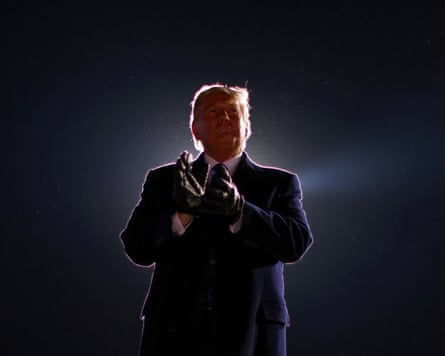
Good morning. Later today, Donald Trump will arrive in the state of Nebraska to rev up supporters, officially kicking off an aggressive campaign blitz of rallies ahead of the critical midterm elections scheduled for 3 November.
If his early speeches on the campaign trail are any indication of what is to come, voters in the heartland can anticipate a familiar blend of poll denial, sharp accusations of veganism, and a high volume of provocative rhetoric. Yet, Nebraskans may well embrace the message: aside from a single "blue dot" congressional district in Omaha, Republicans argue that their political support remains firmly anchored in a state that has reliably backed Trump through three successive presidential cycles.
This high-stakes campaign arrives against the backdrop of plummeting presidential approval ratings, ongoing unravelling within the broader MAGA movement, and a punishing affordability crisis exacerbated by an unpopular war on Iran. Nevertheless, Trump’s base remains among the most highly motivated voting blocs in the country, and Republican campaign committees possess significantly deeper financial coffers to mobilize supporters at the grassroots level.
In an effort to gauge what voters truly want to know about the upcoming US midterms, questions were put to Washington editor Ankita Rao, who directs the US elections newsletter The Stakes.

Weekend roundup and the national mood
Observers of contemporary American politics could easily be forgiven for feeling a sense of deep perplexity. On one hand, voters express profound disillusionment with the president’s military entanglements in the Middle East and grow increasingly furious over the administration’s failure to alleviate the daily cost-of-living crisis at home.
On the other hand, Trump has confidently promised a "big surprise" when ballots are cast on 3 November, reminding the public that conventional polling has frequently miscalculated outcomes in past election cycles.
As Ankita Rao outlined in The Stakes earlier in the autumn, reporting teams stationed across communities nationwide are encountering a consistent set of grievances: Americans increasingly feel that their lives are dictated by an entrenched elite class spanning across traditional political party lines—a sentiment recently encapsulated by Democratic Senator Jon Ossoff’s reference to the "Epstein class." Furthermore, citizens are visibly exhausted by ongoing affordability crises impacting childcare, healthcare, grocery store prices, and gasoline, while trust in fundamental institutions, from local schools to major healthcare systems, has eroded dramatically.
In depth: ‘We are prepared for anything’
Who still believes in Donald Trump?
The short answer, according to Rao, is that many Americans do not feel they have been presented with a viable alternative. This dynamic was clearly visible during the primary season, when both Democrats and Republicans gravitated toward candidates who promised to challenge the political establishment rather than simply regurgitate traditional party platforms.
While millions initially flocked to Trump as an anti-establishment outsider capable of disrupting a stagnant two-party system, many of those same voters now observe him aligning more closely with big tech and corporate interests during his current term in office. A noticeable disconnect has emerged between Trump and his most loyal supporters, with his once-sharp political instincts frequently faltering as he remains fixated on personal projects, foreign conflicts, and the rapid, unregulated growth of artificial intelligence. As one Ohio voter bluntly remarked over the weekend: "I’m sorry, but I don’t give a shit whose name is on the Kennedy Center."
Has Trump got a decisive ‘dirty trick’ up his sleeve?
A paramount concern among voters and international observers alike centers on election interference, the implementation of restricted voting measures championed by Trump, and potential efforts to challenge or dismiss official results.

Rao, who joined Guardian US seven years ago as voting rights editor to launch a multi-year democracy project, notes that election integrity has become a cornerstone of modern political journalism. In the months leading up to the midterms, Trump signed a series of executive orders aimed at asserting greater federal control over voting procedures. In a recent interview, he explicitly refused to rule out declaring a national emergency regarding elections to enforce those mandates.
"So we are prepared for anything," Rao says, adding that legal challenges across individual competitive races are virtually inevitable. "We know the states where the election systems are fully controlled by Republicans, and we’re ready to move everybody there if we see anything strange happening."
Fears regarding potential election manipulation run high, particularly among Democrats who express anxiety over ensuring their votes are properly counted and exhibit heightened caution regarding mail-in ballots. With roughly one-third of Americans utilizing postal voting, attempts by Trump to restrict the practice could paradoxically backfire by stimulating even higher voter turnout. Early registration data from strongly conservative states like Florida already indicate exceptionally high engagement among Democratic voters.
"There’s a sense that ‘we need to go out in droves and make sure that all of these wins are very decisive, so that nobody can question them,’" Rao explains.

Would Republican losses limit Trump’s excesses?
While political prognosticators are reluctant to make definitive predictions given how rapidly the political landscape can shift, a hypothetical election held today would likely see Democrats capture the House of Representatives and potentially secure a majority in the Senate.
However, the constitutional mechanics of governance mean that a decisive majority in both chambers would be required to act as an effective legislative bulwark against executive overreach—a challenge underscored by the fact that Trump bypassed congressional authorization entirely prior to launching military operations in Iran.
Regardless of the legislative balance, analysts anticipate a wave of congressional investigations following the midterms. Lawmakers are already demanding inquiries into newly surfaced revelations that a Russian oligarch helped finance part of Donald Trump Jr’s recent wedding in the Bahamas.
How will democratic socialists influence policy decisions after the midterms?
As progressive candidates capture the enthusiasm of voters demanding radical systemic change, the influence of democratic socialists remains a critical question. While the absolute number of elected democratic socialists in Congress is projected to remain relatively small, they are expected to form a highly vocal bloc.
The strategic direction of these lawmakers remains to be seen. Prominent figures like Alexandria Ocasio-Cortez have maintained a clear democratic socialist affiliation while operating as strategic collaborators within the broader Democratic establishment rather than functioning as obstructionists. Whether a newly augmented progressive cohort adopts a similar pragmatic approach or pivots toward a harder line—particularly regarding contentious foreign policy issues such as Israel’s military campaign in Gaza, which has already created deep internal divisions within the Democratic Party—will significantly shape future legislative battles.
Navigating a militarized capital
Reflecting on the atmosphere in Washington, DC, the tangible shift in the urban landscape since the previous election cycle is difficult to overstate. Navigating streets lined with National Guard trucks and confronting the quiet militarization of the federal city introduces a subtle layer of anxiety into daily routines.

Rather than suppressing civic engagement or deterring citizens from expressing their political beliefs, however, this visible security presence appears to have produced an opposite reaction. In densely populated, vocally Democratic urban centers like Minneapolis, Los Angeles, and Washington, residents have responded with visible defiance, evidenced by a proliferation of campaign signs and undeterred voter enthusiasm.
As the countdown to 3 November continues, the intersection of economic anxiety, voter mobilization, and institutional friction ensures that the upcoming midterm elections will profoundly test the resilience of American democracy.