
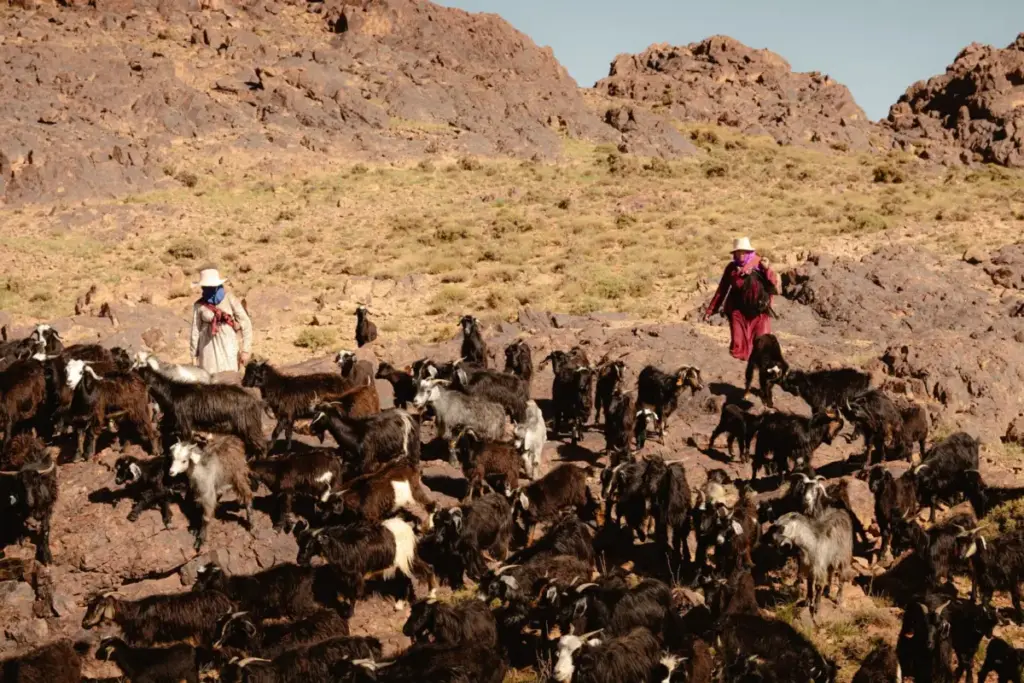
A persistent chorus of shrill bleats and guttural baas echoes across the canyons and basalt towers of Jebel Saghro. Squinting against the midday sun, writer Jen Murphy spots a flash of red high on a rocky peak—the distinct djellaba worn by Telhou Belâwane, the matriarch of the Berber family she is traveling with in southeast Morocco. Her presence confirms that the goats are near. Scanning the crags and stony folds of the mountains for the herd, their onyx coats prove frustratingly indistinguishable from the volcanic terrain to an untrained eye.

Jebel Saghro is the ancestral homeland of Telhou’s people, the Aït Atta, a historically powerful Berber—or Amazigh, meaning "free people"—tribe in southeast Morocco. This rugged region unfurls from the High Atlas Mountains to the edge of the Sahara, serving twice each year as the backdrop for one of the oldest migrations in Africa. For millennia, the Aït Atta and other Berber families have moved their livestock upwards of 180 miles from the summer grazing grounds of the High Atlas to the winter pastures of Jebel Saghro. This seasonal pastoral journey, known as transhumance, defines a semi-nomadic way of life that is rapidly disappearing in the modern era.
It is late September, and Telhou, her husband Hmad, and her daughter Saâdia are ten days into their rigorous trek when Murphy joins them alongside a support team from luxury travel operator Black Tomato. Hiking side-by-side with a nomadic family and their herd is one of five immersive experiences comprising "The Keepers," Black Tomato’s new collection of itineraries. Each trip is meticulously built around people whose ancestral knowledge continues to be practiced and passed down through generations—ranging from a 28th-generation Daoist master in Chengdu, China, to a mariscador on Chiloé Island in Chile who has spent a lifetime reading the ocean’s unpredictable tides.

As a pioneer of off-the-grid luxury travel, Black Tomato has developed a keen instinct for anticipating what discerning travelers will crave next. With The Keepers, Black Tomato co-founder Tom Marchant predicts that in a world where nearly anything can be looked up or generated in seconds through technology, authentic human knowledge and genuine connection have become the ultimate luxuries. More than ever, modern travelers want to step into the role of students rather than remaining passive spectators.
Before Murphy’s arrival, the Belâwanes’ caravan consisted of roughly 200 goats, two dogs to help herd the animals, two chickens for fresh eggs, and three donkeys carrying tea kettles, water jugs, blankets, and essential camp supplies. To accommodate the travel writer and ensure safety and comfort, Black Tomato added five mules and a dozen additional personnel—including two drivers, four logistics men to pitch a canvas tent complete with a bed and flush toilet, a private chef, and five mule handlers whose animals carried all the provisions and luggage. Several crew members are cousins of the Belâwane family, and many—such as head mule handler Zaïd Oukhazaid—have reluctantly abandoned their full-time nomadic ways for permanent village life due to compounding factors like climate change.

On the day Murphy arrives, Zaïd and another mule handler meet her roadside in Tagdilt, a village situated at the edge of the Dadès Valley. Both wear coarse, sheep’s wool djellabas over trekking pants and plaid shirts, with turban-like scarves known as shesh piled high on their heads. Zaïd breaks into a wide smile, exposing the gap left by four missing front teeth. Despite his diminutive stature, he possesses an outsized personality and a deep, abiding pride in his Aït Atta heritage.
Reaching out a sinewy arm after two strong handshakes, Zaïd pulls Murphy into a warm bear hug, exclaiming "welcome, welcome"—one of the handful of English phrases he has mastered while working alongside international travelers. With Murphy’s Arabic, French, and Berber language skills being similarly rudimentary, Noureddine "Nouri" Bachar joins the expedition as a translator. Yet over the course of the next few days, Murphy is continually surprised by how much meaningful communication can be achieved simply through expressions of gratitude, laughter, and smiles.

With rain looming on the horizon, the family started earlier with the herd and planned to meet the group directly at camp, Nouri explains. "The nomads dictate the days," he notes. "You are here to support their journey and we are here to support yours." Once the pack mule is loaded with supplies, Zaïd beckons the group to follow him into the Martian-like landscape stretching out ahead. The stark terrain clarifies why Saghro translates to the "Land of Thirst" in the Berber tongue, sprawling out as an endless expanse of flat-topped mesas, dry riverbeds, and umber cliffs. Sensing Murphy’s underlying uncertainty, Zaïd offers a reassuring perspective: "Drop me in a city, I’d be lost. Drop me anywhere in these mountains, and I know my way."
The initial two-hour hike serves as a light warm-up for the rigorous days ahead, which will require trekking for five or more hours daily. The group reaches the Tircht pass, situated at 6,100 feet, just as the support crew finishes setting up camp. Each Aït Atta family holds traditional rights to specific migration routes, utilizing established campsites featuring stone pens known as azib to shelter their herds overnight. Zaïd fetches water from a local well and builds a fire to heat a kettle for traditional tea. When he reaches for an iceberg-sized chunk of sugar to drop into the pot, Murphy jokingly asks Nouri to tell him she would like to keep her teeth. Catching the humor, Zaïd lets out a hearty belly laugh and pours an unsweetened cup instead.

After the sun sets, the family and the expedition team gather inside a traditional goat-hair tent for formal introductions and a communal meal by candlelight. The atmosphere closely resembles a family reunion, with the men trading stories and gossip while Telhou and her shy 17-year-old daughter Saâdia sit quietly nearby. Traditionally, the man of the house leads the caravan and manages camp setup while the wife and children shoulder the arduous task of moving the goats alongside household duties like meal preparation. Murphy’s presence affords the women a brief respite from cooking as the private chef ladles out bowls of harira—a thick, nourishing tomato soup spiked with beans, herbs, and spices. Nouri hands Murphy a spoon, but following Zaïd’s lead, she lifts the bowl with her hands and takes a long slurp. "The nomad way," Zaïd nods approvingly.
However, sustaining the nomad way has grown increasingly difficult. Rising temperatures and severe droughts have shrunk available pastures. Furthermore, since 2019, Moroccan children between the ages of 6 and 16 are legally required to attend school, leaving fewer young hands available to tend the expanding herds. Four of Telhou’s six children are currently enrolled in school, one daughter is married, and Saâdia is expected to marry soon. Once youths are introduced to modern conveniences like electricity and running water, returning to the profound hardships of living off the land becomes exceedingly difficult. Hmad shares with Nouri that only six families within his sub-tribe, the Ait Slilou, made the migration to Jebel Saghro this year—a sharp decline from historical numbers that once reached upwards of 80 families. This familiar narrative mirrors struggles playing out across the globe, from the sheep herders of the Swiss Alps to ranching families in the American West, where traditional ways of life dependent on family and the land are quietly vanishing.

Each morning, the unmistakable hee-haw of donkeys acts as the camp alarm, rousing the party before sunrise. While Murphy sips coffee and enjoys a breakfast of baghrir—crepe-like pancakes topped with amlou, a Moroccan take on almond butter—the crew efficiently packs up camp, leaving behind no trace other than the stone shelter used by the goats. By 7:30 a.m., Nouri and Murphy set off alongside the family. Hmad guides the donkeys along a dusty trail flanked by almond and date trees, while Telhou and Saâdia tackle the much rougher off-road terrain with the herd. Murphy watches in absolute awe as Saâdia scrambles up near-vertical cliffs of loose scree wearing a shimmery, gold-striped dress and plastic loafers, navigating the steep incline with the same effortless grace as the mountain goats.
The day’s 7.5-mile trek takes the group up and over Tizi n’ Tircht, a mountain pass sitting at 8,200 feet that offers sweeping views back toward the High Atlas and down toward a remote campsite called Azib Almou n’ Ouarg. Encountering only one other nomadic family traveling with a caravan of three camels, the route remains blissfully isolated. Nouri and Murphy arrive at camp with Hmad just past 1 p.m. Famously exhausted and famished, Murphy devours a lunch of kefta and Moroccan salads before removing her hiking boots and joining the crew for a well-earned afternoon nap. The women, moving strictly to the natural rhythm of the herd by pausing hourly for grazing, do not descend into camp until nearly 5 p.m.

By the second night, Murphy feels fully integrated into the fold, an inclusion underscored when she learns a goat has been prepared in her honor. The chef crafts a comprehensive meal utilizing nearly every part of the animal, and as Murphy samples skewers of heart, lungs, and intestines, the dinner conversation shifts to national politics. Nouri explains that it is a historic day in Morocco, as the king has appointed the country’s first female prime minister. When Murphy asks the group how they feel about the news, Zaïd jokes that it spells the end for men. Saâdia responds that she cares little for politics, focusing solely on the goats. Telhou breaks into a wide grin and announces she is happy. Asked why, she tells Nouri through translation, "Because I’m a woman, too."
On the third morning, Murphy asks Nouri if she can join the women directly off the trail. The route spans just under seven miles but presents steeper climbs than previous days. By this point, Murphy has learned to distinguish individual goats—noticing twisted horns, shaggy beards, and the white ears of a yearling she affectionately names "Mittens." Telhou employs primal shouts to keep the main herd unified, while Saâdia uses a makeshift slingshot to skillfully propel stones at wandering strays. Handed the slingshot, Murphy tries her hand at the technique, resulting in a shared burst of laughter when her stone launches backward. Telhou expresses approval of Murphy’s stamina through Nouri, asking if she genuinely enjoys the demanding labor. Murphy answers honestly that she does; what would otherwise be a strenuous hike suddenly carries a vital purpose—helping care for the herd—while forging a profound human connection across an otherworldly landscape.

The striking red rocks and flat mesas resemble the terrain of Utah, turning the daily hike into an immersive geologic safari as Nouri points out rock formations resembling elephants and camels. Reaching camp alongside Hmad leaves Murphy physically exhausted, yet in an era dominated by comfort, undertaking difficult physical labor proves deeply satisfying. Rinsing off the accumulated desert dust in a bucket shower, she reflects on whether she could truly sustain this lifestyle. In many ways, it feels blissfully simple—resembling an annual hiking trip where limited cell signals force everyone to disconnect from their screens. Yet the modern stressors of daily life are replaced by raw, elemental survival challenges for the tribe: securing water, staying warm, and protecting the herd, which serves as the family’s primary currency, from jackals and wild dogs.
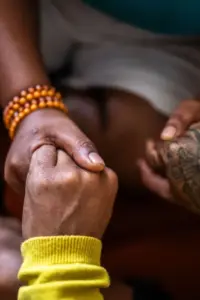
Even after an arduous day, Telhou squats beside the fire that evening, patiently teaching Murphy how to prepare aghroum, traditional Moroccan flatbread, effortlessly tossing the circular dough between her hands. Murphy’s breadmaking skills prove even less refined than her rock-tossing abilities. That night, everyone gathers around a massive communal bowl piled high with couscous studded with goat meat, carrots, and zucchini. Eating directly from the shared dish without plates, Zaïd carefully portions out the meat to ensure an equitable share for all. Before retiring to her tent, Saâdia decorates Murphy’s hands with traditional henna patterns, leaving the dark green plant paste to dry by the warmth of the fire.

On the final morning with the family, Murphy joins the women once more. Gaining confidence on the rocky terrain, her eyes quickly spot a flash of white high up on the pass: mischievous Mittens has strayed from the herd. Tossing a stone and attempting to mimic Telhou’s commanding howl, Mittens obeys the call and scampers back down the slope with Murphy close behind. Before parting ways at the family’s winter home, Murphy asks Nouri to translate her deep gratitude for their extraordinary hospitality. Telhou replies that Murphy has "earned her keep" and would be welcomed back every year, adding, "She is a nomad at heart." Reflecting on the journey, Murphy notes she would gladly return for an annual trek with her newly adopted nomad family, hopeful that such shared experiences can help sustain an ancient way of life against the tides of modernity.