
On Location peels back the curtain on some of your favorite films, television shows, and more. This time, we take a look at Wildwood.
There are several times when Prue, the 13-year-old protagonist of the fantasy epic Wildwood, seems just as in disbelief of the magical world she inhabits as we viewers. As someone who grew up in Portland, Oregon, she thinks she has already encountered the limits of weirdness, and yet—as one of the giant animal denizens of the Impassable Wilderness, known by locals as Wildwood, is quick to remind her—there she is, speaking with an owl having tea in a waistcoat.
Par for the course for the renowned stop-motion studio Laika, the newest creation is a visual feast featuring soaring eagles the size of commercial airplanes, ancient trees with roots that sprawl across the whole realm, and even an all-out war between worlds reminiscent of the D-Day Landing in Saving Private Ryan. As much as audiences could easily lose themselves in these grand spectacles, the film is also emphatic about remembering the magic that imbues just a single blade of grass. As the first Laika movie explicitly set in Portland, the studio looked for inspiration in their own backyards to bring the universe of Colin Meloy’s titular novel to life. Condé Nast Traveler spoke with Wildwood director Travis Knight on the inspiration behind this exhilarating, stop-motion saga that takes place not too far from home.
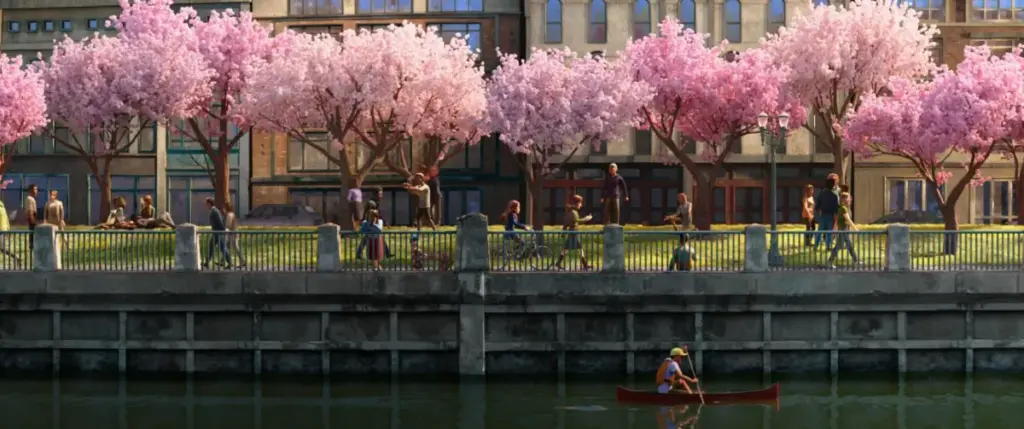
This movie stands out as a genuine love letter to Portland, drawing inspiration from local landmarks and cultural touchstones like the Voodoo Doughnuts Prue and Mac eat, or the Decembrists posters adorning her bedroom walls. As the first Laika film explicitly set where the studio calls home, the production process was deeply personal for those involved.

"It was a joy, unlike anything I’ve ever experienced," director Travis Knight explained when asked how the local setting influenced the filmmaking process. "Filmmaking for me is such a privilege to be able to do for a living. To be able to tell a story that was set in the place that I was born, the place that I’ve lived almost my entire life, the place where our studio is, where so many of us live, was a very special experience because we know that place better than anybody, and we could bring that world to life with real specificity, with real personality. The Portland that you see on screen in Wildwood, while it’s a stylized reality because it’s animation, very much does represent the truth of what it means to live in that part of the world."
One recurring theme woven deeply throughout the narrative is that magic exists in everyday life, both in Portland and in the places humans least expect. Yet, the reverse is true as well within the fantasy setting. In the magical realm of Wildwood, viewers can look forward to spotting distinct fingerprints of Portland and the Pacific Northwest.
"There’s magic in real life, and there is danger in the fantasy world—both of those things are true," Knight noted. "I think when you look at Wildwood the place, not the movie, there are places from Portland, the Pacific Northwest, and Oregon, specifically all over it. Crater Lake is in there, Haystack Rock is, and there’s all these different, beautiful places of Oregon that we infused into this fantasy land, and that was a great joy. We treated Wildwood the place as if it was an ‘Oregon’s greatest hits’ fantasyland. The idea of treating Oregon on the same plane as some of the great fantasy realms from my youth like Narnia and Oz and Middle Earth was crazy to even think about. It was great to be able to showcase that beauty on the big screen."
The film has already earned well-deserved applause for its entirely handcrafted stop-motion approach. In a brilliant blink-and-you-miss-it moment, characters Prue and Mac pass by an art fair in St. Johns, where a craftsperson selling wares displays a sign urging shoppers to buy human-made art "before it’s gone for good." The inclusion speaks volumes about the creative philosophy behind the production.

"That’s part of the way I look at the world, and it’s where our community is from," Knight said. "That particular sign is a visual gag, but it’s also something that you would see in Portland. I also think it is a meaningful statement that is relevant to the film and to our culture at large. There is a huge maker community in Portland. It’s a group of people that actually celebrates handcrafted things, and that really is what’s beating at the heart of the movie, that the film is a celebration of human creativity, of human innovation, of the human touch, and in a world that’s often designed to be frictionless, easier, and automated. I think the human touch is something that’s special and deserves to be celebrated and deserves to be preserved."
Stop motion is a notoriously deliberate and meticulous practice, where every single facial wrinkle and physical adjustment is literally sculpted by hand. When approaching different settings, Knight looks to the inherent personality of the location, as well as the emotional themes underlying the story.
"I think when you’re approaching a story, you really want to listen to what the story wants to tell you," Knight reflected. "When I think about Kubo and the Two Strings, I go back to my own experiences when I was exposed to Japan for the first time. I was eight years old with my father, and it was a world unlike anything that I’d ever seen before. It left a huge impact on me, and those were the types of things that I was channeling. When I was making Bumblebee, I thought back to my experience of being exposed to the Transformers cartoons for the very first time. So you start putting these things through your own prism, and with Wildwood, it was very simple because it was the part of the world that I know better than anywhere. Settings, they have their own personality. Ultimately, what is driving all of these things is the theme and the emotion underneath it, and that is the thing that everything else needs to spiral out of. So, in the end, that’s really the thing I think about more than anything else: what is the story trying to say, and what is the emotion that we’re trying to convey?"
One of the most frequently discussed facts about Wildwood is the staggering 16-year timeline it took to bring the project from a manuscript to the big screen. Over that extensive period, both the real world and Portland experienced significant transformations.

"Portland has changed a lot in 16 years, just like the entire world has changed a lot in 16 years," Knight said. "I first read Colin Meloy’s manuscript in 2010. The first movie that we came out with [Coraline] was in 2009, so it was only a year after that that I discovered Wildwood. Portland is a very different place now than it was then. Many, many things have happened since then, some very positive, some tragic. We moved the film into pre-production in 2019, seven years ago. I felt like at the time, we were ready to make Wildwood. Then the whole world turned upside down, and we were hit with a global pandemic the likes of which we had not seen in a century. It changed the whole world, and it changed Portland, and when I see the version of Portland on screen in Wildwood, it’s the Portland that I know and the Portland that I love. My hope is that, in time, it can become that again."
Constructing the physical sets for the film presented distinct technical challenges, particularly given the natural subject matter of the story. While controlled interior spaces like children’s bedrooms require immense attention to detail, replicating nature in miniature proved to be an entirely different endeavor.
"Nothing is easy in stop-motion. Everything is difficult in stop motion," Knight explained. "But the things that tend to be more manageable are interiors, like a child’s bedroom, but even those have so many details that have to be thought of and designed and built and manipulated. What’s difficult to do is nature because organic shapes have their own unique grammar. Things like a forest are really difficult to do in stop motion, and I made the decision to set a movie that was almost entirely based in a forest. It’s the materials you use, how you build these things, their shape. There’s so much beauty to the natural world that’s so different and so strange compared to the inorganic world, the things that we humans construct, and most of the film is set in those places."
Knight noted that moments such as Prue and Curtis entering the Wildwood for the very first time required extensive design work to capture the breathtaking, museum-quality artistry built by set designers, dressers, painters, and craftspeople.

Drawing from his own upbringing outside of Portland on the side of a mountain, Knight and his collaborators infused the production with a deep respect for local wildlife and ecosystems, treating the picture as an authentic eco-fable.
"As someone who grew up in the Portland area, I have a lot of knowledge of coyotes. We have a lot of knowledge of crows. We’re always next to the natural world," Knight said. "I spent most of my childhood days wandering around the forest and climbing up trees and discovering things. The film is emotionally about one primal thing, but there are a lot of layers to the story that we’re telling, and part of that is that the film is an eco-fable. That was something that we treated seriously, as it’s something that so many of my collaborators care about deeply, and it’s something I care about deeply. We wanted to try to express that in an organic way without feeling like we were emblazoning it in neon that we’re making a message movie. The hope is that you want to honor these things in a way that feels authentic. There’s no greater teacher to you than observation, and going out in nature, and seeing how the world was formed, independent of how we’ve tried to shape it. Fortunately, in Oregon, one of the many great gifts of the state is that in any direction you go, you will discover it. We poured so much of that into this movie."
Having successfully navigated the monumental task of translating his own home into a cinematic fantasy epic, Knight offered thoughtful advice to fellow creatives who might feel intimidated about telling stories grounded in their own origins.
"What is the piece of advice that they leave out on the old chair-side chest? It was something like writing what you know," Knight reflected. "I don’t think that necessarily means write where you’re from, but you have a unique way of looking at the world based on your experiences within it. We know our own lives, unlike anyone else, but that’s also the thing that we have to offer that no one else can offer. That’s the one thing an artist can do that nobody else can do. They know their own experiences, they own their mind, they know their own imagination, which is different than everybody else’s. It’s the one thing that we can really offer—how you’ve lived, how you grew up, the people you grew up with, the people you’ve interacted with. Every place has its own unique characteristics and its own unique personality. Even within that, our experiences are different from the person next to us. The daunting thing shouldn’t be how to tell a story about your home, it’s how to really honor the things that you’re feeling, how to honor your imagination in a way that really does it justice. Those are all things that we strive to do as artists. We have big dreams, we have big feelings, and how can we get that out in a way that it makes sense to somebody, and it makes them care?"