


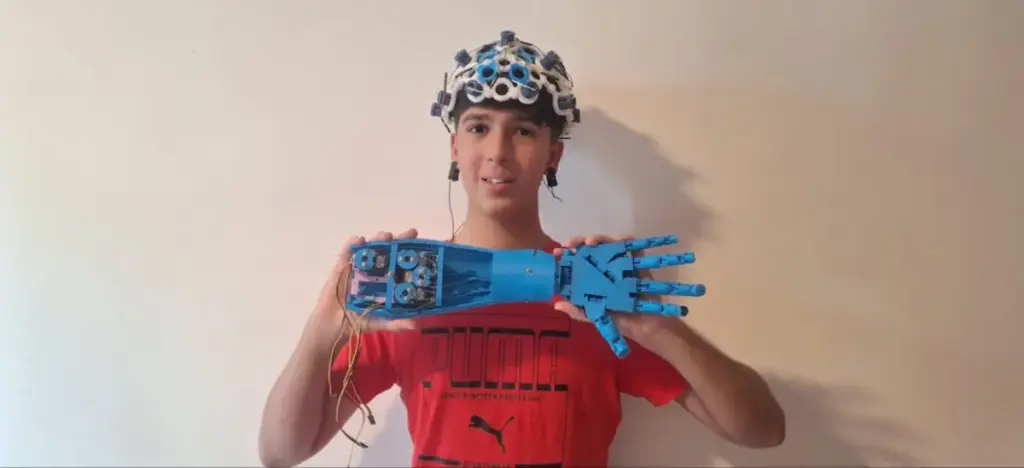
Aarav Sharma is still at work. For those who followed the coverage earlier this year in the Make: Substack, Sharma first made waves when he began building an innovative, 3D-printed, brain-controlled robot arm at the age of just 14. That initial project captured the attention of the maker community for its ambition and the technical skill required to bridge human neural signals with physical machinery.
Now, it turns out that Sharma has not stopped working since those early milestones. Over the intervening months, he has been busy expanding his technical scope, pushing the boundaries of neural control far beyond a single robotic appendage and into a much wider, more versatile communication system.

Backed by a sponsorship from OpenBCI, a prominent developer of open-source brain-computer interface hardware and software, Sharma has successfully engineered a six-command Steady State Visually Evoked Potential, commonly known as an SSVEP system. For those unfamiliar with the technology, it can be conceptualized as a form of eye tracking operating entirely from the inside, relying on direct electrical signals from the brain rather than external camera lenses or optical sensors.
Sharma breaks down the mechanics of the technology simply, explaining that SSVEP is a specialized type of brain-computer interface where different visual targets flash on a display at distinct, calibrated frequencies. When a user deliberately focuses their attention on one specific target, an EEG headset worn on the head detects the matching electrical response generated within the brain. The system then rapidly processes this neurological signature and converts it directly into a designated digital command.
To make the communication process practical and fluid, Sharma has integrated modern artificial intelligence to assist with speed and efficiency. By incorporating word suggestions driven by an OpenAI language model, the system anticipates user intent while ensuring that the human operator retains absolute control over the final output. During preliminary testing of this integrated setup, human testers demonstrated the ability to construct and send full, coherent sentences in under five seconds, showcasing the potential for rapid assistive communication.

Developing and refining a system of this complexity requires rigorous data collection, analysis, and calibration. Describing his development workflow, Sharma details the meticulous process behind the scenes. For offline electroencephalography data collection, a user typically completes around sixty trials where the system instructs them on which of the six flashing visual targets to focus on. Following these trials, Sharma analyzes how system accuracy shifts when utilizing varying amounts of raw EEG data. He utilizes time-frequency representation graphs to verify the accurately detected frequencies and employs confusion matrices to analyze which targets are being mistakenly confused by the algorithm, allowing him to fine-tune the parameters for higher reliability.
Looking toward the future of the project, Sharma is already setting his sights on the next phase of hardware integration. He plans to eventually transition the user interface away from a traditional computer monitor and onto augmented reality glasses. Moving the display to wearable AR hardware would offer a significantly more portable, functional, and practical experience for everyday use, bringing the technology closer to real-world assistive applications.
The ongoing evolution of Sharma’s neurotechnology work highlights the ingenuity of young makers working at the intersection of neuroscience, hardware fabrication, and artificial intelligence. Those interested in following his continued progress and exploring the technical documentation of his BCI projects can find more information online at his project repository.