
At first glance, the humble baked potato may not strike the home cook as a dish requiring specialized culinary technique or rigorous scientific precision. Yet, culinary experts and test kitchen professionals maintain that a vast gulf separates a merely acceptable baked potato from a truly transcendent one. For generations, conventional kitchen wisdom has instructed home cooks to wrap their russet potatoes tightly in aluminum foil before placing them in the oven, operating under the assumption that this traps moisture and ensures even cooking. However, culinary investigations reveal that this common practice is actually counterproductive to achieving an ideal texture. While wrapping potatoes in foil can yield a tender interior, it simultaneously traps steam against the skin, rendering the exterior far too soft and robbing the diner of that highly sought-after textural contrast.
For the most crisp skin possible, culinary authorities recommend abandoning the foil entirely and baking the potatoes directly on the oven grate at a relatively high temperature. To elevate the exterior even further—transforming the skin so that it tastes almost like a savory potato chip—cooks are advised to thoroughly scrub their russets, rub them generously with vegetable oil, and season them liberally with plenty of salt prior to baking. Surprisingly, baking bare potatoes directly on the oven rack does not compromise the fluffiness of the interior. Achieving that light, cloud-like texture inside the potato comes down to a precise internal temperature rather than a moisture-trapping foil barrier. Specifically, the potato must reach an internal temperature of at least 212 degrees Fahrenheit during the baking process. While taking a potato’s temperature with a digital kitchen thermometer might initially feel unusual or overly meticulous, culinary testing confirms that it serves as a foolproof route to the most enjoyable and reliably cooked potato possible.
Once the potato emerges from the oven with its crisped, salted skin and perfectly fluffy interior, a secondary debate arises within the culinary community regarding the proper method for opening the spud. Opinions vary widely on how to breach the outer skin without compromising the delicate structure within. Some authorities, including the Idaho Potato Commission, maintain that the physical method used to open a baked potato directly affects its final mouthfeel and texture. Rather than immediately reaching for a kitchen knife, proponents of this school of thought prefer to eschew blades entirely in favor of a standard dinner fork, using the tines to gently puncture a neat plus sign into the surface of the potato.
Others approach the task with significantly more dramatic flair. Beloved food writer and culinary figure Nigel Slater famously prefers to strike the hot potato as though participating in a martial arts competition, bringing his hand down with calculated force. In a piece published for The Guardian, Slater describes the technique vividly, advising cooks to bring their hand down fast and sharp as if executing a karate chop, applying only enough force to crack open the potato skin without crushing the tender flesh beneath. Whether or not to attempt this high-impact culinary feat remains entirely in the hands of the individual potato-baker. However, rigorous testing conducted by culinary editors suggests a simpler, more controlled approach, finding that a single fork-pricked line drawn down the length of the spud is ultimately the most effective way to release internal steam and prepare the potato for filling without destroying its structural integrity.
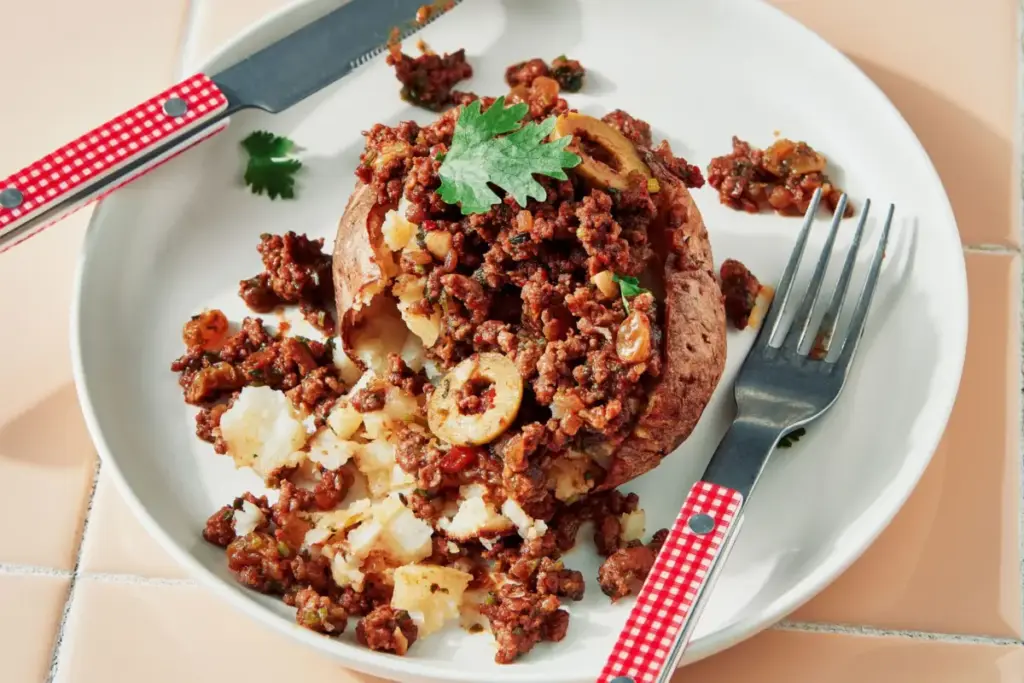
Once opened and properly fluffed, the baked potato transitions from a simple side dish into a versatile canvas capable of supporting an enormous array of hearty fillings and complete meals. Traditional toppings like butter, sour cream, and chives are easily cast aside in favor of more substantial, globally inspired flavor profiles. A baked potato can be filled with anything from bright, herbaceous tuna salad to rich, cheesy baked beans simmering in a savory tomato base. In contemporary test kitchen adaptations, the spud finds itself paired with a picadillo-inspired ground beef mixture. This hearty meat filling is naturally packed with protein, iron, and creatine, though home cooks seeking alternative proteins can easily substitute ground turkey or chicken with equally delicious results.
To build layers of complexity within the dish, the savory ground meat is traditionally adorned with a combination of sweet golden raisins and briny stuffed green olives, creating a dynamic interplay of flavors and textures. As the dish sits, a spicy tomato sauce slowly and deliberately soaks into the fluffy interior of the potato, further seasoning the starch with every passing minute and ensuring that every bite is infused with robust flavor. Achieving the optimal depth of flavor in the sauce requires attention to ingredient selection, such as utilizing a properly blended chili powder that incorporates a harmonious mix of spices like ground chiles, cumin, oregano, and garlic, rather than relying solely on single-note dried ground chiles.
This approach to elevated, comforting weeknight cooking reflects a broader culinary philosophy championed by test kitchen professionals and food editors alike, reinforcing the notion that healthy cooking does not have to be overly complicated or intimidating. In fact, culinary experience frequently demonstrates that the simpler a dish is, the better it ultimately tastes. Through dedicated recipe development projects, food writers continue to share approachable, feel-good meals designed to bring comfort to any day of the week, while actively challenging persistent nutritional myths, such as the long-standing misconception that white potatoes are merely a source of empty calories when, in reality, they offer substantial nutritional value and can form a healthy part of a balanced diet.