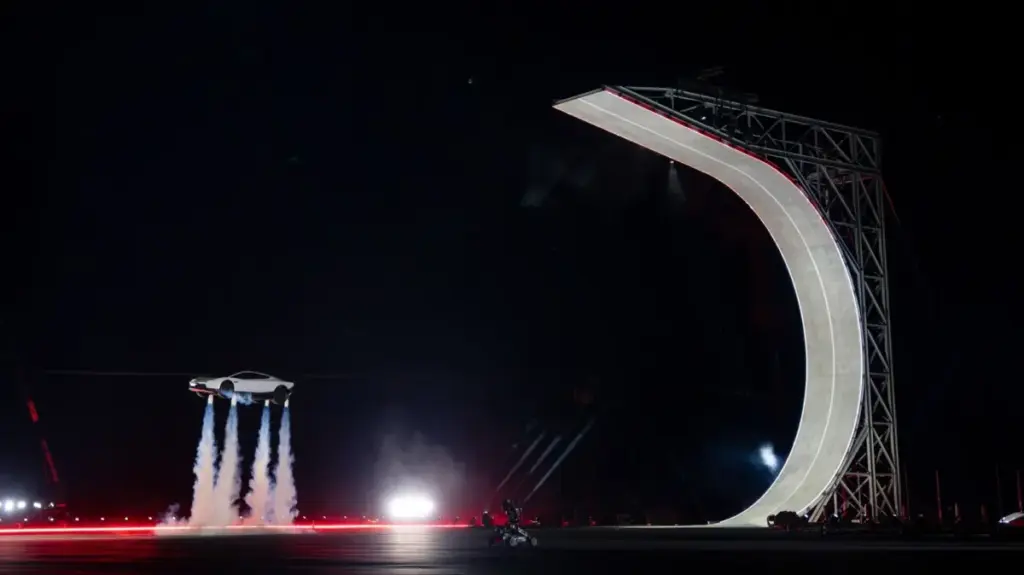
Thrusters are proving to be just as capable of flipping high-end sports cars as they are of hunting down ballistic missiles in the upper atmosphere.
When Tesla formally reintroduced its long-delayed and eagerly anticipated Tesla Roadster during an event, it brought a heavy dose of futuristic spectacle. Alongside a striking, angular design reminiscent of the company’s Cybertruck and a blistering claimed zero-to-sixty acceleration of under one second, Tesla dropped a major surprise: the vehicle would have the capability to fly.
Of course, this does not mean the Roadster will hover gracefully through traffic like the iconic flying DeLorean from Back to the Future Part II. Instead, the car achieves its airborne feats through a carefully orchestrated series of controlled falling, jumping, and flipping maneuvers enabled by advanced propulsion hardware. While the concept has captured the imagination of automotive enthusiasts and tech commentators alike, the underlying technology is not entirely unique to Tesla. In fact, experimental military missile defense systems have featured remarkably similar uses of compressed-gas and propulsion thrusters since the early 2000s, stemming from research into concepts now known as Multiple Kill Vehicles, or MKVs.
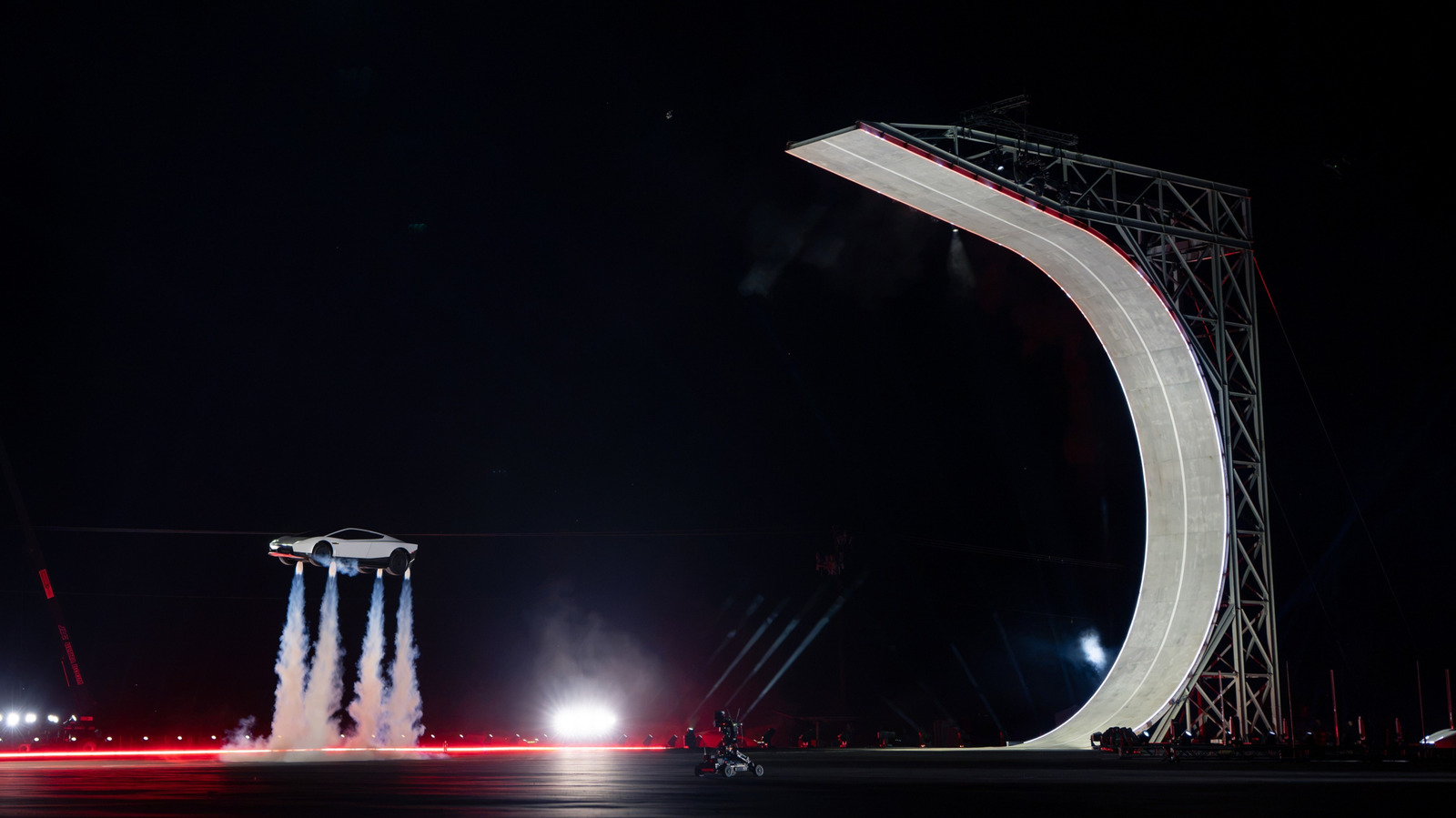
According to Tesla’s specifications for the vehicle, the supercar is able to pull off its dramatic maneuvers thanks to an intricate system comprised of two high-pressure air tanks and ten distinct nozzles strategically placed throughout the body of the car. These nozzles fire off compressed air in rapid bursts to dynamically shift, move, and stabilize the vehicle during extreme driving scenarios. Tesla has indicated that the Roadster will possess the capability to refill those high-pressure tanks autonomously, though the full, uncompromised thruster setup will only be available on the highest-tier "Rocket" trim of the car. Meanwhile, the lower-tier "Thruster" trim will feature thrusters limited exclusively to the rear of the vehicle, and the base "Performance" trim will omit the system entirely. Furthermore, Tesla has explicitly noted that these high-powered thrusters are currently not approved for public road use, meaning drivers will likely only experience these aerial capabilities in closed-course environments.
This reliance on rapid-fire directional thrusters for precise in-air maneuverability bears a striking resemblance to defense technology developed decades ago. Lockheed Martin’s MKV project began in earnest in 2004, following a significant $760 million contract awarded to the defense contractor by the United States Missile Defense Agency. The overarching goal of the military initiative was to construct the first operational system capable of identifying, tracking, and destroying multiple incoming ballistic missile threats and sophisticated decoys using a single launch platform. That military system was designed to carry several smaller, highly agile kill vehicles that would use kinetic force to smash directly into incoming enemy warheads, obliterating them mid-flight. To achieve the necessary precision in the chaotic environment of the upper atmosphere, these interceptor vehicles relied heavily on onboard thrusters capable of instantly altering their trajectory, orientation, and heading on the fly—operating under principles very similar to those driving Tesla’s modern supercar concepts.
Finding clear, verifiable footage of the MKV system in action remains a challenge for researchers and military historians alike. The overarching concept of deploying a single missile defense platform capable of neutralizing multiple targets simultaneously has roots stretching all the way back to the Reagan-era Strategic Defense Initiative, a Cold War missile defense initiative popularly known by the moniker "Star Wars." While various online video clips purport to show Lockheed Martin’s MKV hardware undergoing testing, similar archival footage has frequently been linked to the broader historical efforts of the Strategic Defense Initiative. Compounding the historical overlap, Lockheed Martin itself was formed through a corporate merger in 1995, meaning any technical demonstrations attributed to the company prior to that year involve earlier predecessor entities. Regardless of the exact corporate lineage, the underlying concept was actively pursued by Lockheed Martin and rival defense contractor Raytheon through separate development tracks until the original MKV program was ultimately retired in 2009 as part of broader federal military budget cuts and shifting strategic defense priorities.
Beyond their vastly different intended applications—transporting affluent consumers on the ground versus intercepting intercontinental ballistic missiles in the stratosphere—the Tesla Roadster and the historical MKV platform also feature a fundamental technical distinction regarding how their respective thruster systems operate. Tesla has remained adamant that the Roadster relies entirely on cold-gas thrusters utilizing compressed air. This means the system does not involve combustion, burning fuel, or creating high-temperature chemical reactions to propel or stabilize the vehicle. In contrast, historical documentation from Lockheed Martin, including a 2008 press release detailing propulsion component testing for the Missile Defense Agency, indicates that the MKV utilized "hot-fire tests." These tests strongly suggested that parts of the military system relied on burning chemical propellants for rapid maneuvering thrust. Given that neither technology is currently commercially available for everyday consumer ownership, drawing direct comparisons is complex, though Tesla’s compressed-air approach is inherently less combustible and far safer for automotive integration.