

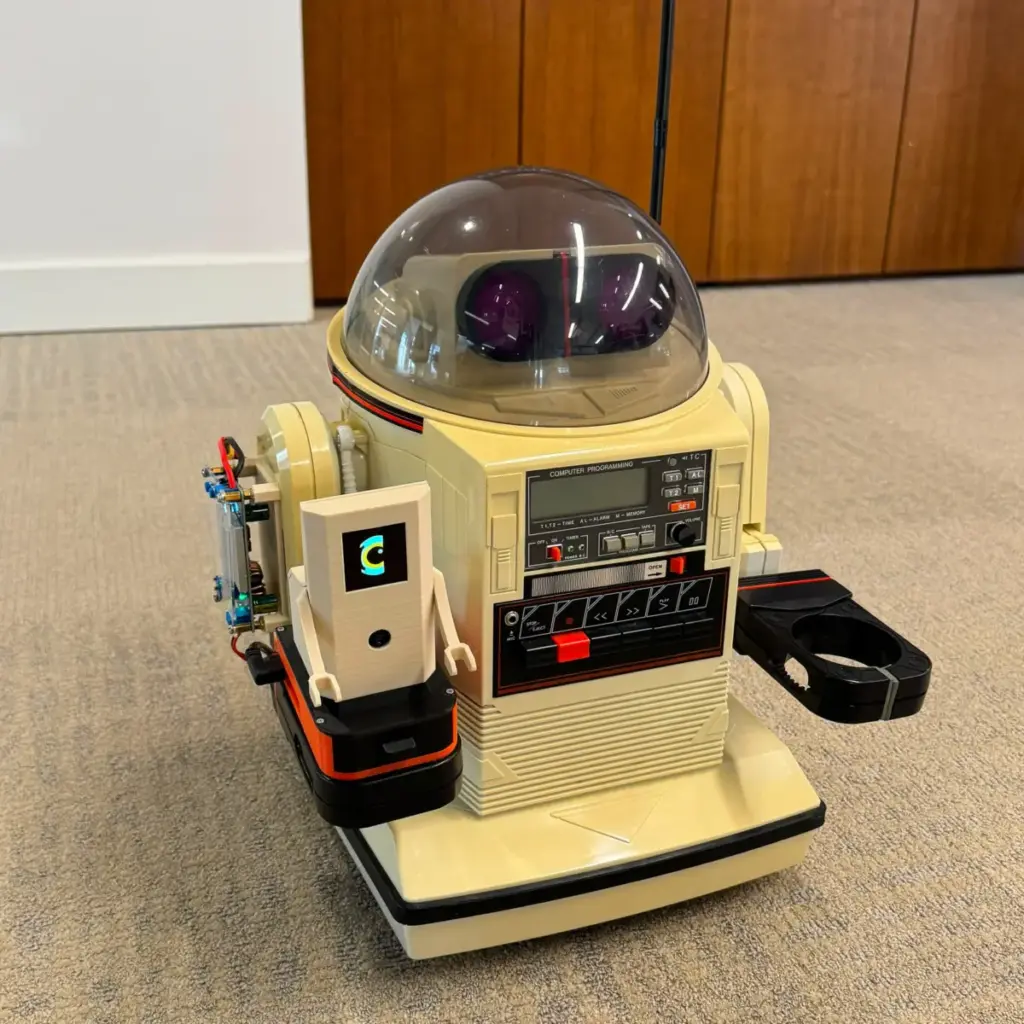
On a workbench inside the Moonlighter FabLab in Miami, a white plastic robot originally manufactured during Ronald Reagan’s first term sits quietly, its smoked-plastic dome immediately evoking the classic aesthetics of 1980s sci-fi culture. This is a vintage Tomy Omnibot, a relic from 1984 that stands roughly two feet tall and features tank-style treads, a built-in serving tray, and a design language that once defined the ultimate domestic dream. Yet, this particular unit is no longer just a static museum piece. Mounted securely to one of its arms is a newly minted, custom-built 3D-printed companion featuring a single glowing cyan eye that blinks, tracks movement, and breathes new life into a decades-old machine.
During a recent demonstration, a nearby monitor displayed real-time tracking data of a laptop across the room, registering its status as the Omnibot gently leaned forward on its drive wheels. Through a small Bluetooth speaker nestled inside the robot’s chest, a synthesized voice announced its success: "I found it." The robot had successfully located the object from across the room without any prior knowledge of its specific location, bridging a forty-year gap between retro hardware and modern artificial intelligence.
A Promise from 1984
When Japanese toy manufacturer Tomy introduced the Omnibot in 1984, the company marketed it as an accessible domestic robot of the future. Retailing for around $600 at the time—equivalent to roughly $1,800 today—the machine could be operated via remote control, play cassette tapes, record and playback messages, and, in promotional materials, deliver a can of beverages on its integrated tray. Several hundred thousand units were sold globally, but very few survived the decades intact. Leaking alkaline batteries frequently destroyed internal electronics, while vintage rubber wheels deteriorated and crumbled over time, causing the grand vision of a household robot butler to fade away.

This particular Omnibot arrived at the Miami maker space as a donated gift, stored inside a box alongside various loose components. Its printed circuit board (PCB) was covered in the crystalline white residue characteristic of severe battery acid corrosion, a sight well-known to vintage electronics restorers. The accompanying remote control was in a similarly degraded state, with several conductive traces completely eaten through. Reviving the forty-year-old logic boards required extensive cleaning with isopropyl alcohol, careful scrubbing, and tedious soldering work.
Once power was finally restored to the system, the internal motors hummed back to life, allowing the Omnibot to take its first successful drive in roughly thirty years. However, the vintage rubber tires immediately disintegrated upon touching the floor, highlighting the physical toll of decades of storage. While the internal mechanical components had suffered, the outer plastic shell remained remarkably well-preserved.
The Restoration That Wouldn’t Stop
The initial goal for the project was straightforward: neutralize the battery corrosion, 3D-print replacement tires, clean up the original cassette mechanism, and consider the restoration complete. However, restoration projects frequently expand beyond their initial boundaries. For this project, the turning point arrived during research into how the original cassette deck functioned. The machine relied on specific audio frequencies recorded on magnetic tape to translate into motor commands, such as 1614Hz for forward motion, 2208Hz for turning left, and 1422Hz to toggle an internal relay routing audio to the onboard speaker.

This mechanism revealed an underlying command language encoded entirely in simple sine waves, suggesting that the robot could theoretically be driven from any external audio source, including a wireless Bluetooth connection. To test this hypothesis, a Bluetooth cassette adapter was inserted directly into the deck, accompanied by a custom script running on a Raspberry Pi to synthesize and stream the necessary audio tones on the fly. Soon, the Omnibot was rolling across the floor under wireless computer control, bringing a momentary illusion that the technological era of 1984 had never truly ended.
Rather than stopping there, the project incorporated a compact, affordable AI camera module to explore autonomous navigation capabilities.
Meet Ring-O
To handle the physical integration of modern computing hardware, the creator collaborated with Placitech, a Miami-based maker specialized in mechanical design. The objective was to construct a secure, well-ventilated enclosure capable of housing a Raspberry Pi 5, an advanced camera module, a cooling fan, a compact OLED display, and a dedicated battery pack, all while resting cleanly atop the Omnibot without damaging its vintage aesthetic.

The resulting creation was dubbed Ring-O, a small companion robot featuring a round body, stubby arms, and a prominent single glowing eye reminiscent of a modern smart doorbell merged with cinematic robot characters. Ring-O does not handle the physical locomotion itself; instead, it processes visual data, runs onboard neural networks, and communicates verbally, leaving the heavy lifting of rolling across the floor to the underlying Omnibot chassis. Despite this division of labor, the addition of Ring-O fundamentally transforms how people interact with the device, drawing immediate attention to its expressive, tracking pupil rather than the vintage control visor.
Navigating Software Challenges and Architecture
Integrating modern artificial intelligence with vintage hardware presented significant technical hurdles, particularly regarding software architecture. The initial setup relied on a cloud-hosted large language model to process live video frames from the camera, reason about the environment, and return directional commands. The vision hardware itself performed efficiently, running a specialized neural network directly on its own silicon to recognize everyday objects at approximately thirty frames per second without consuming host CPU resources.
However, piping these detection metadata streams into a fast cloud-hosted language model produced unexpected results. Regardless of where a person was positioned within the camera’s field of view, the model repeatedly returned identical directional commands to turn right, causing the robot to spin endlessly in place while introducing a frustrating fifteen-second latency that rendered real-time tracking impossible.

Recognizing the limitations of generative language models for rapid mathematical reasoning and spatial calculations, the developer removed the complex prompt engineering layers and replaced them with basic arithmetic rules comparing coordinate values. This straightforward approach instantly delivered fast, accurate navigation decisions every single time. The language model logic was repurposed for a different task: translating recognized object labels into spoken descriptions when visitors prompt the robot to describe its surroundings.
Additional debugging efforts were required to align the vision system’s coordinate mapping. Discrepancies between normalized bounding box outputs, display resolutions, and camera padding layers initially caused visual tracking boxes to appear in inaccurate locations or render invisibly. Implementing precise scaling calculations quickly resolved the issue, ensuring that on-screen tracking boxes accurately followed recognized objects in real time.
Interactive Design and Public Deployment
To make the technology accessible to a wider audience, particularly younger visitors, a specialized arcade-style web interface was developed. Featuring retro cathode-ray tube scanlines, synthwave visual grids, and pixel fonts reminiscent of classic video games, the interface provides large, colorful buttons allowing users to command the robot to find specific objects, execute pre-programmed dance routines, or describe its environment out loud.

A crucial design element contributing to the robot’s appeal is Ring-O’s expressive eye, displayed on a small color OLED screen. Running on an independent thread, the eye dilates, smiles, widens in surprise, and blinks periodically to simulate life, entering a sleep mode after prolonged inactivity. This design choice transforms the device from a mere sensor package into a recognizable character that prompts organic social interaction from observers.
Preparing the robot for a public exhibition required rigorous system hardening to ensure stability during long operating hours. Developers implemented automated service restarts, pre-launch diagnostic checks for camera and audio subsystems, robust error handling for unexpected user inputs, and background polling for wireless connectivity to prevent user interface freezes. These reliability measures ensured the machine remained fully operational throughout public events.
The completed project made its public debut at Maker Faire Miami, where the retro-modern hybrid successfully drew crowds and demonstrated how decades-old hardware can find new purpose through contemporary open-source technology. The complete source code and documentation for the Omnibot and Ring-O integration project have been made publicly available on GitHub for fellow makers and enthusiasts.