Walking the corridors of Industrial Light & Magic (ILM) means being surrounded by living history. Everywhere you look, there are tangible examples of groundbreaking visual effects work from cinematic milestones like Star Wars, Jurassic Park, and Terminator 2. Because extraordinary props and artwork are simply part of the daily scenery, a towering, floor-to-ceiling poster of Darth Vader recruiting for the Imperial army blends right into the background. And that is precisely the point. When no one is looking, sliding behind that massive poster reveals a hidden Rebel Hideout built deep behind enemy lines.
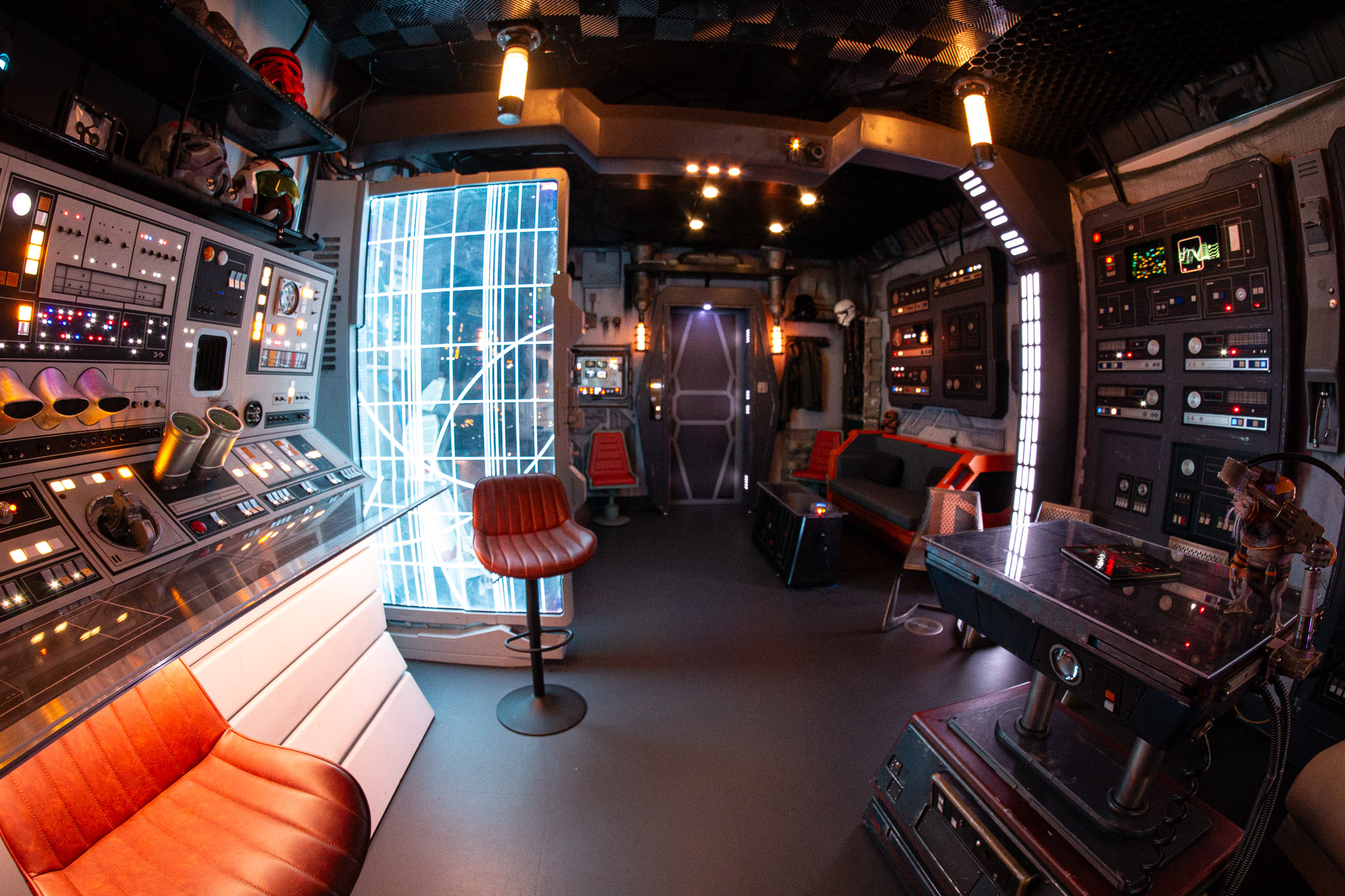
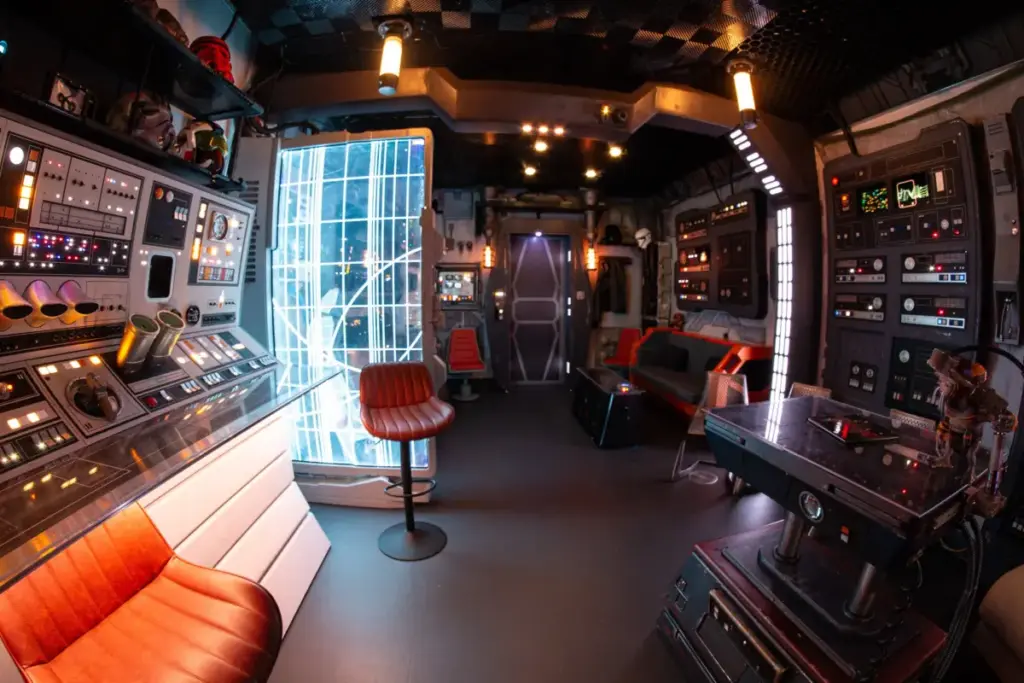
Stepping into the Hideout feels like stepping directly onto a functioning Star Wars set. In literal ways, you actually are. A classic yellow title crawl greets newcomers, explaining the specific narrative slice of the universe they have just entered. Authentic ambient engine sounds, pulled straight from actual production libraries, hum continuously in the background, and nearly every physical object you see or touch originated from an actual film set.
A Long Time Ago
The creation of the theme lounge was a labor of love that took decades of quiet determination. Staff R&D engineer Mike Jutan and Head of Computer Graphics Michael DiComo had pushed for a dedicated themed space for years. They never abandoned hope, but it ultimately took the disruptions of a global pandemic to finally get the project off the ground.

The build was integrated somewhat covertly into an office remodeling project. Occasionally, curious colleagues would look over the architectural blueprints and wonder why a standard conference room required such unusual specifications—or why it needed a sink. Fortunately, no one stopped them, and a passionate grassroots team of employee-fans stepped up to turn a dream project into reality.
It Takes a Team
The Rebel Hideout is the collective achievement of numerous ILM employees working far outside their formal job descriptions. Systems engineer Trent Bateman figured out the complex electronics alongside Tim Dobbert and engineered the underlying software. Bateman, Paul DeBaun, and former AV design engineer Greg St. Germain collaborated to bring the immersive sound system to life. R&D engineer David Hirschfield recalls the pivotal moment when the audio was first tested: “There was a day when they turned on the soundtrack, and everybody in the room was like, oh my God, it just came to life.”

None of these contributors were professional prop builders by trade; they were passionate fans working on a monumental hobby project during their spare time. Former workplace services specialist Kyle Johnson provided vital logistical support by securing access to an on-campus workshop, granting the team the space and heavy tools—such as table saws, drill presses, and painting stations—needed to fabricate the environment. While other tech companies feature secret doors that open into standard, boring conference rooms with conventional office furniture, the ILM crew knew they wanted their lounge to be something entirely different.
Where to Begin?
With the expansive Star Wars universe encompassing hundreds of hours of storytelling media, selecting a specific setting was an intimidating task. Deciding between a classic Rebel base, a seedy cantina, or an Imperial starship felt overwhelming until the team received an unexpected call from the Lucasfilm archives. The message was simple: the archives had a surplus of practical set pieces from recent productions and wanted to know if anyone wanted them before they were discarded.

Practical sets take up enormous amounts of storage space, making it impractical to retain every single prop and physical asset created for a film. After productions wrapped on Rogue One: A Star Wars Story, Andor Season 2, Solo: A Star Wars Story, and Star Wars: Episode IX – The Rise of Skywalker, the archives found themselves with items like leftover Ghorman computer terminals and no immediate plans to reuse them. They provided the team with a vast PDF catalog filled with technical descriptions and low-resolution thumbnail images. It was an overwhelming goldmine, shifting the primary challenge from what to invent to what to leave out.
The team reviewed the photographs, estimated scales, and requested about 30 different pieces. They ultimately secured the Millennium Falcon’s navigation console from Solo, radar screens from Rogue One, and a repurposed vending machine they affectionately dubbed "Admiral Snackbar." The available practical pieces naturally established the room’s dramatic setting within the original trilogy era, blending a gritty mix of Rebel and Imperial hardware.

Kitbashing and Practical Retrofitting
The replica makers at Regal Robot were initially brought in to construct custom furniture, such as a Millennium Falcon holochess table. However, once the influx of authentic production props arrived, their role evolved into curating the collection, validating the interior design, and guiding the team on how to weather surfaces that looked too pristine. Senior Look Development Technical Director Rebecca Forth led a team of volunteers who coated clean surfaces and props in a layer of authentic, lived-in grime.
Storytelling dictated every layout decision. Furniture was only included if it served a narrative purpose within the universe. To visualize the space before physical construction, the team created a virtual layout to test arrangements quickly. They were determined to avoid a standard conference room merely decorated with merchandise; they wanted an authentic hideout ripped straight from the galaxy far, far away.

Many props required extensive retrofitting. Built originally for just seconds of screen time, many pieces arrived with dead LEDs, broken switches, or unlabeled wires. Everything had to be reverse-engineered and repaired. The entryway received an entirely new facade to disguise its standard Earth-door shape, complete with a proximity-sensor "intruder detector." Structural safety and accessibility requirements were strictly maintained, including keeping pathways 36 inches wide—even if it meant cutting a couch in half—while blending safety features like fire sprinklers into blast-hole ceiling aesthetics.
It’s All in the Details
The room functions as an interactive experience rather than a static display. Switches activate real components, sliders trigger unexpected reactions, and the entrance door occasionally forces the hideout into a dramatic "red alert" state. Every networked light, button, and speaker is managed by custom hardware.

The coffee table, for instance, turns out to be Babu Frik’s workbench from Episode IX. Upon taking it apart, the team discovered it was built around a wheelchair base. Principal graphics engineer Lutz Latta tracked down the German instruction manual, integrated radio control, and initially tested it at top speed before narrowly avoiding a colleague’s toe. They dialed the speed down significantly to ensure safe drink delivery during gatherings.
The entire lounge required about a year of development, culminating in an intense six-month push of physical construction during the day while maintaining regular ILM workloads at night. They celebrated their success by hosting an opening party on Star Wars Day, May 4, 2024.

Behind the Scenes and Electronics
Lighting panels, video displays, and sound effects are centrally commanded by a Mac Mini running QLab software. Because purchasing off-the-shelf development boards for every prop would have been prohibitively expensive, the team designed their own custom printed circuit boards (PCBs) with the assistance of the ILM Electronics Club. After multiple iterations, they produced modular boards supported by daughter boards, allowing panels to communicate via Open Sound Control (OSC) and daisy-chain up to ten units safely.
Easter eggs are hidden throughout the environment. Unlabeled controls allow users to transform navigation consoles into synthesizers or jukeboxes, trigger party modes, or play integrated wall trivia. Even chrome handles salvaged from Solo—which appeared deceptively small in reference photographs—were successfully retrofitted with inexpensive accelerometers to provide reliable angle detection without complex mechanical gears or pulleys.

All Aboard Calypso
While the Rebel Hideout is a remarkable achievement, it is technically not the oldest theme room at ILM. Near the Hideout lies a door marked by a wooden cephalopod, leading to Calypso, a pirate captain’s quarters set within a wrecked, beach-stranded ship.
Originally designed in 2012 by Steven Knipping at Pacific Data Images (PDI) and built by the CFX team, the room was transitioned to Visceral Games when PDI closed. When Visceral subsequently shut down after working on EA’s Star Wars projects, the room entered corporate storage. Following the triumph of the Rebel Hideout, Knipping helped reconstruct Calypso within a nearby conference room at ILM.

Because ILM worked extensively on the first four Pirates of the Caribbean films, the room features genuine screen-used props, including yardarms from miniature model ships, a full-size anchor, and walls lined with cannon gunport lids. Non-screen-used production assets are also present, such as a striking Davy Jones bust used for lighting calibration during filming, alongside a barnacle-covered skeleton salvaged from Indiana Jones and the Dial of Destiny.
Unlike the strictly immersive Rebel Hideout, Calypso features a functional table layout suited for traditional meetings, even when immersive lighting and audio effects are turned off. Future expansions plan to add dynamic cove lighting mimicking day and night cycles, a projection-mapped Davy Jones bust, and windows displaying distant burning horizons.

Ultimately, these immersive spaces at ILM were forged not by professional studio set designers, but by dedicated employees and lifelong fans who believed that creative workspaces foster extraordinary creative output.