



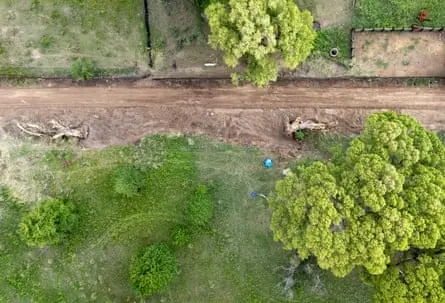
A 200-year-old cottonwood tree near the US-Mexico border, affectionately known by environmental activists and local residents as the "grandmother," has been cut down to make way for the construction of Donald Trump’s expanding border wall. The destruction of the ancient tree brings a dramatic and heartbreaking close to a months-long campaign by land defenders and protesters who fought desperately to protect the fragile riparian ecosystem in the remote desert borderlands.
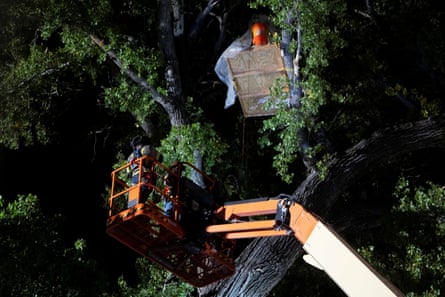
The conflict reached its climax when more than 80 federal agents swarmed a protest camp located on private land in the historic ghost town of Lochiel, Arizona. The raid, executed at dawn, resulted in multiple arrests and blocked supporters from reaching the perimeter of the cottonwood. According to eyewitness accounts, photographs, and videos shared extensively on social media, federal agents operating a steel basket on an extendable crane lift forcibly removed the final remaining protester from a platform high within the tree’s canopy. Other demonstrators were shoved and tackled as they attempted to rush toward the tree in a last-minute effort to prevent its destruction.
Following the clearance of the area, contractors working for Fisher Sand and Gravel—the firm contracted to build this specific section of the border barrier—used an excavator to push over the massive cottonwood. The ancient tree cracked and crashed heavily to the earth, prompting shrieks, tears, and shouts of anguish from the gathered land defenders.
Erick Meza, the Sierra Club’s Borderlands coordinator, who spent months attempting to negotiate with US Customs and Border Protection (CBP) to save the trees, expressed the profound grief felt by the community. Seeing the destruction firsthand, he noted, crushes the human heart. He added that the tree had successfully brought a diverse group of people together, and its loss has ignited widespread community outrage and deep frustration.

Controversy also surrounded the presence of a team from Turning Point USA, a far-right political group, whose members filmed the toppling of the cottonwood. Observers noted that the media crew appeared to be embedded directly with border patrol personnel and was granted unusual, free access to roam throughout public roads that had been officially closed off to the general public and independent journalists.
The destruction of the Lochiel cottonwood is part of a broader, highly contentious push to fortify the southern border through southern Arizona’s scenic landscapes. The tree-sit originally began in late July, shortly after contractors knocked over and killed three other ancient cottonwood trees nearby. Protesters subsequently established a continuous occupation, taking turns living on a wooden platform high in the canopy for more than 70 days to delay construction activities.
We Are Starting a Movement
The standoff extended beyond the primary tree. Another land defender had scaled a second ancient cottonwood situated directly on the international border with Mexico. Over several days, CBP officers and Mexican police—who have maintained a visible presence and coordinated closely with American authorities—intervened. They removed the protester’s platform along with vital food and water supplies. Deprived of provisions for several days, the tree-sitter ultimately climbed down of their own accord late on Friday evening.
Federal personnel involved in the operations included standard border patrol officers as well as the Border Patrol Tactical Unit (Bortac), a specialized tactical force whose self-described mandate includes responding to high-level terrorist threats.
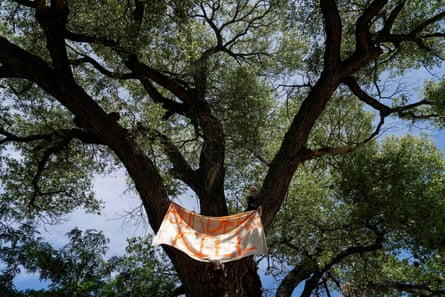
The developments have unfolded across the San Rafael valley, a remote, high-elevation prairie historically celebrated for its idyllic scenery and as the filming location for the classic movie Oklahoma. Flanked by the Patagonia and Huachuca mountains, the valley represents one of the most critical regional wildlife corridors connecting the United States and Mexico. Conservationists emphasize that this ecological highway provides essential passage for endangered and vulnerable species, including jaguars, ocelots, bears, beavers, and porcupines.
Government contractors have already completed 88 miles of secondary wall—a second 30-foot fence erected at a distance parallel to an existing primary wall of the same height. According to the Department of Homeland Security (DHS), another 444 miles of secondary wall are currently under active construction, largely concentrated in Arizona and funded by billions of dollars allocated under Trump’s One Big Beautiful Bill Act.
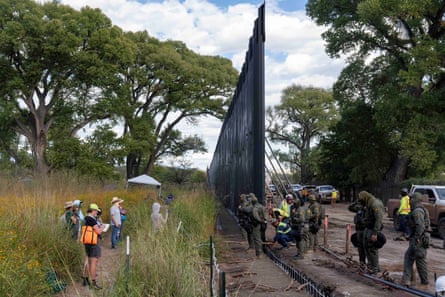
Construction throughout the valley has proceeded rapidly, with work operating around the clock. In recent days, Fisher Sand and Gravel completed sections of the secondary wall directly adjacent to the private property hosting the protest camp, driving 30-foot steel panels into trenches filled with rebar and cement right up to the spot where the grandmother tree once stood.
Environmental advocates point out that cottonwoods rely heavily on stable underground water tables, making them a cornerstone of riparian forests, which are considered an endangered ecotype across Arizona and the American south-west. Russ McSpadden, an advocate with the Center for Biological Diversity, highlighted the irreplaceable ecological value of these trees as a primary motivation driving the land defenders’ resistance.
Concerns have also been raised regarding the immense water consumption required for border wall construction. Heavy water usage has depleted aquifers and threatened natural desert oases throughout the region, including Quitobaquito Springs. While CBP does not publicly disclose the exact water volume utilized for current construction projects, a 2008 DHS environmental assessment estimated that a smaller wall nearby could consume up to 710,000 gallons of water per mile of construction, suggesting that the current, larger-scale project demands even greater resources.
In the days following the tree’s felling, dozens of land defenders have been arrested, many for stepping onto the road between the private property and the border—a thoroughfare ordered closed by federal authorities in late September specifically to facilitate wall construction. Despite the closures, activists have continued gathering in the roadway every morning to hold sunrise prayers near the stump. Chabbott and other participants alleged that several arrested individuals experienced physical roughness from officers, resulting in bruises and black eyes.
Other activists have resorted to creative, nonviolent civil disobedience to delay the heavy machinery. On August 7, a female protester locked herself to the chassis of a cement truck on the site. Witnesses and social media footage documented that the activist was sprayed in the face with mace, wrestled by multiple agents, and subjected to painful limb holds before the truck was driven away with her still attached. She was later cut free by emergency responders and placed into custody.
The incident drew international attention, including condemnation from environmental activist Julia Butterfly Hill, who famously spent two years living in a redwood tree in California’s Humboldt County during the late 1990s. Butterfly Hill stated that she was horrified by the livestreamed footage of the border patrol’s treatment of the protester, describing the woman’s courage and dedication to nonviolent resistance as deeply moving and heroic.
Neither CBP nor Fisher Sand and Gravel responded to requests for comment regarding the clashes or the tree’s removal. However, CBP has consistently maintained that physical barriers are necessary to deter unauthorized immigration and enhance border security. Conversely, local law enforcement has previously questioned the necessity of the project; Santa Cruz County Sheriff David Hathaway has publicly described the wall’s placement in the remote valley as senseless, noting the area has no history of significant illegal cross-border activity.
Elected officials have also begun pushing back against the federal strategy. During an October 8 press conference, US Representative Adelita Grijalva, who represents the district, expressed deep sorrow over the loss of the ancient trees and announced her intention to introduce legislation that would strip the DHS of its sweeping authority to waive federal environmental and cultural laws during border infrastructure projects.
For the activists on the ground, the fall of the grandmother tree has not extinguished their resolve. Kate Scott, one of the leaders of the tree-sit movement, emphasized that the actions of federal agents and contractors are intended to break their spirits, but have instead solidified their determination.
"We are starting a movement, and we’re not going anywhere," Scott said. "We are rooted, like the grandmothers."