In the third episode of “South Park” Season 29, titled “You Like That On Your Face,” creators Trey Parker and Matt Stone deliver another biting piece of contemporary satire. This week’s storyline plunges the show’s chaotic mountain town—recently and permanently renamed South America—into the bizarre realms of internet brainrot, hyper-fixated beauty retail culture, and the deeply modern concept of "aura battles." The latest installment features everything from the gang getting trapped in the ominous "backrooms" of a Sephora to Stan’s father, Randy, shrinking to miniature size after experimenting with skincare products.
As Season 29 presses forward, Parker and Stone continue to show no signs of slowing down, leaning heavily into current online vernacular. Throughout the episode, viewers are bombarded with a non-stop barrage of internet lingo, including terms like “mogging,” “maxxing,” “mewing,” “chad,” “cringe,” and “rizz.” These modern colloquialisms form the bedrock of the episode’s central conflict, which revolves around a high-stakes, live-streamed aura battle at the local school.
The narrative kicks off as Kyle struggles to help his younger brother, Ike, prepare for a digital aura showdown against a formidable opponent named Chad. Kyle, showing his characteristic voice of reason, finds himself deeply skeptical of the entire endeavor. Viewing the fusion of aura battling and looksmaxxing as an inherently flawed enterprise, Kyle’s overt concern renders him largely unhelpful to his anxious little brother, who is desperately trying to secure internet clout and social dominance at school.
Fortunately for Ike, unexpected assistance arrives in the form of Eric Cartman, who steps in with a surprisingly supportive demeanor. In a classic display of situational irony, Cartman adopts a comforting tone while addressing Ike’s pre-battle nerves. Empathizing with the young boy, Cartman remarks that deep down his brother likely wants to help out, even if he simply lacks the capability. Pondering aloud, Cartman adds that if he had a younger brother of his own, he would treat him as his special little guy.
To help Ike get properly prepared, Cartman guides him straight into a local Sephora. The retail destination has completely been overrun by the town’s youth, serving as a direct and biting nod to the viral internet phenomenon and ongoing cultural joke about tweens spending an excessive amount of time browsing beauty stores. The absurdity of the location is underscored by a beleaguered man sitting outside the storefront, who observes that something fundamentally unnatural is happening inside. He recounts how his granddaughter initially asked to visit a clothing store before requesting a quick stop at Sephora, only for six and a half years to pass. In his exhausted view, the beauty chain harbors forces that ordinary men simply cannot comprehend.
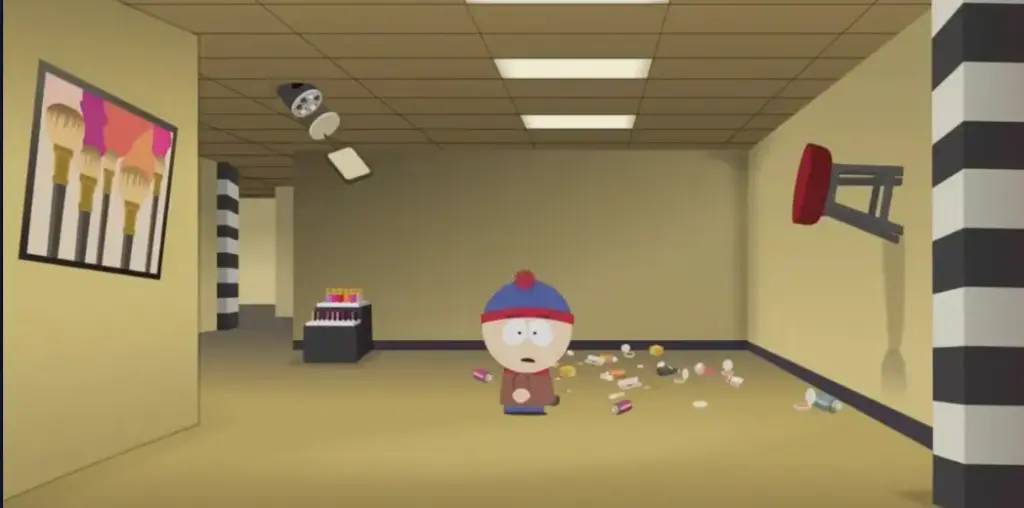
Once inside the sprawling temple of cosmetics, Cartman and Ike find themselves enticed by an employee to venture deep into the store’s hidden "backrooms." These labyrinthine, yellow-wallpapered corridors look straight out of the internet horror lore popularized by creator Kane Parsons. Fortunately, Stan had wandered into the same uncanny backrooms earlier in the episode. Armed with this knowledge, Stan manages to rescue both Cartman and Ike just in time before Ike’s scheduled aura battle begins.
However, all the frantic rescue efforts ultimately prove to be for naught. Despite escaping the Sephora maze, Ike still fails to secure a victory in his live-streamed aura battle. The saving grace—or rather, the chaotic interference—comes from an entirely unexpected source. Randy Marsh, Stan’s father, had earlier experimented with the beauty chain’s products and shrunk down to the exact size of his son. Forced to re-enroll in school due to his miniature stature, Randy takes matters into his own hands and physically beats up Ike’s opponent. The intervention effectively destroys the rival’s meticulously crafted, looksmaxxed face, bringing a violent and chaotic end to the digital dispute.
Notably, this week’s episode completely omitted any references to Donald Trump. The commander-in-chief has featured far less prominently in Season 29 compared to the previous season, which heavily focused its satirical lens on the president’s absurd antics. Viewers of the last season will recall outlandish plotlines such as JD Vance attempting to seduce Donald Trump as a convoluted maneuver to dodge punishment for trying to abort his unborn baby with Satan, among a long list of equally surreal political sketches.
Instead, Season 29 has charted a different comedic course, exploring a wide array of bizarre cultural touchstones since its premiere last month. The season opener focused on Cartman, Stan, Kyle, and Kenny developing a sudden, obsessive love for e-bikes. Meanwhile, the second episode delivered a deeply eccentric narrative as Butters embarked on a mission to rid South America of what he termed "billionaire weenies." These objects turned out to be literal penises alongside data centers that were causing massive disruptions to the region’s electricity supply.
That same episode also took direct aim at anti-vaxxers. When Butters’ parents discover his bizarre anti-billionaire and AI-driven beliefs, they immediately point the finger at the measles vaccine he received as a child. In a rant that highlights the show’s satirical view of modern media consumption, Butters’ father yells that he knew precisely what the vaccination would do to his son because he listened to podcasts, while blaming his wife for not making time to listen to podcasts herself and ultimately turning their son into a liberal.
With the rollout of Season 29, creators Trey Parker and Matt Stone are committing fully to the town’s new "South America" moniker. The geographical rebranding was officially announced earlier in the month just ahead of the season premiere. The first episode—marking the historic milestone of the town taking on its new name—drew an impressive 4.2 million viewers within its first three days, according to ratings data previously reported by Variety. As Parker and Stone continue to push boundaries with contemporary cultural critiques, the latest episodes demonstrate that the long-running animated series remains firmly dialed into the pulse of internet culture, generational trends, and societal absurdity.