




Determining an appropriate diet for a Samoyed requires looking beyond generalized breed stereotypes and historical working roles. While the breed’s arctic heritage as sled dogs and herders suggests a high capacity for endurance and energy expenditure, an individual dog’s true caloric requirement depends far more on its immediate daily routine, current life stage, weight, and body condition score. A working ancestry alone does not serve as a fixed mathematical multiplier for daily food portions.
A successful dietary plan relies on connecting recipe labeling and caloric density directly to measured daily meals, backed by regular, objective physical assessments. Evaluating
four specific fresh-food formulations from JustFoodForDogs illustrates how recipe selection and portion calculations can be customized for different Samoyed lifestyle profiles, providing a framework for adjusting feeding routines whenever a dog’s environment or activity levels shift.
What Food Do Samoyeds Eat?
Like all domestic dogs, Samoyeds require complete and balanced nutrition tailored to their specific life stage and health profile. Whether fed dry kibble, canned wet food, or gently cooked fresh recipes, nutritional adequacy remains the primary baseline. However, choosing the appropriate food format begins with assessing the specific animal rather than relying solely on generic brand claims.
A growing Samoyed puppy undergoing rapid skeletal development has vastly different nutritional demands than an adult dog whose daily exercise consists of gentle neighborhood walks, or a working dog engaged in prolonged athletic performance. A sound nutritional recommendation must evaluate both the specific recipe composition and the precise daily quantity being fed.
According to veterinary standards, evaluating dog food requires looking beyond appealing ingredient lists on packaging. Nutritional adequacy statements, certified life-stage testing, and precise caloric information provide the practical foundation for designing an appropriate meal plan.
Four JustFoodForDogs Choices for Samoyed Feeding Routines
Comparing fresh-food recipes requires examining their specific caloric densities, ingredient compositions, and regulatory adequacy statements. Within the JustFoodForDogs product line, four popular formulations demonstrate how caloric density and nutritional certification vary significantly across options intended for different life stages and household needs.

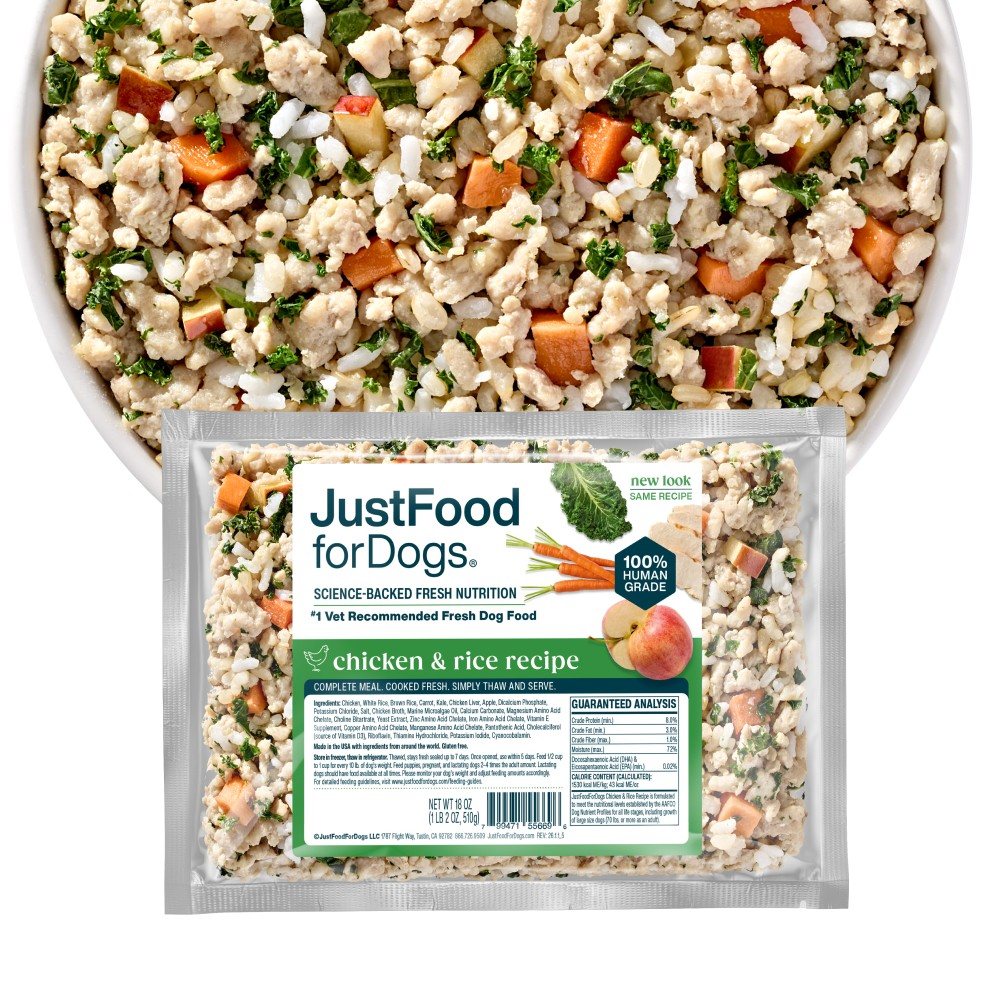
JustFoodForDogs Chicken & Rice
The Chicken & Rice recipe is a fresh-frozen, grain-inclusive option formulated for all life stages, including the growth of large-breed dogs expected to weigh 70 pounds or more as adults. Containing a blend of chicken, white rice, and brown rice, the recipe provides a caloric density of 1,530 kilocalories per kilogram, which translates to 1.530 calories per gram.
Because this formula is qualified for all life stages, it can support a Samoyed puppy through growth and remain appropriate as the dog reaches maturity. However, as the animal completes its skeletal development and enters adulthood, the required daily food amount must be recalculated to prevent unnecessary weight gain, even though the product itself remains identical.
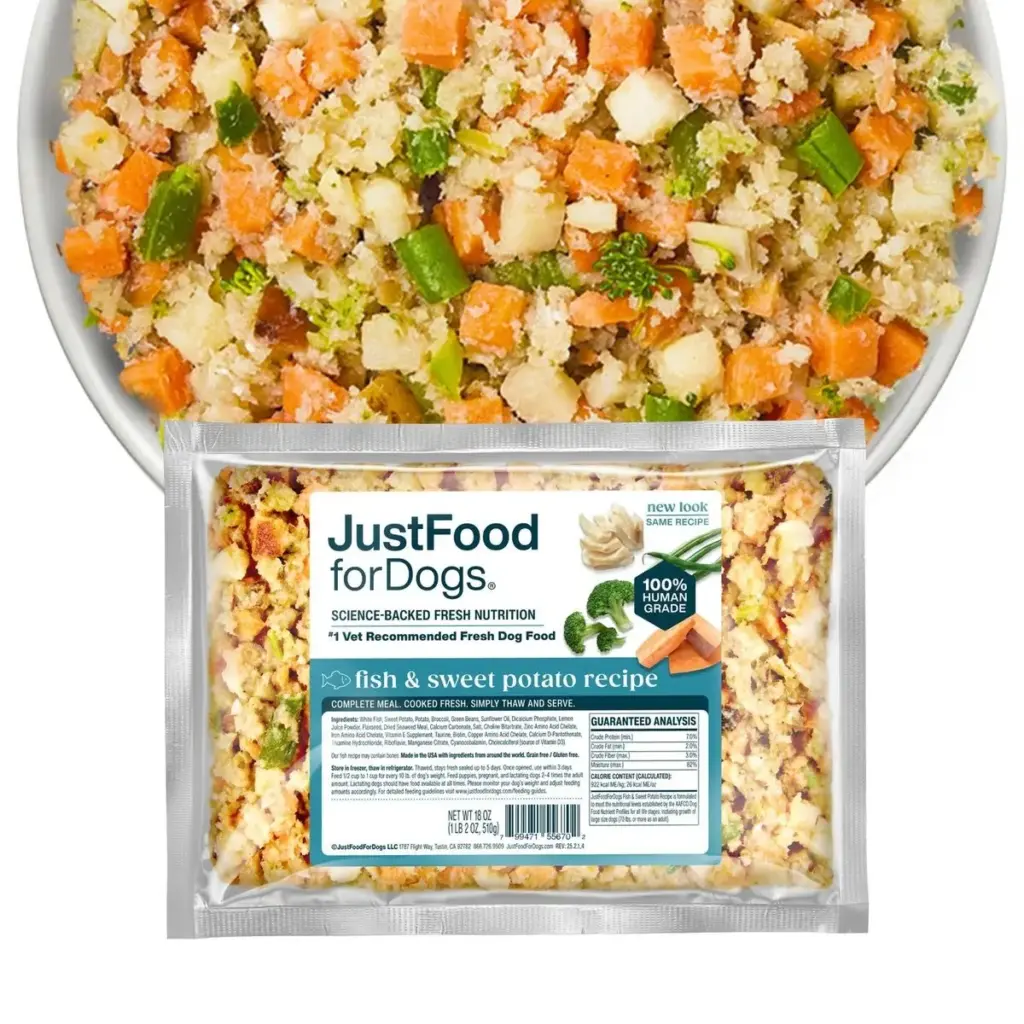
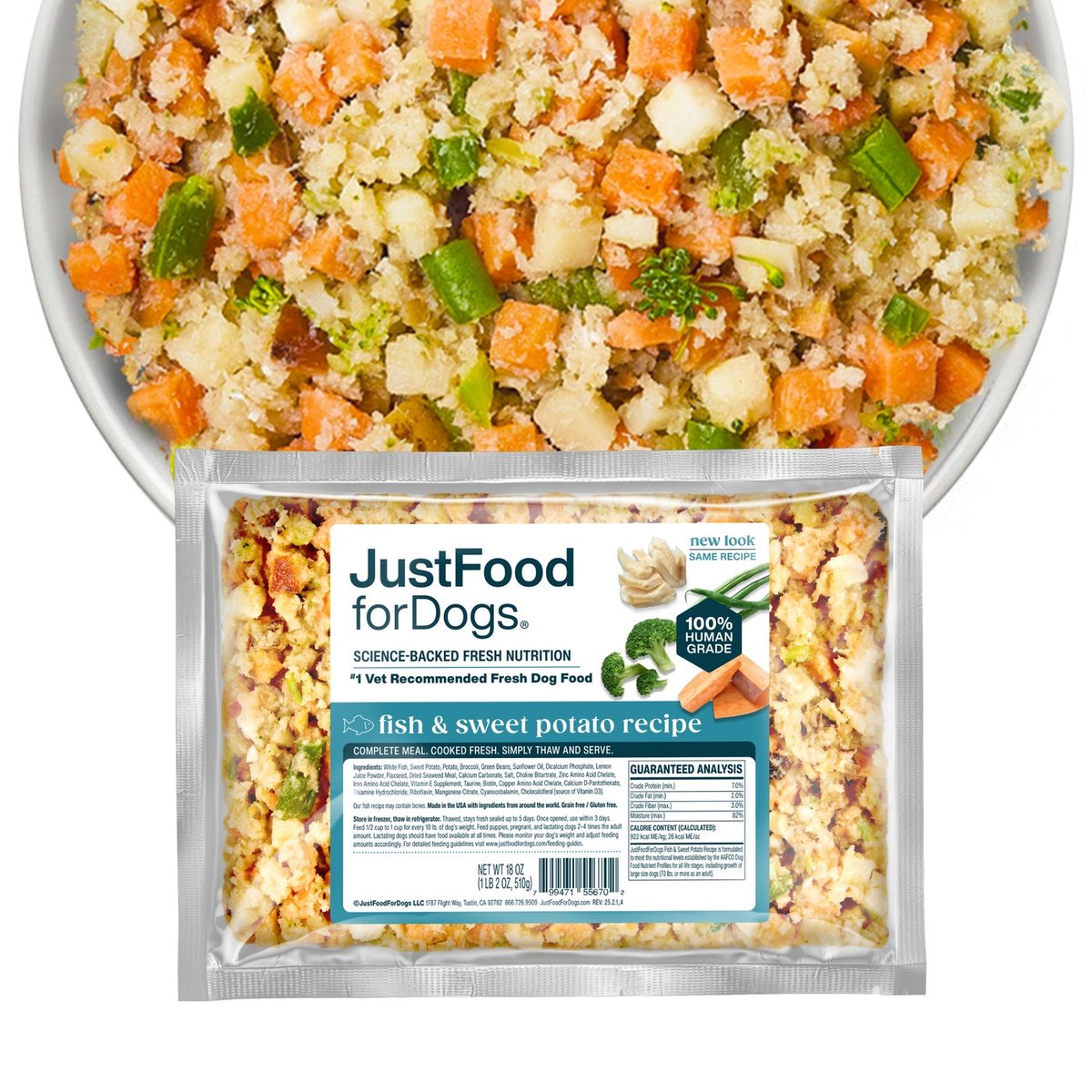
JustFoodForDogs Fish & Sweet Potato
Featuring a marine protein profile composed of cod, pollock, and haddock combined with sweet potato, the Fish & Sweet Potato formula is also certified for all life stages, including large-breed puppy growth. Its primary practical distinction lies in its lower energy density of 922 kilocalories per kilogram, or 0.922 calories per gram.
Because of this reduced caloric concentration, a dog requires a physically larger volume of food by weight to achieve the same total daily energy intake as denser recipes. Lower caloric density is neither inherently superior nor inferior; rather, it offers a functional tool for pets that prefer larger volume meals or owners managing specific daily portion routines. This standard recipe is designed for daily maintenance and is not a prescription diet for food allergies or metabolic weight management.
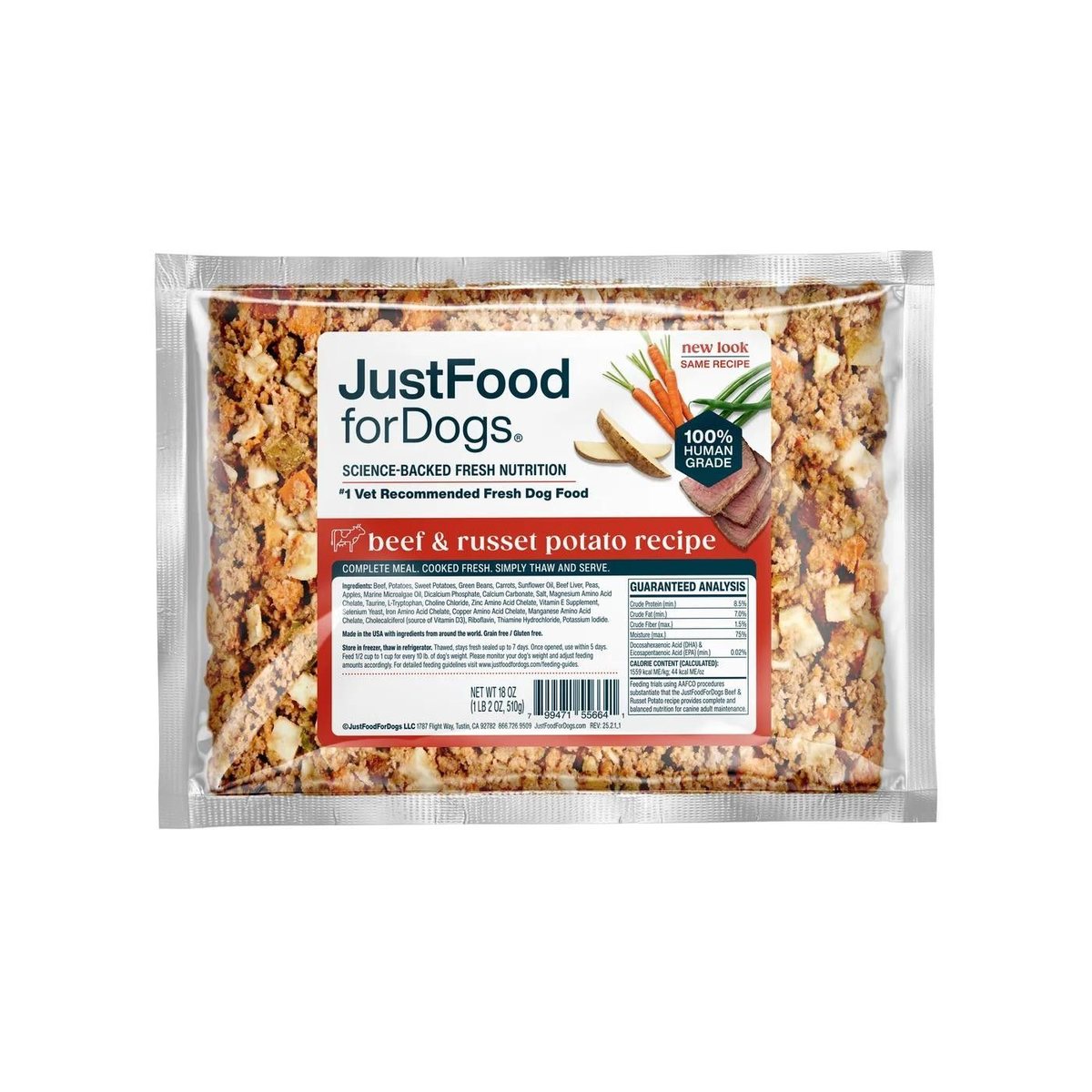
JustFoodForDogs Beef & Russet Potato
The Beef & Russet Potato recipe is formulated specifically for adult maintenance, with its nutritional adequacy verified through standardized feeding trials under Association of American Feed Control Officials procedures. It supplies 1,559 kilocalories per kilogram, equivalent to 1.559 calories per gram, making it the most calorie-dense formula among these four options.
Because it is certified exclusively for adult maintenance, Beef & Russet Potato is not suitable as a complete diet for growing Samoyed puppies. Furthermore, while its elevated caloric density means smaller physical portions deliver higher energy totals, high energy density alone does not make a food an athletic performance diet or an automatic fit for every active adult.
JustFoodForDogs JustFresh Home-Cooked Chicken
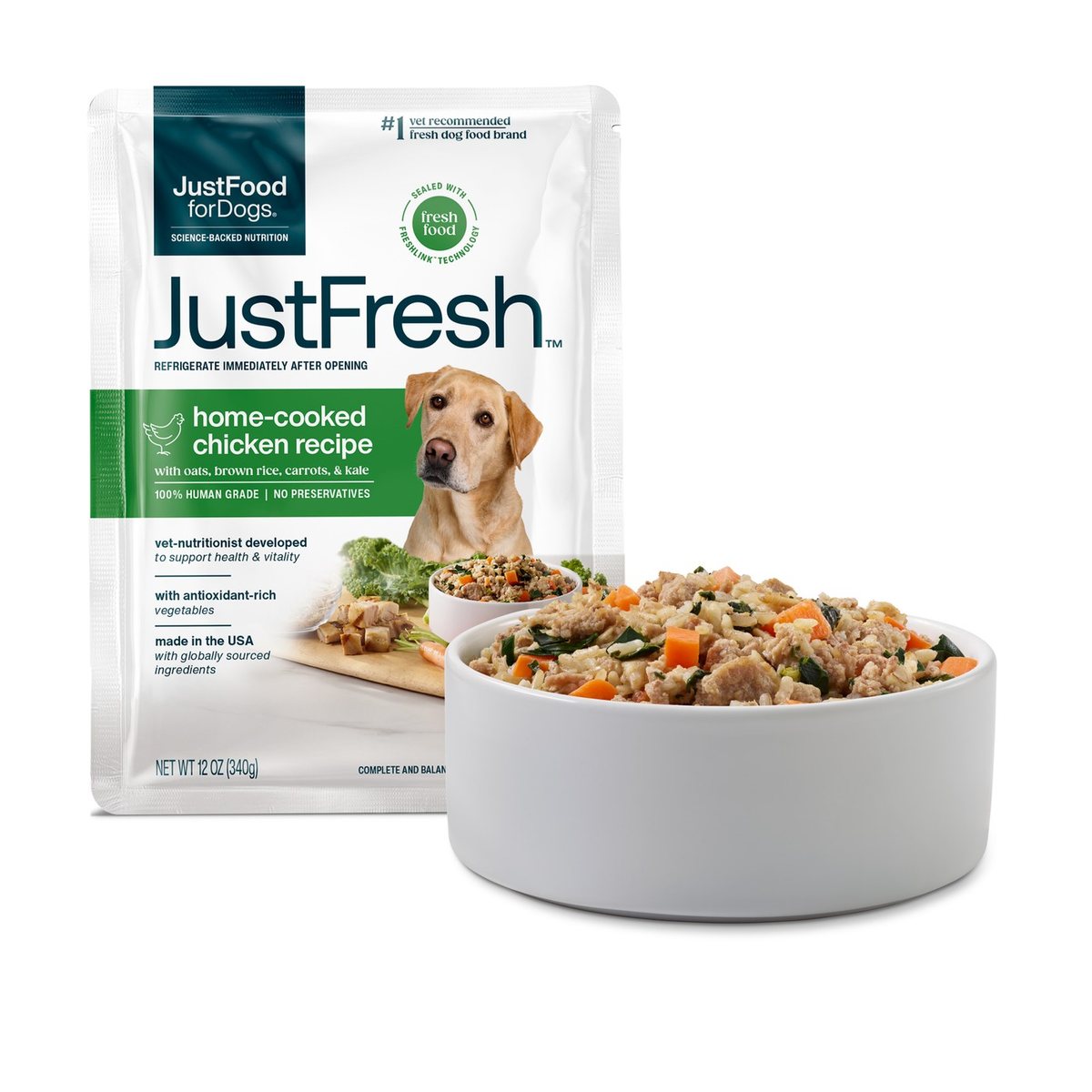
JustFresh Home-Cooked Chicken is an adult-maintenance formula designed for pantry storage prior to opening, offering a distinct physical format from fresh-frozen offerings. Incorporating chicken, oats, and brown rice, this shelf-stable option delivers 1,254 kilocalories per kilogram, or 1.254 calories per gram.

While its unopened shelf stability simplifies household supply management and travel logistics, it is not formulated for puppy growth. Additionally, once opened, the food requires strict refrigeration and adherence to fresh handling timelines, meaning travel plans must accommodate opened package management just like traditional fresh-frozen meals.
Match Meals to Your Samoyed’s Current Activity
To align caloric intake with energy output, dog owners should evaluate concrete physical activity rather than generalized breed assumptions. Describing a Samoyed as an active breed provides insufficient context for establishing a daily feeding portion. A short, relaxed walk around the block, a reward-based obedience class, and hours of sustained physical exercise each place fundamentally different demands on a dog’s metabolic budget.
Evaluating a feeding plan begins by establishing a baseline using current measured intake and the physical body condition it maintains. When lifestyle changes occur, owners should monitor for consistent trends in weight and body condition before modifying daily rations.
When documenting exercise and lifestyle changes, tracking specific parameters provides clarity:
- The precise duration and intensity of daily physical outings.
- The volume and energy contribution of training treats given during structured sessions.
- Any observed shifts in daily energy expenditure or routine pacing.
Increases in structured training often introduce extra calories through treats, which must be subtracted from the primary meal ration. Similarly, an occasional weekend hike does not justify a permanent upward adjustment in monthly meal allowances.
When evaluating routine changes, specific physical observations dictate the appropriate response. For example, if a dog begins longer regular outings, owners should record current intake, workload, and weight trends to confirm whether the existing meal plan maintains optimal physical condition. If training rewards increase, calculating treat calories and reducing meal portions accordingly prevents accidental overfeeding.
If a dog enters a quieter season, portions should be re-evaluated if reduced activity persists over several weeks. A higher reading on the scale calls for inspecting treat intake and physical fat cover to determine whether weight gain represents fat accumulation. Conversely, unexpected weight loss or noticeable muscle wasting warrants a veterinary examination rather than simply increasing the daily food allowance. Finally, changes in coat volume should be verified by feeling the underlying body structure, ensuring diet changes are not made based purely on shedding or hair density.
Maintaining a consistent, written baseline simplifies these decisions. Tracking exact meal weights, daily treat allowances, routine exercise habits, and professional body condition scores creates a clear point of reference. Modifying multiple dietary variables simultaneously—such as changing the primary recipe, treat type, portion size, and exercise routine at once—obscures which factor is responsible for subsequent physical changes.
Use a Samoyed Food Chart That Starts With Calories
A functional feeding chart relies on converting a dog’s targeted daily calorie requirement into precise physical weight, measured in grams. Servings based on arbitrary volume cups often lead to significant inaccuracies, particularly when switching between foods with differing caloric densities.
Establishing an energy intake baseline begins with calculating individual caloric needs, using guidelines such as those published by the World Small Animal Veterinary Association for healthy adult dogs in ideal condition. Once the total target calories are determined, the precise daily food amount is calculated using a straightforward formula: daily grams of food equals assigned daily calories divided by the recipe’s calories per gram.
For illustrative purposes, consider an adult Samoyed with an assigned target of 900 calories per day sourced entirely from one complete recipe:
- Chicken & Rice: 900 calories divided by 1.530 calories per gram equals approximately 588 grams per day.
- Fish & Sweet Potato: 900 calories divided by 0.922 calories per gram equals approximately 976 grams per day.
- Beef & Russet Potato: 900 calories divided by 1.559 calories per gram equals approximately 577 grams per day.
- JustFresh Home-Cooked Chicken: 900 calories divided by 1.254 calories per gram equals approximately 718 grams per day.
These figures illustrate theoretical alternatives rather than portions to be combined. They highlight how physical portion weight changes dramatically across recipes while total energy delivery remains constant.
Calculating Whole-Day Intake and Mixed Diets
Managing a dog’s complete daily diet requires allocating calories across all food sources before serving, rather than feeding full meals and adding treats as uncounted extras. According to American Animal Hospital Association guidelines, non-complete dietary additions—such as treats, table scraps, and chews—should not exceed 10% of total daily caloric intake to prevent nutritional imbalances.
When combining different complete foods, calculations must account for the specific energy contributions of each component. For example, if an adult Samoyed requires 900 daily calories, an owner might assign 600 calories to JustFoodForDogs Chicken & Rice and 300 calories to a complete dry kibble. Dividing 600 calories by 1.530 calories per gram yields roughly 392 grams of the fresh recipe. If the dry kibble contains 4.0 calories per gram, 300 calories equals 75 grams of kibble.
Describing a diet as half fresh and half dry is ambiguous unless specified by weight, volume, or energy. Splitting portions by calories ensures accurate target energy delivery without altering intended nutrient proportions.
When sharing feeding duties within a household, meal specifications should be written clearly in a shared location, specifying exact weight in grams and the precise measuring tool to be used. If the primary recipe is changed, the caloric density value in the calculation must be updated immediately to prevent accidental underfeeding or overfeeding.
Check Puppy Growth Requirements Before Adult Feeding Habits
Selecting food for a Samoyed puppy requires verifying that the chosen formula is certified complete and balanced for growth. Increasing the portion size of an adult maintenance recipe does not render it suitable for a growing puppy, as maintenance diets lack the specific nutrient balances required for skeletal development.
Because adult Samoyeds frequently weigh near or above 70 pounds, veterinary guidelines emphasize selecting puppy diets specifically qualified for large-breed growth. The U.S. Food and Drug Administration notes that nutritional adequacy statements on pet food labels explicitly indicate whether a growth formula accommodates large-sized dogs.
Among the four JustFoodForDogs recipes evaluated:
- Chicken & Rice and Fish & Sweet Potato are explicitly certified for all life stages, including the growth of large-size dogs weighing 70 pounds or more.
- Beef & Russet Potato and JustFresh Home-Cooked Chicken are strictly adult maintenance formulas and should not be fed to growing puppies.
Adjusting a puppy’s daily intake requires frequent recalculation as body weight increases. Owners should avoid adding unprescribed mineral supplements, such as calcium, to a complete growth diet. Unbalanced supplementation in large-breed puppies can contribute to severe developmental skeletal disorders. Furthermore, when bringing a puppy home, maintaining its established diet during the initial settling period reduces gastrointestinal stress before any gradual transition is introduced.
Feel Body Condition Beneath the Double Coat
The dense double coat of the Samoyed presents a unique challenge when assessing body composition. Visual inspections alone are frequently misleading, as a heavy coat can conceal significant weight loss or make a lean dog appear overweight. Physical palpation is essential for accurate evaluation.
Veterinary professionals utilize standard Body Condition Score systems, such as those established by WSAVA, which emphasize hand-on evaluation. Key indicators include easily palpable ribs beneath a thin fat cover, a discernible waistline behind the ribcage when viewed from above, and a clear abdominal tuck when viewed from the side.
Owners should distinguish between total body weight, fat accumulation, and skeletal muscle mass:
- Scale Weight: Tracks overall physical mass but does not differentiate between fluid, fat, and lean muscle.
- Body Fat Cover: Evaluated by feeling the thickness of tissue over the ribs, spine, and pelvis.
- Muscle Mass: Assessed by feeling muscle tone over the shoulders, back, and hips.
To ensure consistent tracking, physical evaluations should be performed regularly using uniform techniques. If physical assessments indicate a trend toward excess fat or muscle loss, dietary adjustments should be made based on documented observations and confirmed with a veterinarian.
Plan Food Storage Around a Larger Daily Ration
Feeding fresh-food diets to medium-to-large breeds requires structured storage planning. Calculating household food turnover prevents inventory shortages while ensuring products are consumed within safe quality timeframes.
Total food requirements are calculated by multiplying daily meal weights in grams by the number of days between shipments or purchases. For households feeding multiple recipes or reserving food for training, each component must be calculated separately.
Package handling must adhere to manufacturer safety guidelines once defrosted or opened. JustFoodForDogs specifies that thawed, non-fish fresh-frozen meals remain safe for refrigerated storage for up to five days. Fish-based recipes and opened JustFresh packages should be used within three days. Thawing guidelines recommend allowing up to 24 hours in the refrigerator for an 18-ounce package and up to 48 hours for a 72-ounce package.
Proper handling aligns with FDA pet food safety advice, which recommends maintaining refrigerator temperatures at or below 40°F (4.4°C) and promptly refrigerating or discarding uneaten perishable food. When traveling, owners must maintain uninterrupted cold storage for fresh foods or transition the dog to a suitable shelf-stable alternative using recalculated portion sizes well in advance.
Does a White-Coated Samoyed Automatically Need Allergy Food?
Coat color is not a clinical indicator of food allergies. The presence of a white coat does not mean a Samoyed requires a specialized hypo-allergenic or novel-protein diet. Symptoms such as chronic itching, skin inflammation, or recurrent digestive issues require systematic veterinary evaluation rather than arbitrary ingredient restriction.
VCA Animal Hospitals guidelines highlight that diagnosing true cutaneous food adverse reactions requires a strictly controlled elimination diet trial supervised by a veterinarian. Switching between standard commercial recipes with different main proteins does not constitute a diagnostic trial and can complicate future clinical evaluations.
Prior to a veterinary consultation regarding suspected allergies, owners should maintain a detailed log documenting exact food intake, treat consumption, environmental exposures, and the timing of symptoms. If a diagnostic elimination trial is prescribed, all unapproved treats, flavored medications, and edible chews must be paused to preserve trial integrity.
Addressing Common Samoyed Feeding Questions
Does a Samoyed always need a high-energy food?
No. An individual dog’s activity level dictates its energy requirements. While working dogs engaged in sustained physical labor require higher caloric intake, companion animals with moderate exercise routines thrive on standard balanced formulas. Recipe caloric density should be used to calculate appropriate physical portions rather than as a substitute for individual assessment.
Can training rewards interfere with a prescribed food trial?
Yes. Unapproved training treats or flavored chews introduce unmanaged proteins and additives that can invalidate a diagnostic elimination diet. During an active trial, only foods explicitly sanctioned by the attending veterinarian should be administered.
Should I add supplements to keep my Samoyed’s coat white?
No. Adding unprescribed supplements or modifying a complete and balanced diet solely to influence coat color lacks scientific backing and can risk nutrient toxicity or imbalances. Any significant changes in coat texture or skin health should be evaluated clinically by a veterinarian.
Should my Samoyed eat less when our routine becomes quieter?
A sustained reduction in physical activity warrants reviewing daily caloric intake to prevent gradual weight gain. Owners should monitor scale weight and body condition score over several weeks, adjusting measured portions systematically rather than applying arbitrary reductions based on short-term schedule changes.

Can an older Samoyed keep eating the same complete recipe?
An aging dog can remain on a familiar complete recipe provided the food continues to meet its metabolic needs and health profile. However, energy requirements, appetite, and body composition often shift with age, requiring portion recalibration or transitioning to a specialized senior or medical diet if recommended by a veterinarian.