


When video game players think of Nintendo, adroit political commentary is rarely the first thing that comes to mind. It is not something the company frequently—or really ever—engages in. Even Monolith Soft’s famously big-picture Xenoblade Chronicles games tend toward overarching philosophy more than direct political allegory. Up to this point, developer Intelligent Systems has generally limited the political messaging in its long-running Fire Emblem series to broad, digestible warnings, such as advising players not to get in bed with dragons—both literally and metaphorically—or noting that when a king starts laughing maniacally, it is probably time to stop giving him power.
That last line is an eternal truth, but Fire Emblem: Fortune’s Weave, the latest entry in the tactical role-playing franchise released on September 17 for the Nintendo Switch 2, takes that concept very seriously. Beneath its grand tactical battles and elaborate character interactions, the entire game functions as a sharp, deliberate commentary on nationalism and the inherent dangers of failing to confront the ugly truths of the past, no matter how horrific those historical realities may be.
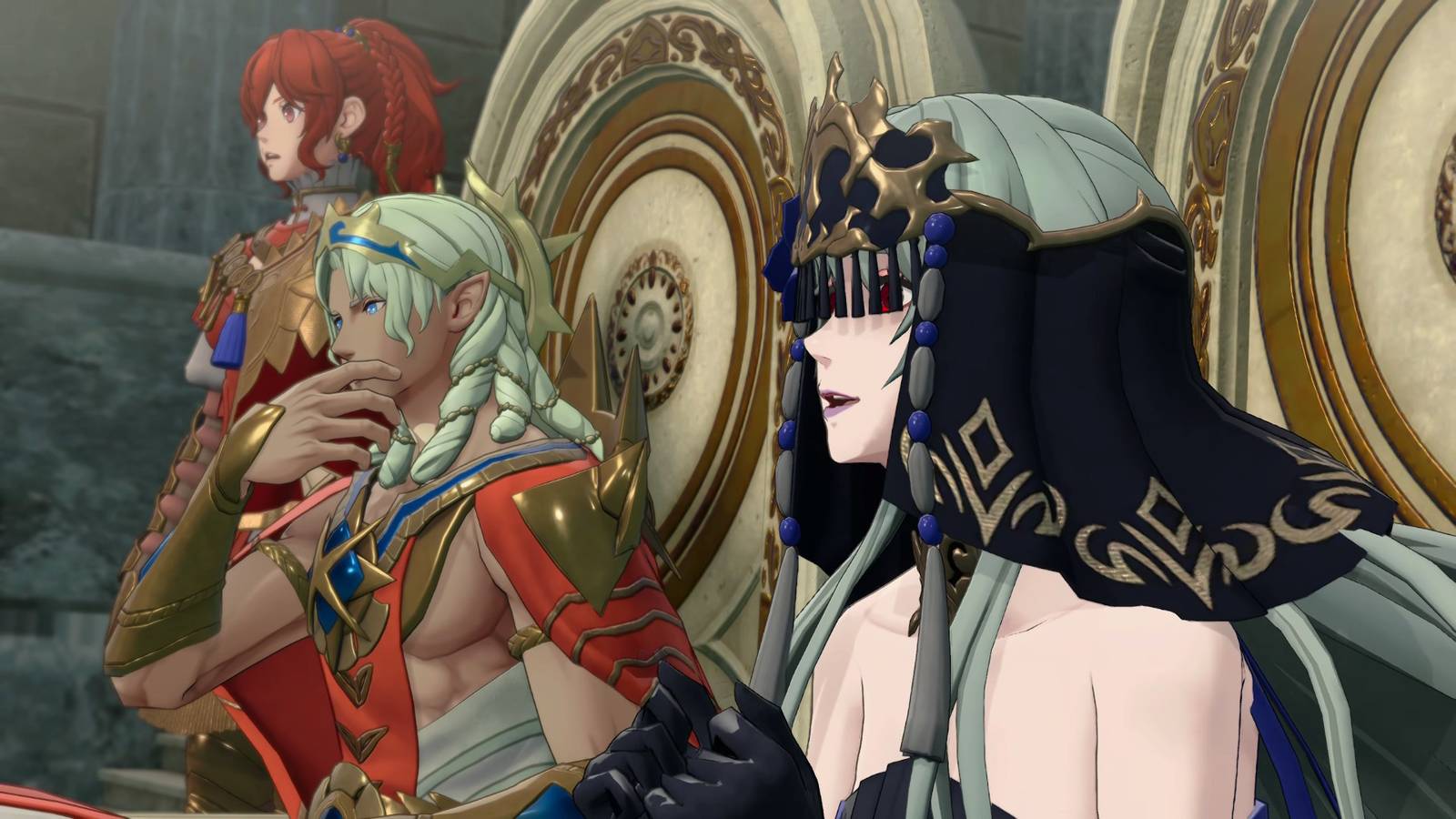
The core narrative of Dagda follows a template as old as human civilization itself: the story of an expanding empire. Centuries of relentless warfare and territorial conquest broadened its borders, gradually giving rise to a fervent, institutionalized belief in the divine righteousness of that expansion. When a nation’s supreme ruler is viewed as a living god and the direct offspring of the world’s ultimate deity, the common populace can be persuaded quite easily. In Part 2 of the game, Dagda justifies his latest military campaign by reminding his court—specifically the members he has not already executed—that Sothis, his mother and the progenitor god, originally tasked him with bringing the entire continent under his singular control.
There are echoes of the ancient Chinese concept of the Mandate of Heaven in his absolute conviction, the historical belief that emperors ruled with direct divine backing and risked forfeiting that legitimacy if they misbehaved. However, after spending Part 1 exploring the empire’s supposedly glorious history through the in-game Heroic Games, it is hard for players not to draw comparisons to Manifest Destiny, the 19th-century doctrine espoused by U.S. presidents to justify American westward expansion. Under that doctrine, God supposedly ordained the nation’s future, meaning everyone who disagreed or stood in the way was automatically marked for death.
As the narrative unfolds, players discover that this is precisely what happened to the smaller tribes and indigenous nations scattered across the continent. The empire’s official history spans centuries of subjugating smaller communities and systematically erasing their cultural identities, with the sole exception of its initial war against Brigid, which Dagda ultimately lost. The standard imperial playbook involved installing a royal kinsman as a puppet ruler or regional deity in newly conquered lands. Over time, through sustained cultural conditioning, the local populace would come to view themselves as loyal Dagdans, fiercely revering their emperor and remaining utterly devoted to gods who supposedly had their best interests at heart.

Further investigation into the lore reveals the grim reality behind this facade. Dagda either viewed the People of the White Egg as an existential threat or simply treated them as expendable resources, or perhaps a combination of both. Though they posed no actual military threat to his regime, he ordered the execution of 100,000 of them, hunted down their surviving descendants, and forced the remainder into a barren, isolated corner of the continent. The historical parallels with how federal and state governments treated Indigenous Americans are striking, though historical echoes can also be found in other conflicts around the world, such as the treatment of the Ainu by Japan, the Mongols by China, or modern geopolitical struggles in the Middle East.
Yet, much like real-world instances of genocide and state-sponsored oppression, the modern citizens of Dagda remember these dark chapters only as paeans to their empire’s glorious past—whitewashed atrocities conveniently repackaged as public entertainment. The People of the White Egg were reduced to the stuff of dark fairytales, though they remained real enough that anyone wearing entirely white clothing still risked arbitrary arrest. The official state version of events is one that instills immense pride and a false sense of unity among Dagdans. During Leda’s route, when Anatolia joins the party as a guest, the character Sha Lan expresses profound surprise and sadness upon learning the authentic version of her people’s history, realizing that virtually nobody outside her community understands the full truth. Her sorrow is entirely justified; that systemic ignorance and blind faith ultimately paved the way for the empire’s undoing.
Following the initial genocide against the People of the White Egg, Dagda turned his tyrannical focus toward the children of Damascar, who were descendants of the survivors, intending to purge them as well. Yu Phas, daughter of Balor and wife of Dagda’s son Solel, intervened to rescue as many targeted people as she could. As punishment for her defiance, Dagda had her murdered.

The inherent nature of a god often keeps them emotionally detached from humanity. What deeply concerns a mortal walking the earth for a mere eighty years barely registers in the consciousness of a being whose lifespan stretches across millennia. While Dagda’s wife Jurah and several of his children later expressed horror at his actions during the Damascar incident, none of them took direct action until his cruelty finally impacted their own immediate status and safety. Ultimately, Solel took up his axe and struck down his own father in retaliation for Yu Phas’ murder—the very "slumber" that Dagda entered into five hundred years before the events of Fortune’s Weave begin.
The parallels to contemporary socio-economic dynamics are difficult to ignore, particularly concerning the disconnect between ultra-wealthy elites and the general populace. From their isolated positions of absolute privilege, ruling classes often perceive the economy as thriving even as ordinary citizens struggle to afford basic necessities, celebrating technological shifts like artificial intelligence because they generate immense personal wealth. However, the moment their own comfort, security, and status are threatened, swift action invariably follows.
After assuming his new role as Divine Sovereign, Solel chose to perpetuate his father’s foundational lies. He acts as the quintessential politician desperate to preserve the established status quo at any human cost. He permits the continued public denigration of his deceased wife, Yu Phas, allowing her to be falsely branded as an unholy goddess of death. Defying his father’s original murderous intentions, he grants the Children of Damascar the land that would eventually become Saramis, but this is executed as a shrewd political maneuver; the displaced group effectively serves as a strategic buffer between Dagda and its hostile southern neighbors. Furthermore, he allows the Order of Mithras—a shadowy cult founded by his father that eventually facilitates Dagda’s descent back into madness—to operate completely unchecked. He also unquestioningly accepts corrupt testimony that conveniently justifies Arago’s brutal, politically motivated massacre in Cydonia. From Solel’s perspective, questioning the official narrative offers no personal benefit, while looking deeper into state atrocities would only destabilize his fragile political order.

This systemic indifference leads directly to the establishment of the Heroic Games. No one within the ruling hierarchy—not even the divine figures—stops to consider the inherent cruelty of the event. Effectively functioning as a magical, high-stakes tournament reminiscent of modern dystopian fiction, it forces desperate people to fight for the amusement of the ruling class under the guise of winning promises that the sovereign could easily fulfill at any moment. For instance, Solel promises Leda that he will reinvestigate the Cydonian Massacre that destroyed her hometown if she manages to win the games, treating a historic tragedy as a transactional bargaining chip rather than a moral imperative. Temples assure Dagda’s citizens that these games serve the empire’s ultimate glory, arguing that martial prowess and romanticized reenactments of the nation’s bloody past will bring honor to everyone and eventually awaken Dagda from his prolonged slumber. The populace readily believes it, blinded by carefully curated nostalgia for a past that never truly existed in the benevolent light they imagined.
Despite fully knowing the immense harm his father caused and understanding the inherent danger of ever waking him, Solel ultimately does nothing to stop the charade. He and the rest of the ruling family gamble on giving a genocidal tyrant and ruthless dictator a second chance, operating under the naive assumption that a five-hundred-year nap might have somehow mellowed him out, or perhaps simply because they had spent centuries believing their own fabricated propaganda. Their good intentions prove disastrously misguided. The moment Dagda assumes power once more, he immediately resumes his conquests by launching a fresh war against Saramis, executing those who dare question his authority, turning on his own children, and eventually ordering the slaughter of everyone in Dagsion. The outcome proves that the tyrant was just as merciless and destructive the second time around as he was during his initial reign.
Playing through these narrative beats, the parallels to modern political landscapes are striking. Modern players navigating Fortune’s Weave in 2026 can easily draw comparisons between Dagda’s return and contemporary political figures whose legacies of failure and systemic harm still manage to secure a pathway back to power, utilizing distorted historical narratives, manufactured grievances, and fear of outsiders to convince voters that they alone have the public’s best interests at heart. These geopolitical echoes extend far beyond any single nation, mirroring ongoing right-wing nationalist shifts in countries like Japan and the growing electoral gains of far-right movements in Europe, all of which often rely on deep-seated anxieties regarding outsiders and a collective determination to ignore uncomfortable historical truths.

Across all these real-world and fictional scenarios, a recurring theme remains the element of surprise—the collective shock when history inevitably repeats itself, when populations fail to recognize warning signs, and when those in positions of authority choose inaction while democratic or societal norms erode. This thematic resonance has fueled extensive fan theories across social media regarding characters like Eshmel, with many speculating that Eshmel is actually the reincarnated form of Solel seeking atonement. Whether through subtle visual design cues or narrative hints dropped during character creation—where Fortuna explicitly remarks on karma and the opportunity for a soul to seek genuine redemption—the shadow of past actions looms large over the narrative’s conclusion.