


As the stock market continues to scale record valuations driven largely by the current artificial intelligence boom, investors are once again asking a familiar, anxious question: Is an unprecedented crash just around the corner? For many retirees and savers watching their portfolios swell on the back of technological frenzy, the prevailing sentiment is not celebration, but trepidation.
This financial anxiety is hardly new. Markets have consistently surprised observers over decades, crashing and recovering, plunging retirees into panic only to climb to even higher peaks. Yet, the current boom—built entirely on the rapid, frenzied ascent of artificial intelligence—has many drawing parallels to the dot-com bubble of the early 2000s. That particular market cycle famously defined the early career of popular financial commentator and blogger Mr. Money Mustache, fueling his path to early retirement before an ensuing crash nearly derailed his professional life and citizenship application.

Addressing these widespread anxieties, the veteran financial writer recently debuted a presentation tackling the intersection of market bubbles and human psychology at the Camp FI Midwest event, with a polished version slated for the upcoming Bogleheads conference in November. Drawing on more than two decades of retirement experience, the core message to nervous savers is simple: while market volatility is guaranteed, economic prosperity is ultimately driven by human productivity, and the real enemy of a comfortable retirement is not the stock market, but fear itself.
To put current market fears into perspective, it helps to look backward. Reflecting on a conversation with a friend two decades ago in 2006, the parallels to today’s anxieties are striking. Back then, investors were paralyzed by entirely different ghosts. Society wrestled with concerns over corrupt leadership, Middle East conflicts, soaring national debt, and inflation. Just as today’s market worries over an overvalued stock market driven by AI—and fears that AI will eliminate human jobs—investors in 2006 panicked over a housing market bubble and the outsourcing of jobs to India and China. There was even widespread panic over "Peak Oil," a theory that fossil fuel supplies would inevitably plummet as demand increased.

What followed those 2006 worries was the Great Financial Crisis, triggered by irrational exuberance over housing prices and complex financial leverage. It stands as the largest market crash since the Great Depression. Yet, viewed through the lens of history, even that catastrophic event appears as a minor dip on a much larger upward trajectory. A $100,000 investment made during that turbulent era would have ballooned significantly over the subsequent two decades, easily absorbing subsequent shocks like the 2020 pandemic crash.
Simultaneously, the broader world experienced remarkable progress. Over the 20-year span following those 2006 worries, the proportion of people living in extreme poverty dropped from 20 percent down to 8 percent. Infant mortality rates were cut in half. Clean energy expanded dramatically as solar panel costs plummeted by roughly 40 times, allowing solar generation to dominate new energy additions globally. Meanwhile, pure electric vehicle sales surged from near zero to roughly a quarter of all new car sales worldwide.

Despite these undeniable long-term gains, financial media continues to spin compelling, fear-driven narratives about looming economic collapse, political instability, and technological displacement. However, these pessimistic outlooks often overlook a fundamental economic truth: at its core, human prosperity does not derive from abstract financial systems or stock market tickers, which are merely numbers computed digitally. True prosperity stems directly from productivity.
The fundamental lesson of long-term investing remains unchanged across generations. Capitalist systems are inherently choppy, subject to wild, cyclical swings. Yet beneath the surface waves, real people continue to perform real work, invent new tools, and solve complex problems. The concept of an economy or a financial system is itself a human invention; if a system breaks down due to shifting metrics, societies simply adapt, restructure, and return to work—a cycle successfully repeated through numerous historical crises, including 2008.

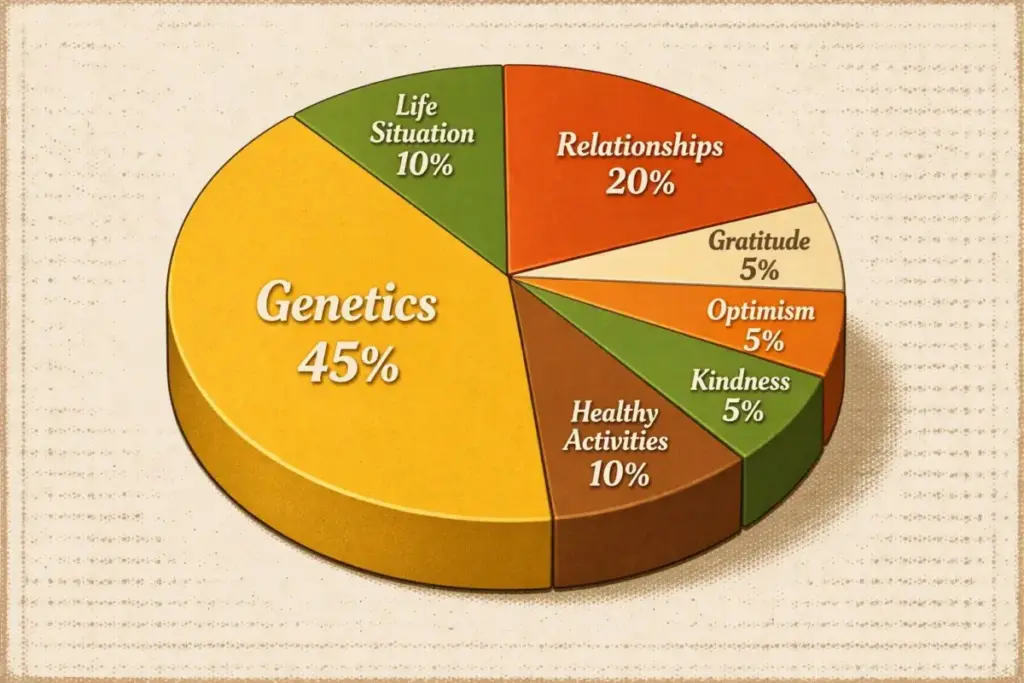
Furthermore, once a society achieves a certain baseline standard of living, human happiness ceases to scale proportionally with wealth. In developed nations, those minimum material requirements were surpassed decades ago. True human satisfaction relies heavily on factors within personal control: cultivating strong, positive relationships, practicing gratitude and optimism, and maintaining an active, outdoor lifestyle. Genetics and personal choices play a far greater role in day-to-day happiness than portfolio balances ever will.
The persistence of financial anxiety, even among seasoned savers who understand these principles, points to a deeper psychological root: human evolution. Modern human beings are fundamentally danger-detection machines. Evolution wired the brain with a background fear response designed to protect against immediate physical threats, predators, and scarcity.

However, a quirk of this evolutionary machinery is that once immediate physical dangers are resolved, the brain continues searching for new things to worry about. When scarcity is conquered, people worry about social status, neighborhood aesthetics, or tax strategies like required minimum distributions—worrying, paradoxically, because they have accumulated too much money.
Combating this pervasive fear requires self-awareness and rational thinking. Understanding one’s personal history—such as childhood experiences with scarcity or financial trauma—helps clarify that contemporary anxiety often stems from the past rather than an objective assessment of the present. Identifying worst-case scenarios through logical analysis frequently reveals that feared outcomes are rarely as catastrophic as anticipated. Taking concrete action remains the ultimate antidote to fear, transforming the unfamiliar into the familiar and building genuine personal resilience.

By intentionally curating a daily mental diet—specifically by tuning out the sensationalized negativity of the daily news cycle—individuals can redirect their energy away from abstract worries and toward positive behaviors. Humans were built to solve problems using their minds and bodies, ideally outdoors, rather than sitting in offices consuming relentless streams of alarming media. Aligning daily habits with natural human needs naturally diminishes existential dread.
Viewing major life shifts through the lens of experimentation further diffuses anxiety. Whether changing careers, adjusting living arrangements, or navigating the modern technological landscape, approaching change as an experiment strips away its terror.

This experimental mindset applies directly to the artificial intelligence boom currently gripping the public imagination. While AI represents an unknown and potentially disruptive change, it can also be understood simply as a powerful new cognitive tool designed to boost human efficiency. Just as physical tools like nail guns revolutionized construction, AI acts as a cognitive amplifier that enhances productivity and, by extension, long-term prosperity.
Naturally, technological shifts cause displacement, impacting entry-level administrative and technical roles much like past industrial revolutions. Yet, history demonstrates that such shifts simultaneously reduce service costs and spark the creation of entirely new industries, mirroring the massive economic ecosystems unleashed by the internet and smartphones. While the rewards of these innovations often concentrate among capital owners and shareholders—including everyday investors holding broad market portfolios—the underlying technology remains an opportunity for adaptation rather than a cause for panic.

Ultimately, navigating the uncertainties of modern financial markets requires moving past the symptoms of anxiety to address its root cause. As financial observers frequently note, everything an individual truly desires in life lies directly on the other side of fear.