

I drive upside down on the boulevard of broken dreams.
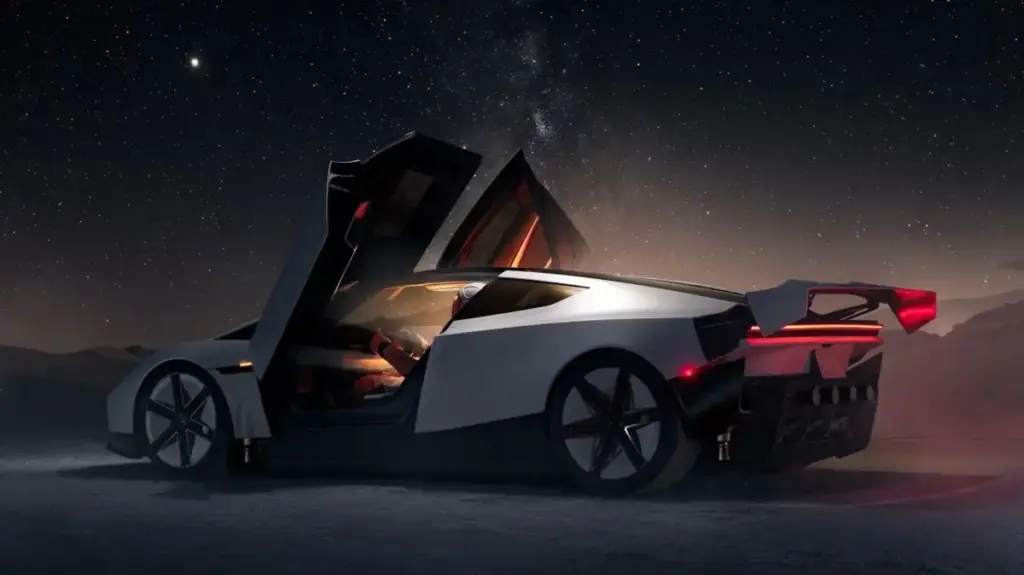
Tesla dominated headlines following a high-profile corporate event characterized by high-octane spectacle and an unexpected dose of aerospace ambition. In officially re-announcing the heavily redesigned second-generation Roadster, the electric vehicle manufacturer leaned heavily into cinematic theatrics, blending automotive engineering with rocket science. During the October 15 presentation, the company staged an eye-catching demonstration that saw a prototype Roadster drive up a specialized C-shaped suction rig until it was fully inverted, before smoothly floating back down to the ground courtesy of integrated rocket boosters.
Alongside the pyrotechnics, Tesla used the showcase to outline concrete reservation details and a timeline for the much-discussed sports car. The company revealed that the vehicle is now targeting a 2028 production window. Prospective buyers looking to secure the premier "Thrust" trim level, which comes equipped with specialized cold-gas thrusters, will need to put down a hefty $250,000 reservation fee. "We enter production in 2028," CEO Elon Musk told the audience during the event, adding for emphasis, "Actually, for real."
For observers of the automotive industry and long-term Tesla watchers, the presentation inevitably sparked a profound sense of déjà vu. This is far from the first time Tesla has formally announced the second-generation Roadster, and the company’s leadership did not exactly draw heavy attention to the vehicle’s tortured, multi-delayed history during the re-launch. Consequently, skepticism remains widespread across the financial and automotive sectors, with many industry analysts and prospective buyers questioning whether this latest showcase represents another classic paper launch for Tesla’s perpetually embattled halo sports car.
To understand the weight of the Roadster nameplate within the Tesla ecosystem, it is necessary to look back at the company’s formative years. The original Roadster served as a monumental milestone for the fledgling automaker when it was released in 2008. Produced in very limited numbers, that initial vehicle was originally conceptualized and ideated by one of Tesla’s original co-founders, Martin Eberhard, long before Musk bought out Eberhard and his fellow co-founder, Marc Tarpenning, to take firm control of the company. It was the visionary concept of an electric sports car that initially drew Musk to the startup in 2004, prompting his crucial early financial investment. Musk eventually assumed direct oversight of the Roadster’s production. Crammed inside a modified chassis borrowed from a Lotus Elise, the original vehicle was a technical marvel for its era, proving that a battery-powered passenger vehicle could achieve an impressive 244 miles of driving range on a single charge.
Nearly a decade later, the redesigned Roadster was first unveiled to the public in November 2017, arriving with sweeping promises that it would represent the absolute apex of Tesla’s engineering and electric vehicle manufacturing capabilities. At the time, Musk grandly described the upcoming sports car as "a hardcore smackdown to gasoline cars." Originally slated for a commercial release in 2020, the vehicle was showcased alongside the Tesla Semi, a Class 8 electric commercial semitruck that would also subsequently face its own protracted production delays before trickling out to early customers like Pepsi. Just a few months after the initial 2017 unveiling, in February 2018, Musk took to social media to promise an optional "SpaceX" package for the sports car. He claimed the package would incorporate approximately ten small rocket thrusters arranged seamlessly around the vehicle’s body to dramatically improve acceleration, top speed, braking, and cornering performance.
Then, the delays began to accumulate. Even as Tesla continued to actively accept customer deposits ranging from an initial $50,000 up to the full $250,000 price of the Founders Series, the heavily publicized 2020 production window quietly came and went. Addressing shareholders during a July 2020 earnings call, Musk revised his timeline, stating that production of the sports car would officially begin within the following 12 to 18 months. With the global economy subsequently engulfed by a severe public health crisis, this initial postponement was hardly the most shocking development in the corporate world. However, in an interview with podcaster Joe Rogan conducted that same year, Musk candidly noted that his personal priorities lay elsewhere, admitting that he wanted to prioritize the development and launch of the Cybertruck first—a goal the company eventually accomplished following years of high-profile delays for the polarizing electric pickup truck.
Yet, a year and a half after the initial 2020 target expired, the Roadster remained entirely absent from production lines. In early 2021, Musk pushed the projected release date further out to 2022, only for that timeline to slip again to 2023 by the end of that same year. Additional delays were subsequently announced throughout 2023 and 2024, stretching consumer patience to its absolute limits.
Those intervening years proved to be uniquely turbulent for both Musk and Tesla. The CEO underwent a highly visible and controversial public transformation, shifting from a celebrated Silicon Valley environmentalist and tech entrepreneur into a polarizing political figure. This trajectory culminated in a period where Musk headed up President Donald Trump’s newly formed Department of Government Efficiency (DOGE), overseeing a aggressive slash-and-burn restructuring of the federal government. By July 2025, the medical journal The Lancet published a modeling study projecting that the sweeping federal cuts implemented by the DOGE team could lead to more than 14 million deaths by 2030. Although Musk strongly disputed those figures and challenged the study’s methodology, the severe reputational damage generated by his tenure in Washington quickly spilled over into his commercial enterprises. Tesla bore the brunt of this backlash, facing widespread global protests, brand alienation, and sliding consumer sentiment. When Musk ultimately stepped down from his role at DOGE in May 2025 amidst swirling allegations of personal substance abuse and family drama, the long-delayed Roadster was understandably far from the top of the billionaire’s corporate priority list.
By the time Tesla leadership recommitted to finally releasing the Roadster this past April, a vast segment of the automotive community and consumer base had entirely abandoned hope that the sports car would ever transition from a design exercise into a street-legal reality. Tesla’s chronic inability to deliver the vehicle had long since transformed into a running pop-cultural joke. Even prominent, long-time Tesla supporters and high-profile owners began publicly airing their frustrations. YouTuber Marques Brownlee, who had interviewed Musk on multiple occasions for his popular MKBHD channel, expressed exasperation on an episode of his Waveform podcast in September 2025, noting pointedly that Tesla had been sitting on his $50,000 reservation deposit for eight years without delivering any tangible progress. Brownlee was hardly alone among tech industry elites; other high-profile figures who publicly voiced grievances over unfulfilled Roadster reservations included Musk’s former business partner and current artificial intelligence rival, OpenAI CEO Sam Altman.
As industry analysts have frequently pointed out, a glamorous product unveiling event devoid of a binding, reliable launch date carries limited weight in the broader automotive market. Even in the wake of Tesla’s visually striking October presentation, Musk and his executive team face an uphill battle. They must now convince skeptical consumers, institutional investors, and frustrated reservation holders that locking up significant capital for a futuristic sports car is a sound financial decision, rather than simply throwing money away on another novelty project reminiscent of the Boring Company’s infamous promotional flamethrower.