

When a survival drama features an aging, ruggedly handsome movie star who handles his own punishing stunts and delivers a quiet, emotionally devastating performance, audiences might assume they know what to expect. Yet in David Ayer’s gripping new film, Heart of the Beast, the true emotional anchor is not Brad Pitt—magnificent though he is—but his four-legged companion, a canine actor who steals the show and anchors the narrative with profound soulful depth.
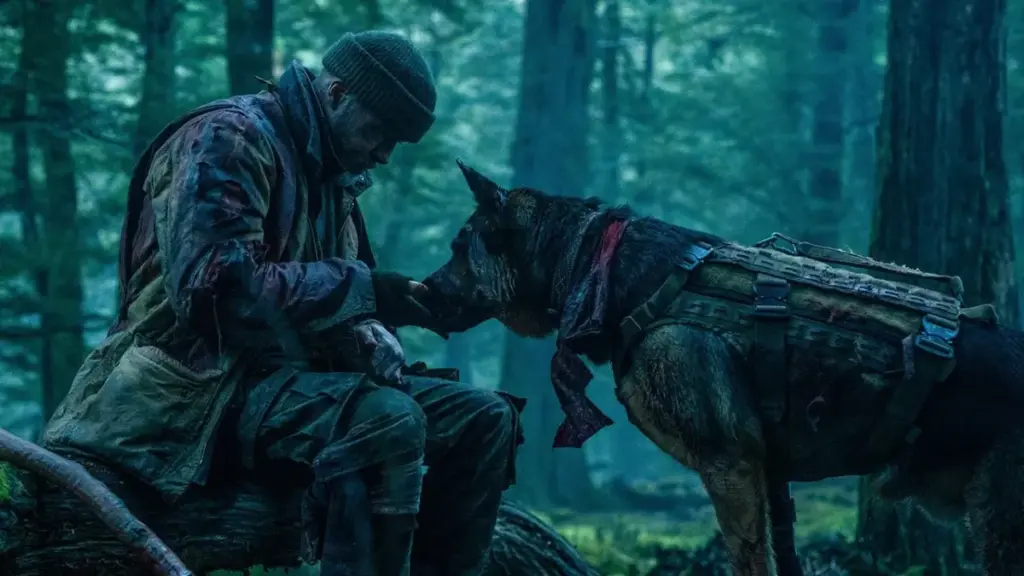
The film opens with a lingering close-up on the expressive face of Odin, a former United States Army combat dog portrayed by a real-life dog named Uber. Odin bears the physical and psychological toll of his service: he carries scars, titanium reinforcement in his mouth, and a prosthetic leg, all resulting from injuries sustained on the battlefield. His handler and owner is James Belmont, played by Brad Pitt as a retired Green Beret whose face remains obscured for the opening moments of the narrative. Although James serves as the story’s central human protagonist, the film largely unfolds through Odin’s perceptive perspective, establishing a unique sensory vantage point for the harrowing journey ahead.
Both James and Odin grapple with severe post-traumatic stress disorder stemming from their combat deployments, reminding audiences that military working dogs experience the exact same psychological trauma as human soldiers. Despite their shared invisible wounds, their bond is unyielding. This mutual devotion and absolute dependence form the bedrock of the narrative, providing the vital emotional momentum that keeps them moving forward after James suffers a sudden heart attack and crashes his Cessna airplane during a remote camping expedition in the rugged wilderness of Alaska.
Following the crash, James is subjected to a relentless gauntlet of physical hardships. Over the course of several grueling days, he and Odin must traverse roughly 50 miles of punishing terrain, battling harsh elements, treacherous geography, and aggressive wildlife in a desperate bid to reach the nearest road and secure help.
Under the assured direction of David Ayer, working from a heartfelt screenplay penned by Cameron Alexander, Heart of the Beast subjects James and Odin to virtually every conceivable wilderness survival trial. From the unforgiving challenges of navigating isolated backcountry to enduring severe injuries, violent storms, wolf packs, and a massive grizzly bear, the duo encounters nearly every mortal peril the North American wilderness can offer, short of a masked, machete-wielding serial killer.
The sheer brutality of their trek resonates deeply because the film invests so thoroughly in the relationship between man and dog. The viewing experience balances heart-in-throat moments where viewers whisper silent pleas for safety against visceral sequences of physical agony. James and Odin continuously come to each other’s aid to ensure their mutual survival, even if the canine hero proves thoroughly unhelpful when it comes to the mundane logistics of setting up and breaking down campsites.
Rather than relying on overt emotional manipulation of the kind frequently found in traditional canine-centric cinema, Heart of the Beast trusts Odin’s natural reactions and expressive face to carry the dramatic weight. At the same time, Brad Pitt elevates the entire dynamic through an intensely grounded human performance. As tough, stoic, and quiet as James is, his wounded soul and profound world-weariness are communicated entirely through Pitt’s eyes. This masterclass in subtle eye acting shines through most brightly during the film’s poignant closing moments.
Throughout a celebrated career defined by iconic characters who take severe physical beatings in films such as Fight Club, Snatch, Mr. and Mrs. Smith, Bullet Train, Fury, and Meet Joe Black, Pitt absorbs an unprecedented level of punishment here. For roughly three-quarters of the film’s runtime, his character is battered, bloodied, and pushed to absolute physiological limits, making the physical shoot an undeniably grueling undertaking for the actor.
While the primary survival narrative grips the audience from start to finish, the film occasionally stumbles during its flashback sequences. These glimpses into James and Odin’s military past are competently executed, but they ultimately fail to impart significant new information to the viewer. The origins of their physical and psychological torments are already made crystal clear during an earlier, masterfully concise encounter with a retired miner, played by J.K. Simmons, whom the duo meets shortly before the plane crash. These recurring flashbacks tend to interrupt the forward momentum of the current-day survival plot, highlighting just how compelling the core journey of man and dog truly is.
On a technical level, the film benefits immensely from Mauro Fiore’s sumptuous landscape cinematography and a haunting, atmospheric musical score composed by Jared Michael Fry. Less successful are the visual effects utilized for the computer-generated wolves and grizzly bear. While the practical reasons behind employing digital wildlife are understandable, the digital creatures occasionally stand out, slightly disrupting the otherwise remarkably realistic aesthetic of the production, though they thankfully avoid the uncanny valley pitfalls seen in previous animal-centric CGI efforts like The Call of the Wild.
Ultimately, Heart of the Beast succeeds by taking familiar wilderness survival tropes and grounding them in an authentic, primal love between a man and his three-legged companion. Brad Pitt gives the project his physical and emotional all, delivering an understated, heartbreaking performance that lingers long after the credits roll. Combined with Uber’s remarkable portrayal of Odin, the film introduces a canine screen hero destined to be remembered for years to come.