



Tech companies have gradually invaded the film festival space, but Meta’s secret new project proved to be a remarkably fitting presence at this year’s Toronto International Film Festival. The device arrived both because of its impressive entertainment capabilities and because its unveiling felt like something straight out of a cinematic narrative. Not far from where festival-goers gathered to watch the new Zack Snyder film, a makeshift gallery played host to covert keynote presentations. Each session featured an audience of one, led by a well-dressed entertainment executive who spoke with surprising candor about the current state of virtual reality and spatial computing.
"We are… self-aware," she sighed during the presentation. It was a strange way to begin a marketing pitch, but a surprisingly welcome one. Her remarks echoed thoughts that have likely crossed the mind of anyone who has thus far rejected the industry’s clunky VR-sphere and its closed-off, ski-goggle-like headsets. Devices like the Meta Quest and the Apple Vision Pro haven’t exactly pivoted society toward a Ready Player One reality, and perhaps everyday life is better for it. However, the reveal of Meta’s new entertainment-centric gizmo, the Meta VR Glasses, arriving this spring, might just be enough of a departure to entice skeptics and agnostics alike. The appeal starts with the basic realization that wearing them doesn’t make you feel like you’re trapped inside an episode of Black Mirror.
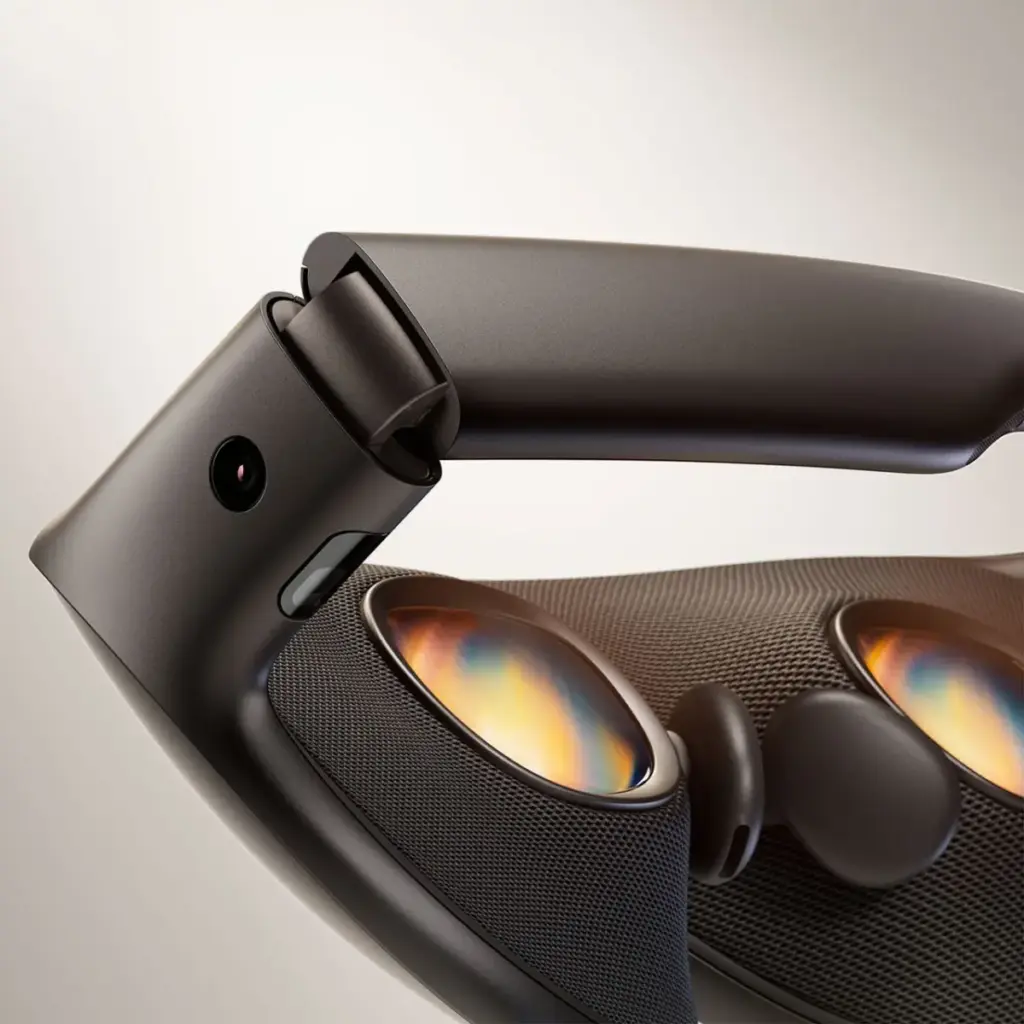
For all intents and purposes, the new hardware resembles a pair of slick dark glasses. They still carry the noticeable bulge characteristic of virtual reality hardware, but their design leans closer to the streamlined look of X-Men’s Cyclops rather than the heavy-duty cybernetic aesthetics of Johnny Mnemonic. These streamlined shades feature a tethered cable leading to a "puck" roughly the size of an iPhone—a combined battery-and-computer pack that users can slip into a pocket or handbag, or clip securely to a belt. Its 45W fast-charging capability will likely come in handy, given that the internal battery holds enough juice for only about three hours of continuous playback. Even with this tethered accessory, the trade-off feels far less obtrusive than dealing with larger, heavier predecessors. The glasses themselves weigh in at a mere hundred grams—about a quarter of a pound—a stark contrast to the five-to-six-hundred-gram weight of the standard Meta Quest.

The most significant operational upgrade from the Meta Quest, however, is the complete absence of handheld controllers and the heavy reliance on physical hand gestures instead. While Apple’s equivalent hardware already utilizes gesture-based controls, the Meta VR Glasses offer the ability to use flicks and pinches without making the user feel like they are trapped in a high-tech torture device.
Initial physical adjustments appear relatively straightforward, featuring switchable nose pads of different sizes and lenses that users can slide horizontally to ensure proper interpupillary distance. While official information regarding accommodations for prescription eyeglasses remains unconfirmed, industry leaks suggest that prescription lens compatibility is part of the final product plan. Tiny cameras positioned alongside the stems of the glasses capture minor movements—such as using a thumb to mimic scrolling on a touch remote or pinching an invisible button. These motions in turn trigger and toggle menus affixed to the spatial environment surrounding the user. Meanwhile, outward-facing cameras on the front re-create regular vision, though with a minor catch. The surrounding world appears noticeably noisier, filled with digital visual static, and the frame rate does not always sync seamlessly with fluorescent lightbulbs, occasionally producing a slight flicker when looking past the floating user interface to actual physical surfaces.
Navigating the real world while wearing the device will likely remain a challenge, and certain advanced features like hologram projections and spatial audio for video calling were omitted from the initial tech demo. Nevertheless, the Meta VR Glasses feel intentionally engineered for sitting down to watch movies and television programs rather than actively augmenting physical reality. Equipped with a 5K display built from micro OLED panels, 37 pixels per degree, and Dolby Vision enhancements, the device delivers a remarkably high-quality visual image, with navigation gamified to match. Once a user syncs their eye movements to the cursor, simply glancing at an app icon illuminates it, requiring only a simple finger pinch to select.
The software ecosystem supporting the device is where the hardware becomes particularly compelling. In addition to standard streaming favorites like Prime Video, YouTube, DIRECTV, AMC+, Crunchyroll, Plex, and notably Tubi, Meta has partnered with IMAX to bring the immersive world of full-frame 1.43:1 IMAX movies directly to the headset. Currently, this partnership is poised to be the only way for audiences to watch films like The Odyssey in their native aspect ratio outside of a very limited selection of specialized cinemas. Sadly, that specific viewing option was unavailable during the limited tech demo, but the capability sets the Meta VR Glasses apart even from physical home media formats like Blu-ray and Ultra HD, which traditionally max out at standard 16:9 widescreen televisions. With films like The Odyssey, Sinners, and Dune: Part Three reflecting a surging consumer demand for expansive cinematic aspect ratios that traditional home setups cannot fully satisfy, this technology serves as a compelling alternative.

When it comes to the actual viewing experience, users are provided with a couple of distinct options. For most traditional films, a virtual screen pops up at a fixed distance, which future software updates will allow users to push backward or pull forward. That positional feature was not yet fully operational during the demo, leaving a portion of the screen slightly outside the glasses’ immediate field of view. While less than ideal, it remains early days for a product scheduled for release several months from now. The second option, tailored for select films and specialized experiences, is an "Immersive Cinema" virtual reality viewing room designed by Industrial Light & Magic in direct synchronization with the film content itself. During a Disney+ demonstration, the reviewer experienced a scene from Avengers: Infinity War—specifically the moment Thor harnesses the power of a dying star to forge his new hammer, Stormbreaker. For anyone who has ever fantasized about watching a blockbuster while seated inside a grungy space factory as molten lava splashes around the edges of the screen, the feature delivers. For other major Marvel and Star Wars properties, fully realized environments such as Tatooine and Avengers Tower appear to be in active development.
The 3D performance proves equally competent, as evidenced by a brief clip from Doctor Strange in the Multiverse of Madness, though the visual effect is arguably no more or less immersive than most current generation 3D television sets. At launch, dedicated 3D content will be available through partnerships with streaming services including HBO Max, Paramount+, and Peacock. However, the technology reaches a true level of novelty when transitioning from traditional cinema to live sports broadcasting. Users gain the option of watching games not just with a sweeping 180-degree field of view—exemplified during the demo by Game 4 of the 2026 NBA Finals—but by virtually sitting in a variety of exclusive courtside seats and glancing around the arena at will. This illusion is achieved through specialized cameras strategically placed by Meta during the event, meaning future sporting broadcasts must be specifically equipped for this type of capture if fans want to experience looking around the venue. At the same time, events like the NBA Finals and the FIFA World Cup underscore that sports are fundamentally social gatherings, suggesting that isolating oneself inside a headset might ultimately serve as a backup plan when other arrangements fall through.
The built-in speakers integrated into the glasses—controlled via tiny tactile buttons along the bottom of the stems—deliver a surprisingly robust surround sound experience powered by Dolby Atmos. This acoustic capability proves beneficial for rhythm-based gaming experiences like Beat Saber, one of 75 built-in games available at launch that have been specifically enhanced for the device’s hands-free tracking capabilities, alongside Xbox Cloud Gaming support for streaming full titles directly to the headset. Users also retain the option to scroll through social media feeds and type using a virtual keyboard projected onto flat surfaces in front of them, watching their digital ghost hands emit a spectral glow. While the novelty of such features may eventually wear off, the initial experience is undeniably thrilling for anyone unfamiliar with spatial computing technology—a demographic that appears to be the primary target market for Meta’s new hardware. Furthermore, traditional productivity capabilities are included, allowing users to mirror a Mac or PC desktop into the virtual workspace either wirelessly or via a physical USB-C connection.
Despite these advanced features, the device’s $1,299.99 retail price tag—which exceeds the cost of a high-end television and a dedicated Blu-ray player combined—may prove to be a significant deterrent for average consumers who have not yet dipped their toes into virtual reality. That hurdle likely explains why Meta plans to roll out heavily involved, hands-on tech demos for prospective buyers. The technology is difficult to appreciate fully through standard flat-screen video re-creations, as there is an undeniable sense of wonder in putting on the glasses and turning around to find a fully or semi-rendered digital space waiting to be utilized.

Certain technical hurdles remain to be resolved ahead of the official spring launch, such as light leakage from sources directly behind the user interfering with the field of view—perhaps the one inherent downside to adopting a more open frame design. A simple head tilt can generally mitigate the issue, and engineers demonstrated on-the-fly adjustments for reorienting screen placement within the horizontal field of view, promising that user-controlled positioning will arrive in a future software update.
Navigating the landscape of big tech in an increasingly complex digital environment naturally breeds a degree of skepticism regarding data privacy and corporate motives. Yet, the robust lineup of streaming partnerships, specialized viewing features, and lightweight design choices makes the Meta VR Glasses one of the more intriguing developments in modern consumer electronics for individuals who have remained hesitant to embrace traditional virtual reality hardware. Compared to existing market alternatives, the openness of the physical design—allowing wearers to easily peek out and reconnect with the real world at a moment’s notice—strikes a practical compromise that fence-sitters may find acceptable. If nothing else, the hardware offers a convenient and slightly less cumbersome alternative to seeking out rare theatrical screenings.