




For women navigating the complex social landscape of adulthood, friendship takes on many distinct chapters. There are childhood companions, camp friends, college confidantes, and colleagues who double as personal supports. But for those who opt into parenting during their reproductive years, a brand-new category emerges: the mom friend.

For many, the quest for mom friends can feel like reaching the final, most challenging level of a multi-decade game—a rite of passage that marks the ultimate frontier of post-childhood socialization. Finding your people in motherhood is notoriously difficult. Until a child reaches school age, parents often find themselves floating through awkward playdate fix-ups, relying on friends of friends, or striking up hesitant conversations with unfamiliar families at the local playground. Daycare programs can feel transient and transactional, and building genuinely solid, lasting relationships within a small community program often takes a year or more of consistent effort.

While some parents may be fortunate enough to have pre-existing close friends who happen to have children around the same time, those relationships come with geographical complications. Close friends often live across town, in entirely different neighborhoods, or even in separate states, meaning they remain safely categorized in their original friendship buckets rather than functioning as daily local supports.

Mom friends are fundamentally unique because they are structurally dependent upon another relationship entirely—that of your child and their child, and whatever natural commonalities those children share. They are also starkly time-dependent. Can you meet up on a whim? Would they like to grab that elusive post-drop-off coffee? For many, the casual morning coffee date feels like a myth, something that exists primarily in 1990s television shows rather than the hectic reality of modern parenting. Is making those connections ever really that straightforward?

For writer Hannah Pasternak, the traditional avenues of modern networking yielded limited results. Ultimately, the solution she found came from the oldest playbook available: returning to organized religion.

Returning to Religious Roots
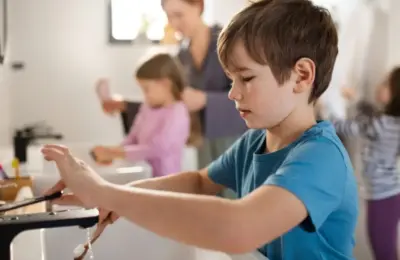
Nearly every Saturday morning, Pasternak and her husband take their young daughter to their local synagogue at 10 a.m. for "Tot Shabbat." Situated just two blocks from their apartment, the century-old building features magnificent stained glass windows and architectural quirks like a ceiling that looks perpetually on the verge of caving in. While the main Sabbath prayer service unfolds in the sanctuary, parents and toddlers gather in a multipurpose room featuring basketball court floors. Children aged five and under play freely on a blue carpet strewn with blocks, magnetic tiles, and toy cars.

Meanwhile, the mothers and fathers stand nearby, drinking their coffees and chatting. After a period of open play, the group transitions to a structured circle time led by a young teacher who guides the children through songs centered on gratitude and spiritual tradition, complete with colorful pom-poms. The families typically remain until noon, and crucially, none of them use their phones during this time. According to Pasternak, this low-tech, community-centered environment is precisely how she finally managed to make meaningful mom friends.

Pasternak acknowledges that her family’s routine places them somewhat outside the cultural mainstream. In a 2023 opinion column for the New York Times, journalist Jessica Grose highlighted the sharp decline in religious service attendance across the United States, describing it as potentially the largest and fastest religious shift in modern American history. The following year, Grose explored the phenomenon of young women fleeing organized religion in droves, a trend largely driven by traditional ideologies surrounding bodily autonomy and restrictive gender roles. Furthermore, a 2025 sociological study revealed that more than one in four Americans now consider themselves completely unaffiliated with any organized religion.

Culturally, among urban mothers of Pasternak’s generation, maintaining weekly religious observances is rarely seen as en vogue. Many people visibly bristle when she mentions observing the weekly Jewish Sabbath, often defaulting to assumptions that such traditions are overly restrictive, conservative, or anachronistic.

Yet, counter-currents are beginning to emerge. Where organized religion is being embraced anew, it is frequently championed by younger demographics, such as Generation Z, who are exploring the benefits of structured community, shared ritual, and collective belief during an otherwise isolating historical moment. The Wall Street Journal recently reported that Sunday Mass has unexpectedly emerged as a popular social hotspot for young New Yorkers. Last year, the New York Times documented a resurgence of the cross necklace as a fashion and identity statement among everyone from pop stars to political staffers, a trend also covered earlier by fashion publications like Elle.

Within modern interpretations of traditional Jewish culture, new hospitality concepts are also bridging ancient customs with contemporary urban life. Organizations like Shtick, founded by producer Jacqueline Lobel, curate editorial Friday night dinners and gatherings that celebrate classic New York City Jewish foods and customs, including a high-profile Shabbat dinner hosted for the Council of Fashion Designers of America.

These cultural shifts suggest there may be enduring value in what turning toward family traditions and denominational history can offer. Shared beliefs and structured rituals provide a foundational anchor. A house of worship, provided one finds the right cultural fit, naturally generates a localized community network—often at a financial cost significantly lower than a commercial children’s museum or specialized developmental class.

Finally Finding Mom Friends
When Pasternak initially began bringing her daughter to the synagogue, the motivation was rooted more in survival than socialization. Her daughter was only six months old at the time—a difficult napper who was invariably happier and calmer whenever they managed to get out of the house. Barely able to sit up independently, the baby was far too young to interact with peers. To Pasternak, the other mothers in the room appeared seasoned, poised, and operating like veterans, possessing an instinctive grasp of child-rearing that felt entirely out of reach.

For months, Pasternak largely kept to herself, quietly listening in on the conversations swirling around her. While some mothers were welcoming, asking her name and admiring her baby, she simply focused on the act of showing up consistently.

The dynamic shifted significantly after her daughter turned one. A new wave of toddlers joined the group, all concurrently learning how to walk, experimenting with solid foods, and developing longer attention spans. This cohort formed her daughter’s natural "class"—a group of children born within the same six-month window who had dropped their morning naps and were ready to build towers together and clap during circle time.

As the children synchronized their schedules, Pasternak and her daughter finally found their social groove. Invitations began to circulate for Shabbat lunches at fellow families’ homes, and Pasternak started hosting gatherings in return. At the end of these events, as mothers wrestled children into heavy winter coats and wiped leftover kugel from flushed faces, they would routinely make spontaneous plans to meet up later that afternoon in Central Park.

Because these gatherings occurred on the Sabbath, during which none of the participating families used their electronic devices for a 25-hour period, the arrangements relied entirely on commitment rather than digital coordination. Without phones, text notifications, or social media feeds to distract them, the parents engaged in uninterrupted conversation once they reached the park. Pasternak describes the weekly ritual as simultaneously bucolic and surreal—an alternate reality operating on a completely different frequency from the rest of her modern social life.

The resulting circle of mom friends consists of women living in the same immediate neighborhood who pursue diverse careers and maintain independent social networks outside of motherhood. Their shared group chat remains strictly practical, used primarily to confirm weekly meetups or coordinate attendance at holiday celebrations like Purim puppet shows and Hanukkah parties.

Reflecting on the experience, Pasternak suggests that this is precisely what religious institutions, despite their historical divisions, were originally designed to offer: a dependable destination to visit with your child every weekend, the institutional momentum to keep showing up, and a community of people who genuinely expect you to be there. And, for those fortunate enough to participate, the occasional slice of kugel.