



By Frederick Dreier
Published October 6, 2026
Outside features editor Frederick Dreier participated in the October 4 Ötillö Swimrun race at Horsetooth Reservoir, Colorado. Dreier has competed in triathlons, bicycle races, and other endurance sports for 25 years.
A few vivid memories come to mind from my recent Ötillö Swimrun, the unique endurance race that combines open-water swimming with trail running. In one, I am floundering in the chilly waters of Colorado’s Horsetooth Reservoir near Fort Collins, my arms feeling heavy as concrete as I struggle to maintain a straight line. In another, I am sitting by the side of a rocky trail, gingerly plucking cactus spines out of my backside moments after a clumsy toe-strike sent me tumbling headfirst into a clump of prickly pear.
Both of these scenes, however, are ultimately superseded by a memory with an altogether different vibe. That, of course, is crossing the finish line and exchanging a flurry of enthusiastic high-fives and hugs with a group of random, sweaty strangers, all of us clad in neoprene wetsuits, goggles, and running shoes.
You see, despite the dead-tired arms, the aquatic struggles, and the cactus needles in an uncomfortable place, I had an absolute blast racing my first Ötillö Swimrun event on Sunday, October 4.
What the Heck Is a Swimrun?
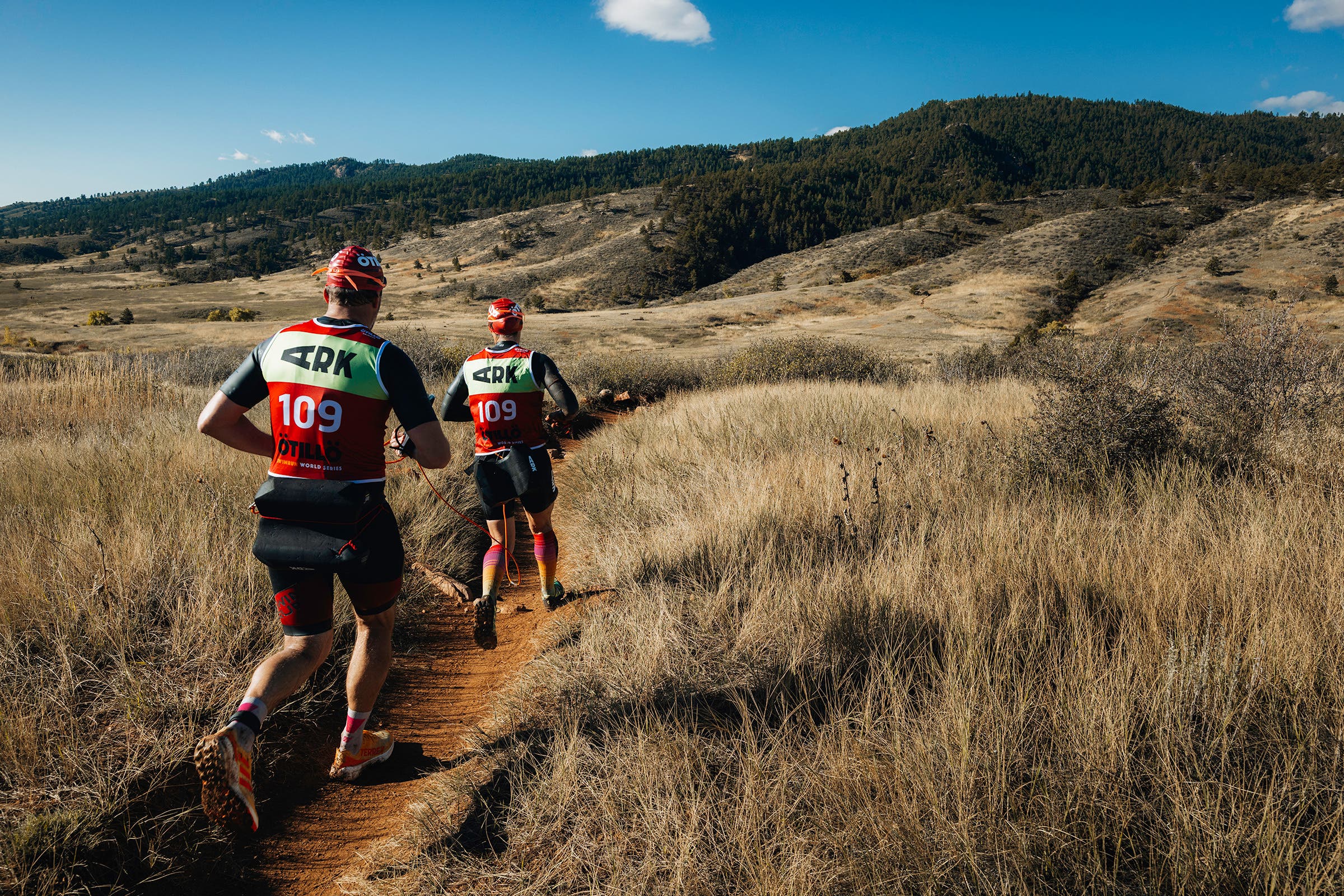
If you have never encountered the swimrun racing format, a quick primer helps clarify the unique physical demands. Picture a traditional triathlon, but subtract the cycling component entirely. Now, take the swimming and running portions, chop them up into smaller, alternating segments, and lay them out across a continuous, point-to-point course. You run, then swim, then run again, then swim, repeating the cycle until the finish line. The event I tackled was a sprint-distance race comprised of five distinct swims and six trail runs, winding across roughly 12 miles of rugged terrain and open water.
It took me nearly three hours to complete the course, and at no point during those three hours was I actually sprinting.
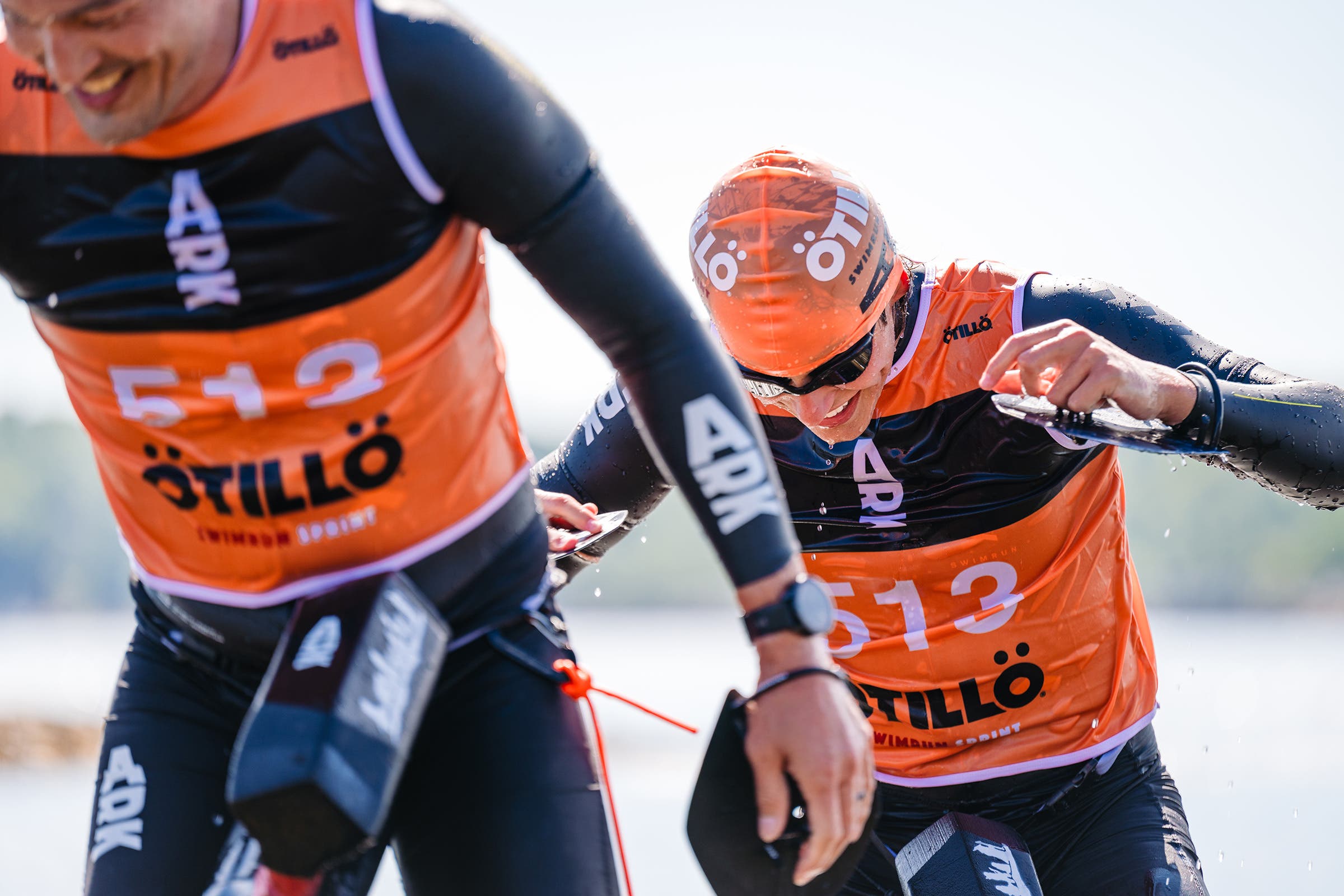
Unlike a standard triathlon, where participants abandon their gear in transition areas after each leg, swimrun requires athletes to carry every piece of equipment from the very beginning to the very end. Consequently, you must swim while wearing your running shoes, run while zipped up in your wetsuit, and carry your pull buoy, hand paddles, and any other allowed swimming aids for the entire journey. This equipment constraint regularly leads to some hilarious blunders out on the course.
Within the global swimrun community, Ötillö stands out as the proverbial Ironman—the most recognizable and prestigious brand in the sport. Outside has a rich history of chronicling the Swedish company and its distinctive events, starting with coverage in 2013 and 2014, followed by a 2017 column by Brad Stulberg. In 2019, longtime contributor W. Hodding Carter wrote an in-depth feature about his own misadventures at the Ötillö World Series race in Cannes, France, where he and a partner paddled across the green-blue Mediterranean Sea and jogged through the picturesque French Riviera.
In all of those accounts, Ötillö swimrun races emerge as grueling, remarkably fun, and distinctly European affairs. The racing format itself was developed in Sweden and first held across a desolate, beautiful chain of islands just east of Stockholm, which still serves as the permanent home of the annual Ötillö World Championships. The name “Ötillö” is derived from a Swedish phrase that loosely translates to “island to island.”
Ötillö Expands to North America
Fortunately for American endurance athletes, Ötillö is no longer confined strictly to Europe. Back in 2023, the organization expanded its footprint into North America by acquiring a budding collection of U.S. swimrun events known as the Odyssey series. That domestic series was co-founded by Lars Finanger, an industry figure with whom I happened to share a house as a roommate in Boulder two decades ago, back when we were both dirtbag triathletes chasing a daily endorphin high on the local roads and trails.
Today, Finanger is working to spread the Swedish swimrun gospel across the United States, where jogging along dusty trails in a full-body wetsuit remains about as culturally mainstream as snacking on pickled herring.
“We started out with a lot of triathletes, Ironman finishers, and Eco-Challenge racers—it was a really eclectic group of endurance athletes,” Finanger told me recently. “Now we have a small but dedicated following of athletes who see themselves as swimrunners first, even though they might do a triathlon or a bike race, too.”
Finanger first learned about the sport through the 2013 Outside article. Experiencing burnout from years of traditional triathlon and road cycling, he was actively looking for a fresh challenge. He ultimately signed up for the demanding world championship event in Stockholm, a punishing contest featuring 38 miles of running and 5.7 miles of swimming, which requires participants to compete in teams of two. It stands as a rigorous test of endurance and grit that requires upwards of ten hours for many teams to complete.
“I had this big grin on my face throughout the whole thing, even though the water was so frickin’ cold and the trails made you feel like you were running through the hobbit scene from The Lord of the Rings,” Finanger recalled. “I realized we didn’t have anything quite like it in the USA.”
Eager to bring the concept stateside, Finanger wanted to start his own race but lacked a logistical roadmap. As fortune would have it, he was not the only individual intrigued by the format. Jeffrey Cole, a veteran of the endurance sports industry and a longtime triathlon race director, reached out to Finanger via email to discuss the potential of the swimrun format. Cole suggested that Casco Bay, Maine, near his home in Kennebunkport, offered the ideal coastal topography to replicate the island-hopping nature of Sweden’s Ötillö. In 2015, they launched the inaugural Odyssey event along the scenic Maine coast.
“I think about the history of triathlon, where athletes raced in Kona and then went back home to put on their own races where they lived,” Finanger said. “We wanted to produce a swimrun that we’d have wanted to do ourselves.”
The operational model proved successful. Finanger and Cole subsequently expanded their offerings to establish additional swimrun races across the U.S., including events on Orcas Island in Washington, Cedarville in Michigan, Austin in Texas, and California’s Catalina Island. These events became annual fixtures, with participation numbers eventually surpassing 400 athletes at select venues.
Following Cole’s passing in 2018, Finanger maintained the business alongside a small group of new partners. In 2023, Ötillö approached them about purchasing the Odyssey series to bring the American events under its corporate umbrella. Finanger noted that the acquisition decision was a straightforward one. It meant partnering with the widely recognized gold standard in the sport.
These days, the former Odyssey races continue to award ranking points to elite competitors seeking qualification for the world championship in Stockholm. Yet they also maintain shorter distances, solo entry categories, and a remarkably laid-back atmosphere. The primary objective, Finanger emphasized, remains welcoming newcomers into the fold.
“We are still this meeting ground for all of these different types of athletes—swimmers, cyclists, triathletes,” he said. “The one thing they have in common is that they are adventure-minded.”
Jell-O Legs and Juggling Gear
Qualifying for a competitive European championship was far from my mind as I prepared for the 2026 Colorado Ötillö. The shorter sprint distance I chose did not offer qualification points toward the Stockholm world championships, though the much longer World Series race held concurrently on a 23-mile route certainly did.
When I asked Finanger for strategic guidance ahead of the start, he simply laughed off the request. “Just have fun out there, dude,” he advised, reminding me that the entire point was to curate a personal adventure while swimming and jogging around the lake.
The casual atmosphere at the starting line reinforced Finanger’s advice. Over the years, I have nervously awaited the starting horn at Ironman triathlons, marathons, and various competitive cycling races. At Ötillö, the collective vibe was exceptionally relaxed, resembling the welcoming mood of a color run or a recreational bicycle parade rather than a strenuous multi-hour test of stamina.
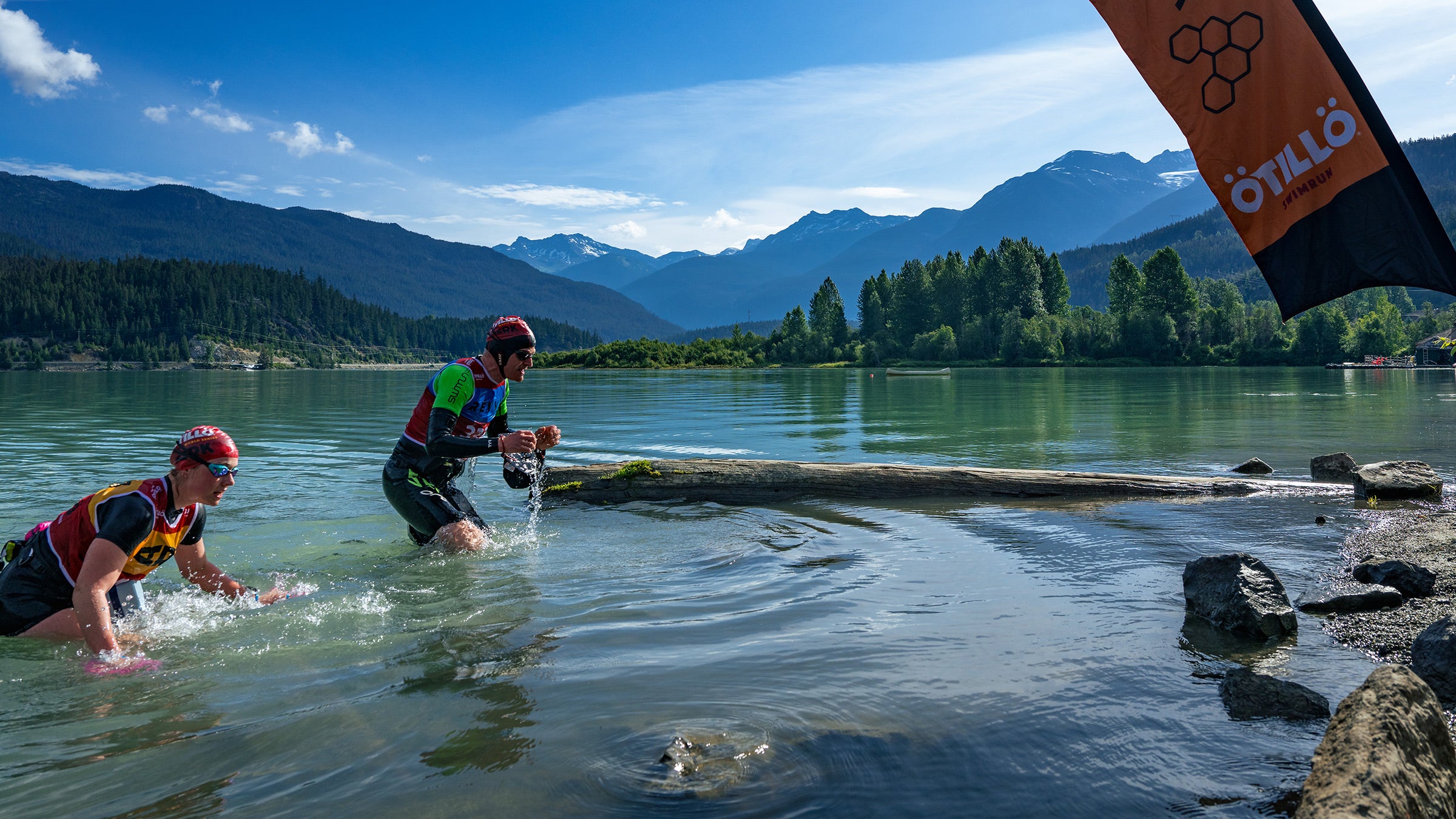
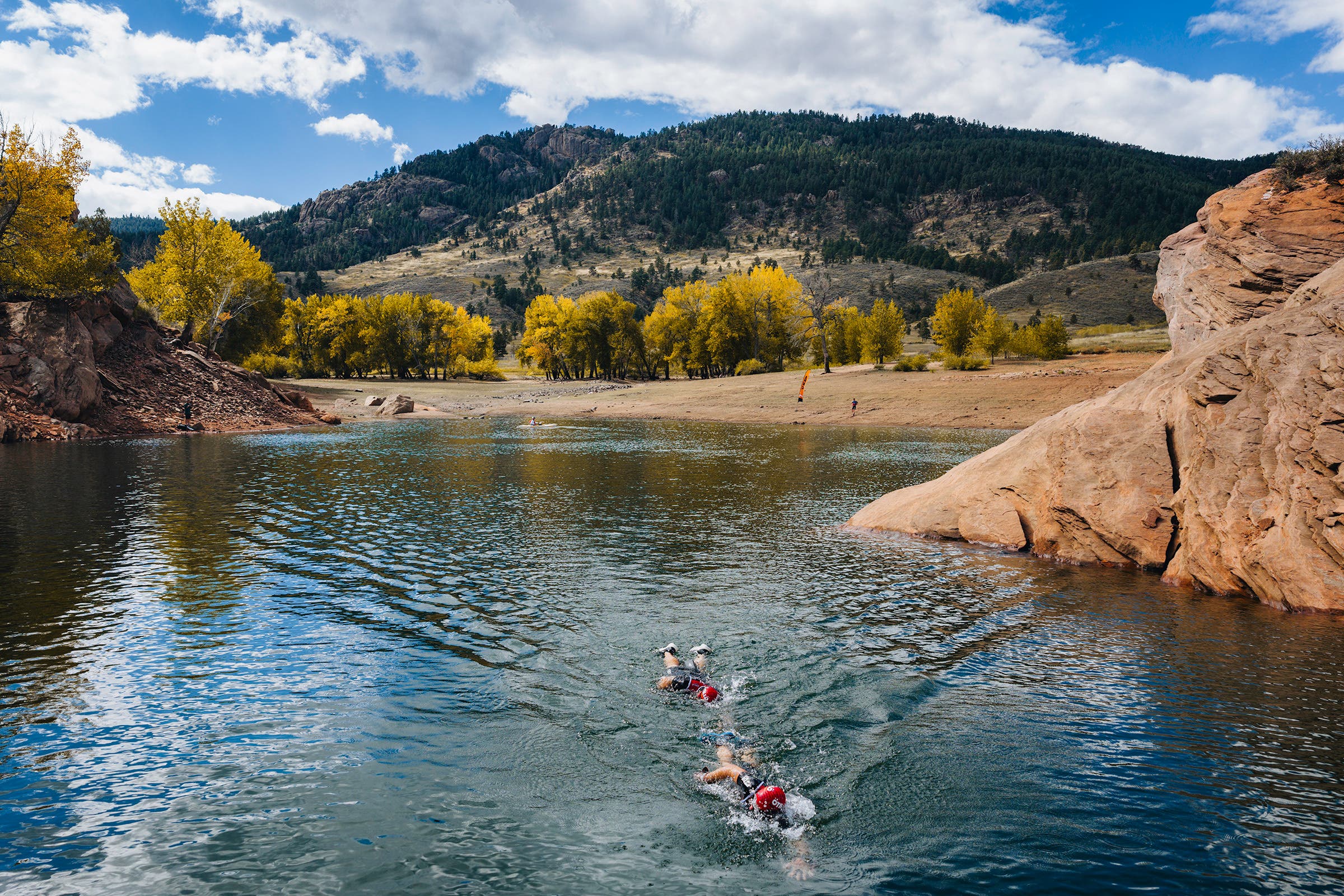
Still, I had to deliberately remind myself to relax during the early moments of the race. Following a fast one-mile trail run to kick off the event, the field plunged directly into the chilly waters of Horsetooth Reservoir for the first swim leg.
As a former NCAA Division-III swimmer and a multiple Ironman finisher, I am well-accustomed to swimming in choppy water surrounded by thrashing limbs. However, I initially struggled to find an efficient rhythm while managing swimrun gear. I had to pause several times to properly position my pull buoy between my thighs and adjust to the unusual drag of kicking while wearing sneakers. An even greater physical challenge awaited me upon exiting the water.
Stepping onto the rocky, clay shoreline, I immediately stumbled around like a newborn fawn. The sudden transition from horizontal swimming to vertical running left me feeling as though I had consumed several shots of tequila. I lumbered toward the trail entrance, zigzagging my way up an incline like a punch-drunk fighter.
Upon leaving the water, experienced swimrunners typically secure their pull buoys to their waists using an elastic cord, allowing the foam apparatus to rest against their lower back like a fanny pack. I fumbled clumsily to secure mine as I trotted along, the buoyant block bouncing awkwardly against my backside. As I twisted and turned to adjust the cord, one of my plastic swim paddles slipped from my fingers, clattering loudly into a roadside bush. I weighed my options: should I keep moving or stop to retrieve it? I chose to stop.
That brief pause allowed my spiking heart rate to settle. Within moments, the exercise-induced fog cleared from my mind, allowing me to regain my focus. I located the stray paddle, and as I resumed jogging along the path, I familiarized myself with the peculiar gear configuration. I practiced tucking and untucking the pull buoy into its tether and threaded my fingers securely through the elastic retaining loops on my hand paddles.
In a standard triathlon, competitors rely heavily on equipment engineered specifically for each isolated discipline: aerodynamic bicycle frames, highly cushioned running shoes, and streamlined swim goggles. Part of the quirky charm of swimrun, by contrast, involves learning to manage gear when it is temporarily serving an unconventional purpose.
As my confidence grew, I picked up the pace, jogging past fellow participants while stepping aside whenever faster racers called out to pass. The mood on the trail remained uniformly positive. Nobody appeared so consumed by their personal physical struggles to skip offering an encouraging shout of encouragement to those passing by.
An Adventure Where Things Go Wrong—and It’s OK
The sprint course eventually diverged from the longer World Series route near the five-mile mark, prompting me to wave farewell to the athletes tackling the extended distance. Spotting a handful of sprint competitors positioned just ahead, I decided to push my pace along a long, winding switchback ascent in an effort to close the gap.
Whether it was my soaring internal temperature trapped beneath the neoprene wetsuit or lingering fatigue, my concentration faltered as I closed in on the runner ahead. My toe clipped an uneven rock, sending me into a clumsy somersault that ended abruptly in a patch of prickly pear cactus. Brushing myself off, I made a mental note regarding the realities of the sport: things can deteriorate quickly if focus lapses even for a second.
The minor mishap required me to spend a few minutes plucking lingering spines from my rear end after crossing the finish line. Yet that exact ordeal delivered one of the most enduring takeaways from the entire experience.
Perfection simply does not exist in a swimrun event. Even during a shorter sprint race, participants are bound to swallow lake water, fumble with equipment drops, battle profound physical exhaustion, or stumble on uneven terrain. How an athlete responds to those inevitable setbacks ultimately defines the day.
Having spent the past quarter-century participating in various endurance sports, I am intimately familiar with the trajectory most athletes follow. You initially try out a sport and fall deeply in love with the inherent adventure, camaraderie, and community. As the years progress, however, the focus often shifts heavily toward performance metrics, strict training regimens, optimized dietary protocols, and obsessive tracking of race results.
While I fully intend to enter another Ötillö Swimrun in the future, I cannot envision myself ever becoming overly rigid or hyper-competitive about the format. Simply completing this race delivered a genuine sense of adventure and carefree silliness, entirely devoid of self-importance. Embracing the imperfect nature of the experience provided half the joy, and I look forward to chasing that feeling again.