

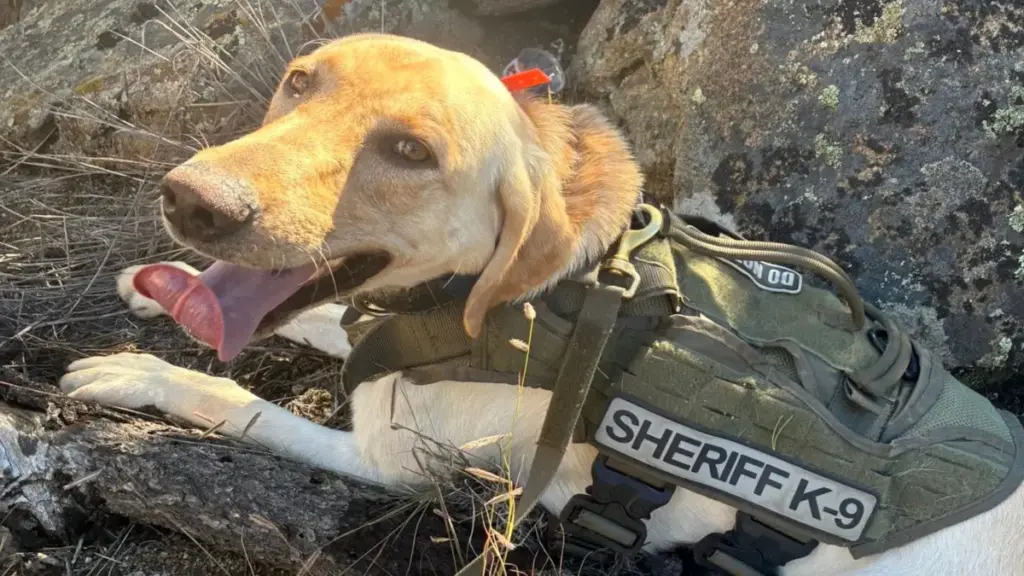
BUENA VISTA, Colorado — When three young children vanished into the rugged terrain of the Rocky Mountain backcountry near Buena Vista on September 26, local emergency responders immediately mobilized a comprehensive search operation. Fearing the worst as temperatures threatened to drop and daylight waned, the multi-agency response team deployed high-tech drones, multiple foot patrol units, and an aerial helicopter to comb the sprawling landscape near the popular Midland Bike Trail.
Yet, despite the array of modern technology scanning the dense timber and rocky outcroppings, it was a low-tech, four-legged K-9 officer that ultimately turned the tide of the search. Archie, a two-year-old yellow Labrador specially trained in scent tracking, cut through the wilderness and located the missing children just five hours after they were first reported missing, proving the irreplaceable value of an exceptional nose in remote terrain.
The incident began earlier that day at a campsite situated near the Midland Bike Trail, a heavily trafficked multi-use singletrack route located on the eastern side of Buena Vista. The children—comprising two six-year-olds and one nine-year-old—were part of a large group enjoying a camping trip in the area. Around 9 A.M., family members realized the trio had wandered away from the campsite and were nowhere to be found.
Perplexed and alarmed, the family conducted their own frantic two-hour sweep of the immediate area before realizing the children were genuinely lost. Recognizing the potential danger posed by the sprawling and unforgiving mountain environment, family members contacted the Chaffee County Sheriff’s Office to request emergency assistance.
When law enforcement and search and rescue teams arrived at the scene, they faced a daunting operational challenge. The landscape surrounding the Midland Bike Trail is characterized by steep inclines, dense vegetation, rocky formations, and a myriad of natural hiding spots that can easily conceal small children from both ground searchers and aerial surveillance.
Deputy Kendra Hoffman of the Chaffee County Sheriff’s Office, who coordinated the emergency response, noted that traditional aerial search methods have severe limitations when looking for young children in rugged terrain. Because children are naturally smaller in stature and frequently seek out shelter beneath natural rock overhangs, fallen timber, or dense brush when they become frightened or disoriented, overhead technology often fails to spot them.
"Kids are smaller. They like to hide in places," Deputy Hoffman explained in an interview detailing the operation. "Just because we have drones and helicopters in the air, if they’re hiding under a rock or a tree, we’re not going to see them through the air. That’s why I was like, ‘let’s get Arch en route.’"
When to Bring in a SAR Dog
Deploying a search and rescue dog in a backcountry environment requires careful tactical timing by law enforcement and rescue coordinators. Standard protocol in many search operations dictates that handlers typically avoid bringing in tracking canines if a person has been missing for an extended period, generally exceeding several hours. As time elapses, the risk of scene contamination increases significantly as other searchers, family members, and bystanders move through the area, inadvertently leaving behind a chaotic web of competing human scents that can easily overwhelm a working dog.
Despite these standard operational hurdles, Archie was rushed to the scene and integrated into the active search almost immediately after deputies arrived. Because the timeline was still relatively tight and the children’s last-known location was well-established by the campsite, handlers determined that a scent-specific tracking dog offered the best chance of cutting through the dense wilderness.
To give the young Labrador the best possible start, search handlers utilized a stuffed animal belonging to one of the missing children. By allowing Archie to thoroughly sniff the personal item, handlers imprinted the specific scent profile onto the dog, giving him a distinct target to pursue in the open wilderness.
The strategy yielded immediate results. Relying entirely on his acute sense of smell and specialized training, Archie quickly locked onto the scent trail and began driving forward. He led his handler and a team of three deputies downhill from the campsite toward a sandy wash located approximately 1.5 miles away. Along the sandy wash, the human searchers spotted clear children’s footprints, confirming that Archie was tracking the correct path.
"He [took] rescuers pretty much right to them," Deputy Hoffman said, reflecting on the precision of the dog’s tracking work. "It was downhill, but I know that my three deputies were definitely very worn out when they got back to the command."
Approximately five hours after they had first disappeared from their campsite, the three children were located unharmed in the remote area 1.5 miles from where they were last seen. Though cold and tired, they were safely recovered and reunited with their anxious family members, thanks in large part to the relentless pursuit of the department’s newest canine member.
For the Chaffee County Sheriff’s Office, the successful operation carried extra significance because Archie is still relatively new to the department. Deputy Hoffman noted that this high-stakes deployment marked the young Labrador’s very first on-duty search assignment.
"I wanted to personally see how he could work," Hoffman said, expressing her satisfaction with the dog’s exceptional performance under pressure.
Teach Your Kids to Avoid Getting Lost
While Archie’s swift and decisive work resulted in a happy ending for the three children and their families, the dramatic rescue serves as an urgent reminder to parents and guardians venturing into the backcountry of the vital importance of wilderness safety education. According to local search and rescue authorities, the incident highlights several critical lessons that can drastically reduce search times and keep children safe if they happen to become separated from their group.
Deputy Hoffman emphasized that the single most important rule for children who become lost in the wilderness is to stay put rather than wandering further into unfamiliar terrain. Parents should explicitly teach their children to stop moving the moment they realize they are lost, using the simple and memorable phrase "hug a tree" to anchor them to a single stationary location. When lost children continue to walk, they often inadvertently increase the search radius exponentially, making it significantly harder for ground teams and tracking dogs to intercept them.
Furthermore, Hoffman advised that if children spot individuals actively searching for them, they must make themselves immediately visible rather than remaining hidden out of fear or shyness. Rescuers, particularly search and rescue personnel, typically wear bright, high-visibility clothing specifically designed to stand out against the natural tones of the forest. Children should be instructed to approach anyone wearing a uniform or bright rescue gear and clearly state that they are lost. Additionally, children should always establish a firm rule to inform an adult before wandering away from a designated camp area.
These fundamental safety steps can dramatically accelerate rescue operations when emergency responders are racing against the clock. However, having witnessed firsthand the extraordinary capability of the department’s K-9 unit in navigating the rugged Chaffee County landscape, Hoffman indicated that the sheriff’s office plans to integrate the canine team into future emergency responses much more frequently.
Following his stellar debut in the Rocky Mountain backcountry, it appears the rookie yellow Labrador has earned the full confidence of his department.
"I see us using Archie a lot more now," Hoffman said.