


Fans of Truman Capote’s enduring literary legacy will soon have an unprecedented opportunity to own a tangible piece of the author’s private life. Decades after the iconic writer’s death in 1984 at the age of 59, nearly 400 lots of his personal effects are heading to the auction block. The upcoming sale offers a rare glimpse into the intimate world of the man behind American literary masterpieces like In Cold Blood and Breakfast at Tiffany’s, whose vibrant life and complex social circles have recently been re-examined in popular culture through the 2005 biographical film Capote and the 2024 television miniseries Feud: Capote vs. the Swans.

The massive collection of personal possessions is being put up for auction by Gerald Clarke, a journalist, close friend, and Capote’s biographer, who inherited many of the author’s belongings following his death. Now 89 years old and in the process of downsizing, Clarke has entrusted Cornell Auction in Bellport, New York, with the significant task of finding new homes for these historical items. The official auction is scheduled to take place on November 21, preceded by an online preview and the opening of bidding on October 26. While the full catalogue has yet to be publicly released, the auction house shared an exciting preview via social media, revealing that the vast majority of the items included in the sale were meticulously documented half a century ago. Specifically, most of the artifacts up for grabs were featured prominently in a landmark 1976 Architectural Digest spread that showcased Capote’s custom-built beach house in Sagaponack on Long Island’s South Fork.
Among the standout pieces confirmed for the auction are elements from Capote’s extensive and unique collection of paperweights. According to Clarke, the famous scribe "became addicted to paperweights and collected so many of them" that they practically populated every corner of his home. Several of these mesmerizing objects were crafted by Capote himself using delicate flowers preserved in resin. Perhaps most remarkably, one specific paperweight included in the auction lot was constructed using small stones gathered directly from the Kansas farm that served as the harrowing backdrop for his groundbreaking 1966 non-fiction novel In Cold Blood. Other notable lots heading to the auction block include a deeply personal, signed copy of To Kill a Mockingbird gifted by his lifelong friend and fellow literary giant Harper Lee, a whimsical bronze frog inkwell, and even Capote’s own house keys.

The provenance of these items is deeply tied to the secluded Long Island sanctuary that Capote once described as "Kansas with a sea breeze." Finding the author’s Sagaponack residence has always been a formidable task, hidden entirely behind dense barriers of scrub pine, towering privet hedges, and thick rows of hydrangea bushes. Located in the heart of the Hamptons—a picturesque landscape where rolling potato fields and lush farmlands meet the crashing waves of the Atlantic Ocean—the property offered Capote a quiet refuge. In its heyday, the surrounding area functioned as a kind of rural Montparnasse, playing host to a concentration of towering artistic and literary figures including James Jones, Willem de Kooning, Marya Mannes, Jean Stafford, and Joseph Heller. Yet, despite its proximity to high society, the sleepy community maintained a small-town charm where local establishments would run affectionate birthday ads for the author in the biweekly newspaper, allowing him to come and go entirely as he pleased.
The journey to the flat-roofed, box-shaped wooden beach house typically began with Capote behind the wheel of his deep-green Buick, navigating a bumpy ride down a historic dirt lane first established in 1670. A quick turn into a gravel driveway past a natural bird sanctuary and a friend’s cottage situated on the property would bring visitors to the author’s front door. "I own these fields," Capote proudly remarked during the 1976 Architectural Digest interview, sweeping his hand across the six acres he purchased in 1962. He had the structure built precisely to his own specifications by a local carpenter, deliberately cultivating an untended, rustic look. "It’s intentional. You can see how quiet it is here because you can barely see the top of another house. This is a place to be alone."

While Capote was internationally renowned as a social butterfly who effortlessly moved between prisoners and princesses, socialites and sailors, his life in Sagaponack was defined by strict isolation and a rigorous writing routine. During the autumn and winter months, he saw virtually no one, retreating to the dunes to focus entirely on his craft. His daily schedule was remarkably regular: rising around 7:00 a.m. to work until 11:00, pausing briefly to read the morning papers, and returning to his desk until a 1:00 p.m. lunch. Afterward, he would drive to the post office, run routine errands, take long walks, and spend his evenings reading or walking his famous English bulldog, Maggie. By 9:30 p.m., he was typically tucked into bed with a book.
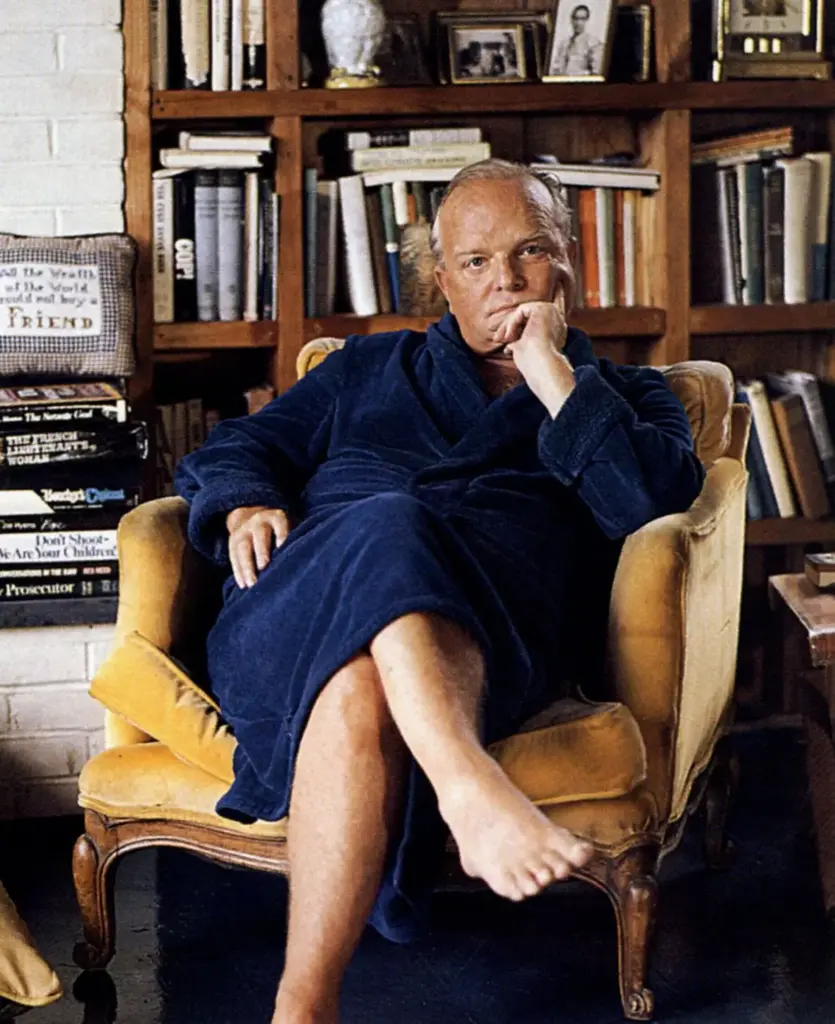
Inside the two-story, marine-blue-floored living room, the atmosphere blended oceanside ease with intellectual depth and eccentric humor. Possessions were arranged for comfort rather than display, featuring a priceless Tiffany lamp, a worn yellow velvet easy chair, and a distinctive "witchcraft altar" set up on a small set of steps. The altar featured an eclectic array of objects, including an antique wood cat baring its fangs, a bronze bell, and a Cocteau-designed needlepoint mask pillow. A spiral steel staircase led to a balconied second-floor study lined with red sofas, wicker furniture, and a celebrated pencil portrait of the author by René Bouché. Capote designed the interiors entirely himself, famously declaring that using a professional decorator was a bore because he preferred to live exclusively with things he inherently understood and loved.

At the time the home was photographed for Architectural Digest, Capote was actively working on his long-awaited, highly controversial novel Answered Prayers and had recently wrapped up his first major film role as the eccentric millionaire Lionel Twain in Neil Simon’s comedy Murder by Death. Reflecting on his life, his collections, and his deep-seated attachment to the places he had lived, Capote often embraced the transient nature of his belongings, once quipping about his extensive collection of rumpled panama hats, "Home is where I hang my hats." Now, decades after his passing, those hats, paperweights, manuscripts, and memories are finally preparing to find new homes, offering collectors and admirers a rare and permanent connection to one of America’s most singular literary voices.