
Few chefs have shaped Chicago’s contemporary dining landscape with quite the prolific energy of Zubair Mohajir. Over recent years, his culinary footprint has expanded across the city through ventures like Lilac Tiger, Mariela, Mirra, and Sarima. Yet, his most recent opening, Muhājir, represents a profound departure from the formulaic launches typical of modern urban dining scenes. Instead of relying on conventional trends or contemporary fusion tropes, Muhājir serves as a deeply personal exploration of historical spice routes, global migration, and ancestral identity.
The restaurant stands as a centerpiece of Now Open, a yearlong editorial series celebrating some of the most exciting new restaurants across major metropolitan areas including Chicago, New York City, and Washington, D.C. Throughout the year, culinary teams provide behind-the-scenes glimpses into the grueling, exhilarating reality of launching a buzzy concept. These insights culminate in exclusive dining experiences hosted as part of Dinner Party, presented by Capital One, offering diners and industry observers alike a rare window into the challenges, candid reflections, and creative philosophies driving the nation’s top culinary proprietors.
For Mohajir, Muhājir is more than just another restaurant addition to a growing portfolio; it is the culmination of a lifelong search for professional and personal alignment. To understand the restaurant is to understand the literal and figurative journey encoded in its name. In both Arabic and Urdu, the word "muhājir" translates to "one who migrates." Historically, the term was applied to the millions of Muslims who were displaced during the tumultuous partition of India and Pakistan. Growing up, Mohajir often wondered about the origins of his surname, a question that lingered as he transitioned from a career in finance into the professional culinary world.
That curiosity was further fueled by his late maternal grandfather, who dedicated himself to mapping the precise geographical origins of the family name. The trail ultimately led back to Southern Basra in Iraq—a discovery that profoundly shifted Mohajir’s perspective, as the region sits directly along one of history’s most influential and ancient spice routes.
This fascination with historical trade routes is not entirely new for the chef. For the past five years at Coach House, Mohajir has immersed himself in the ancient culinary traditions of southern Spain and Portugal. Those regional cuisines carry the complex imprints of pre-Crusade Muslim, Christian, and Jewish influences, which were continually reshaped by Southeast Asian traders navigating the maritime and terrestrial spice roads threading through the Mediterranean, North Africa, and the Iberian Peninsula. An obsessive student of history, Mohajir realized that his cooking could serve a higher purpose: feeding people while grounding every dish in its historical and geographical context.
At Muhājir, that philosophy takes center stage by mapping a spice road that stretches from Portugal through the Mediterranean, weaves through the Levantine region, extends out of Basra into the Persian Gulf, and ultimately terminates in southern India, where Mohajir’s family roots lie. In Mohajir’s view, the restaurant’s narrative extends beyond his own genealogy to encompass a universal human truth. Everyone’s family originated somewhere, making the concept of migration a unifying force that drives the restaurant’s culinary vision.

What Did You Want to Explore With Muhājir That You Hadn’t Been Able to Do Yet With Your Previous Restaurants?
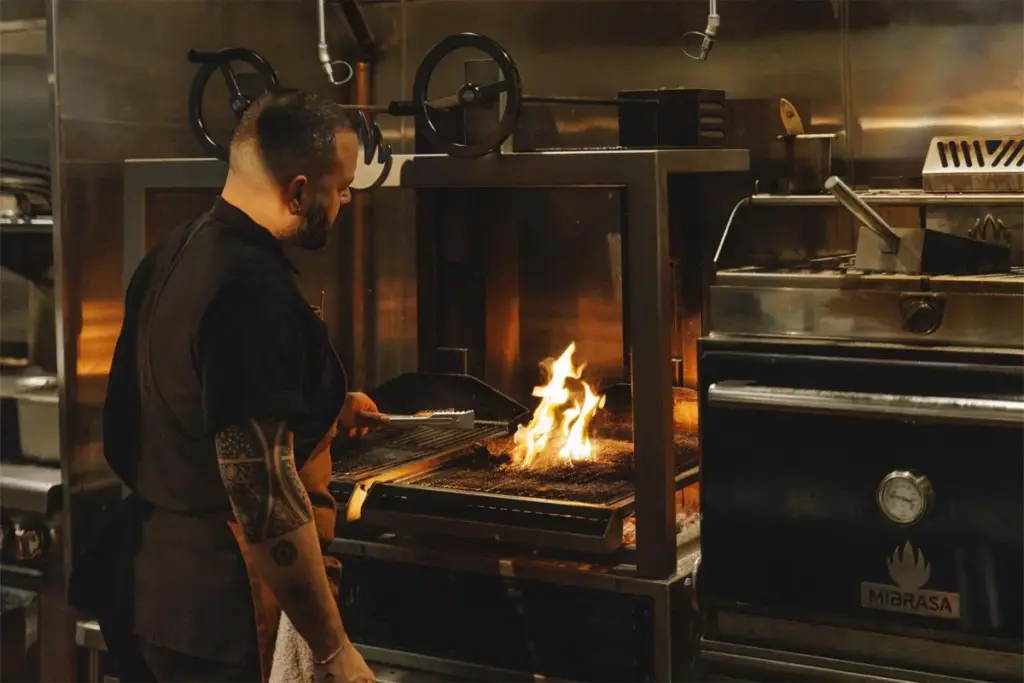
The decision to ground Muhājir in personal history manifested physically through the restaurant’s primary cooking medium: live fire. Although Mohajir had never previously cooked over live fire in his professional career, the choice felt like an inevitable return to culinary fundamentals. Reflecting on his childhood in his grandmother’s home in India, where modern gas stoves were far from ubiquitous, he recognized that the narrative he wanted to express could not be achieved simply through a standard sauté pan on a conventional kitchen range. Telling the story of ancient trade routes and ancestral migration demanded the elemental, raw energy of wood fire.
This commitment to historical authenticity and primal cooking methods is most vividly expressed through the restaurant’s signature dish: a duck experience inspired by a remarkably preserved 927-year-old recipe uncovered from southern Spain. The dish serves as a edible chronicle of cross-cultural synthesis, carrying echoes of Roman garums alongside distinct Muslim and Jewish culinary origins.
The preparation is an intensive, multi-day process. The kitchen begins with a whole duck, which is meticulously butchered. The crown is set aside to dry-age for seven days, while the wings are rendered down into a rich jus and the legs are transformed into a tender confit. When service begins each day, the duck crown is blasted directly over the open fire before being finished in the brasa. Diners seated in the dining room have a direct view of the whole ducks hanging and smoking above the flames.
When the dish is finally presented to the table, it arrives on an ornate Turkish platter designed to mirror the grandeur of historical feasts. The arrangement features a complex black raspberry achaar, a warm saucier of duck jus, and a side of seasoned duck rice. The duck skin is meticulously sliced into crisp medallions that sit atop the presentation almost like duck chicharrón, accompanied by the primary duck breast, which boasts a remarkably crispy skin. The crown of the breast is seasoned with an authentic spice blend faithfully reconstructed from the 900-year-old manuscript, featuring a sophisticated balance of cumin, coriander, cardamom, toasted pine nuts, red wine vinegar, and fish sauce. It stands as a literal and figurative testament to historical cross-cultural collaboration.
A Tale of Two Spaces: Integrating Muhājir and Bobo
The culinary experience at Muhājir is closely tied to its physical environment, which extends beyond the main dining room into an adjacent bar named Bobo, located directly behind the restaurant. The creation of Bobo was a collaborative vision shaped by Jacob Dela Cruz, Mohajir’s close business partner and collaborator on previous ventures like Sarima. It was Dela Cruz who originally suggested the name Muhājir, pointing out the profound simplicity of the reality that everyone comes from an immigrant background.
When the time came to conceptualize the bar space behind the restaurant, the collaborative spirit was reciprocated. Bobo is affectionately named after Dela Cruz’s father, whose name is Bho, combined with the Tagalog word "bobo," which translates to "silly" or "stupid" as a term of endearment. The concept behind Bobo acknowledges that even as Muhājir offers a transformative, history-driven culinary journey rooted in the spice roads, there is still ample room for levity, fun, and casual hospitality.

The physical layout of the two venues creates a dynamic, symbiotic relationship between the dining room and the bar. Patrons arriving early for their reservations are frequently ushered back to Bobo to enjoy a drink before dinner, while others naturally gravitate toward the bar for a nightcap after finishing their meal. Because guests must walk through the main restaurant to reach Bobo, the transition between the spaces creates a sense of continuous discovery. Diners in the restaurant are left wondering what is happening in the bustling space in the back, while visitors to the bar are frequently enticed by the aromas and sights of the dining room, often resolving to return for a full meal.
Navigating the Realities of Running Muhājir
Operating a restaurant of this scale and ambition inevitably comes with operational hurdles, but Mohajir approaches these challenges with a hardened sense of perspective gained from years in the industry. While he stops short of claiming that running Muhājir is inherently easier than his past endeavors, he notes a distinct shift in his personal management style. Rather than reacting with panic to unforeseen problems, he has cultivated a methodical framework for confronting issues head-on, relying on collective problem-solving alongside his team and supporters.
Crucially, the financial and operational structure of Muhājir stands apart from the venture capital-backed models common in modern hospitality. The restaurant is supported not by private equity firms, but by its own guests. This direct connection to the community helps manage expectations and navigate obstacles, a process that Mohajir believes becomes more manageable through sheer repetition and experience.
For Mohajir, building Muhājir represents the realization of a long-held professional dream. While previous ventures involved collaborative concepts where he was often removed from the daily rhythm of the kitchen—such as Mirra, where he helped design the concept while leaving chef Rishi Kumar to run the kitchen—Muhājir feels entirely different. It is the professional home he has spent his entire career working toward and yearning to find, a place where he envisions himself remaining for decades to come. Despite the wild, chaotic, and demanding nature of a high-profile restaurant opening, Mohajir finds himself increasingly settling into the quiet realization of a long journey’s end, sitting comfortably in the knowledge that he has finally found his home.