


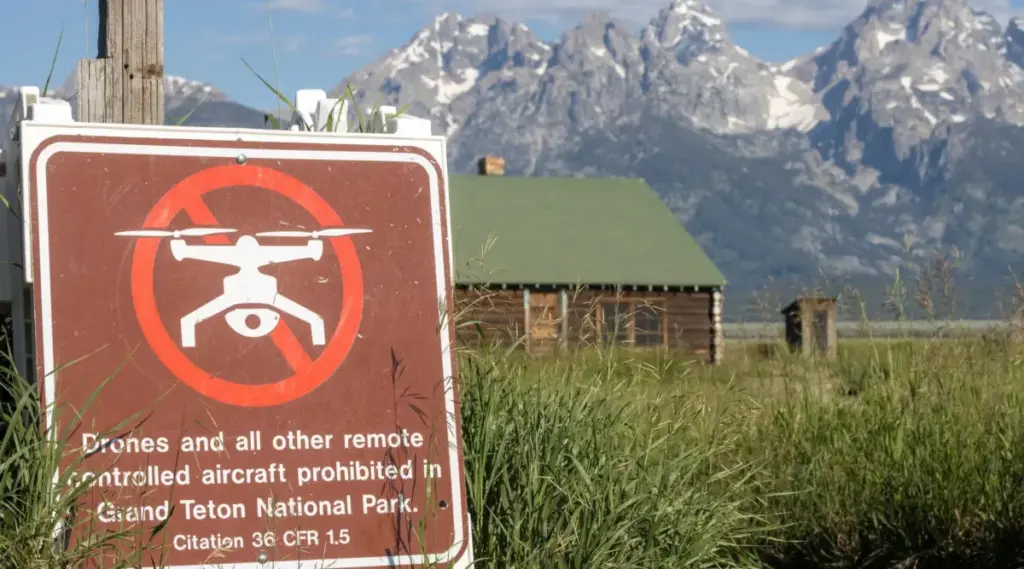
A deleted music video featuring a DJ performing high above the landscape of Grand Teton National Park has reignited intense public scrutiny and federal concern over illegal drone operations in America’s protected public lands—activities that routinely carry severe legal penalties, including steep financial fines and potential jail time.
The online controversy centers around a mountainside performance video that quickly drew sharp criticism on social media platforms for displaying aerial camera angles reportedly captured within Grand Teton National Park. According to local reporting by the Wyoming-based newspaper Jackson Hole News and Guide, a YouTube user uploaded the contentious video clips on October 14. The footage featured a man wearing a green jacket actively mixing music on Blacktail Butte, a prominent 7,000-foot mountain situated entirely within the boundaries of the national park.
Following immediate backlash from online viewers and local conservation advocates, the creator of the video scrubbed their presence from the internet, wiping the footage and associated channels. When contacted by Outside regarding the incident, the video creator did not respond prior to publication.
Emily Davis, a spokesperson for Grand Teton National Park, confirmed in a statement to Outside that park officials are fully aware of the circulating footage. However, park administration declined to specify the exact coordinates of the filming location, whether the individual operating the drone had secured prior written authorization from the superintendent, or if law enforcement rangers had formally issued citations in connection with the event.
“Drones can disturb or displace wildlife, create noise, detract from the natural soundscape and scenic views, and pose safety hazards to visitors,” Davis told Outside, emphasizing the multifaceted risks uncrewed aircraft pose to the ecosystem. “Unauthorized flights can also ground aerial search-and-rescue missions and wildland firefighting operations.”
Drones Are Prohibited in National Parks
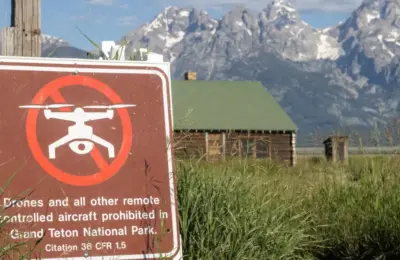
The incident highlights a longstanding and heavily enforced federal prohibition. In 2014, the National Park Service enacted a sweeping ban on the use of uncrewed aircraft systems—commonly known as drones—across all 433 parks and facilities managed by the agency, unless the operator has obtained explicit written approval from the individual park superintendent. Violating this federal regulation is not merely a minor park infraction; it carries severe consequences, including fines of up to $5,000 and a maximum sentence of six months behind bars.
Despite the stringent rules and heavy penalties, recreational drone use continues to spark frequent controversies and public safety hazards across various national parks, turning into a persistent management challenge for federal land agencies.
The ongoing issue spans multiple iconic locations and years of repeated violations. In May 2026, a visitor in neighboring Yellowstone National Park filmed an unauthorized drone flying within dangerous proximity of a famous grizzly sow, known as Beryl, and her two dependent cubs right alongside a heavily trafficked park roadway, as first reported by Cowboy State Daily.
The tension between drone operators and park ecosystems dates back to the very inception of the 2014 ban. During the initial year of the policy, a recreational drone catastrophically crashed into Yellowstone’s fragile and thermally unique Grand Prismatic Spring, while a separate device plunged directly into Yellowstone Lake during a separate unauthorized flight.
The modern proliferation of social media content creation has only amplified the phenomenon. When the Blacktail Butte DJ video surfaced online, Reddit users quickly mobilized, questioning whether the high-altitude aerial shots violated federal park regulations and urging fellow outdoor enthusiasts to report the content to park authorities.
Grand Teton National Park has faced similar headaches in the past. In 2017, park rangers publicly appealed to the local community and visitors for assistance in identifying an anonymous drone operator after an aircraft was spotted hovering aggressively over grizzly bears near the park’s scenic Oxbow Bend area. Despite launching an investigation, park personnel were ultimately unable to locate the drone or identify the pilot at the scene, according to official National Park Service documentation from the time.
With digital content creators continually seeking out breathtaking vistas for viral media projects, incidents like the Blacktail Butte DJ set serve as a sharp reminder from park visitors, the National Park Service, and online communities alike that unauthorized commercial and recreational drones remain strictly unwelcome across the nation’s protected landscapes.