




The stock market has a persistent habit of surprising observers. As the years pass, indices regularly climb to record-breaking valuations, prompting a familiar wave of anxiety among investors. When markets crash, retirement portfolios shrink, stirring immediate panic. Yet, even when markets rise to unprecedented heights, a different kind of worry emerges: the apprehension that a larger, more devastating crash is just around the corner. Today, this prevailing anxiety is frequently anchored to the frenzied boom surrounding Artificial Intelligence, leading many to question whether history is repeating itself on a grander scale.

For those who remain detached from the daily financial drama, life goes on uninterrupted. However, the broader economic conversation is dominated by comparisons to past tech booms. Investors worry that while AI is undoubtedly a major technological advancement, the commercial mania and capital injection surrounding it are happening too fast, setting the global economy up for an amplified version of the early 2000s dot-com crash. That particular historical boom played a formative role in the early career of online financial commentator and early retirement advocate Mr. Money Mustache, who experienced firsthand how the subsequent market correction threatened employment stability and personal milestones.
As an established voice in the personal finance space, questions regarding current investment cycles are a regular occurrence, mirroring inquiries from past market booms and busts. To address these growing concerns directly, presentations have been developed for specialized audiences, including a recent address at Camp FI Midwest and a planned presentation at the upcoming Bogleheads conference. These discussions aim to contextualize modern economic fears by looking back at how previous generations of worriers fared against similar existential and financial threats.

Reflecting on more than two decades of retirement, financial commentators often encounter a recurring question from anxious friends and followers: how anyone can remain comfortable and sleep at night given the state of the world. A standard reaction to this inquiry is often one of mild surprise, as daily worriers point to a litany of headline-driven crises. Today, those worries typically encompass geopolitical instability involving leaders like Donald Trump and Vladimir Putin, persistent inflation eroding purchasing power, the towering United States national debt, and active military conflicts in Ukraine and the Middle East that threaten wider escalation, alongside the omnipresent shadow of the AI bubble.
Yet, a historical perspective reveals that these anxieties are merely updated versions of older fears. More than twenty years ago, in 2006, people faced a remarkably similar psychological landscape. At the time, the headlines featured controversial leaders like George W. Bush and Saddam Hussein, ongoing conflicts in Iraq, anxiety over national debt and inflation, and a vastly overvalued stock market driven not by artificial intelligence, but by a dangerous housing bubble. Instead of AI threatening white-collar employment, the dominant fear was that jobs would be permanently outsourced to India and China. There was even a widespread panic regarding peak oil, driven by the belief that fossil fuel consumption would inevitably outstrip supply and doom global civilization—an outcome that was ultimately upended by technological shifts in energy production.

Examining what transpired over the subsequent two decades provides crucial context for modern anxieties. While the world did experience the Great Financial Crisis—a severe economic downturn caused by irrational exuberance in housing prices combined with complex financial leverage—the long-term trajectory of the stock market continued upward. In the grand scheme of things, even the most severe historical crashes, including the pandemic-induced market drop of 2020, appear as minor dips within a much broader era of wealth accumulation and global improvement.
Parallel to financial growth, significant metrics of human well-being improved dramatically over the same twenty-year period. The proportion of the global population living in extreme poverty dropped from twenty percent down to single digits. Global infant mortality rates were cut in half. Meanwhile, the clean energy sector underwent a massive transformation, driven by solar panels becoming significantly cheaper and accounting for the vast majority of new energy capacity added globally. Electric vehicle sales transitioned from a theoretical concept into a substantial fraction of worldwide automotive sales.

This historical contrast raises a fundamental question about human psychology: whether energy is better spent worrying about an uncertain future or focusing on productivity and optimism. Critics frequently question whether the current economic cycle is fundamentally different—wondering if the national debt has finally reached a tipping point, if the AI bubble will prevent future market recovery, or if artificial intelligence will evolve into a superintelligence that renders human labor obsolete. Financial media outlets thrive on generating compelling, fear-inducing narratives around these possibilities. However, these pessimistic outlooks often overlook a core economic reality: true prosperity does not originate from the financial system or the stock market, which ultimately function as numerical representations tracked on computers.
Instead, foundational prosperity stems directly from productivity. The capitalist system is inherently volatile and prone to dramatic swings, but beneath the surface turbulence, real people perform tangible work and develop practical inventions. The concept of an economy or a financial system is a human construct. If a system collapses due to unsustainable valuations, societies have repeatedly demonstrated the capacity to reset financial metrics and resume productive labor, as occurred following the 2008 financial crisis and prior historical corrections. The underlying tools that drive economic growth, higher standards of living, and the feasibility of early retirement—namely, human productivity and innovation—remain intact.

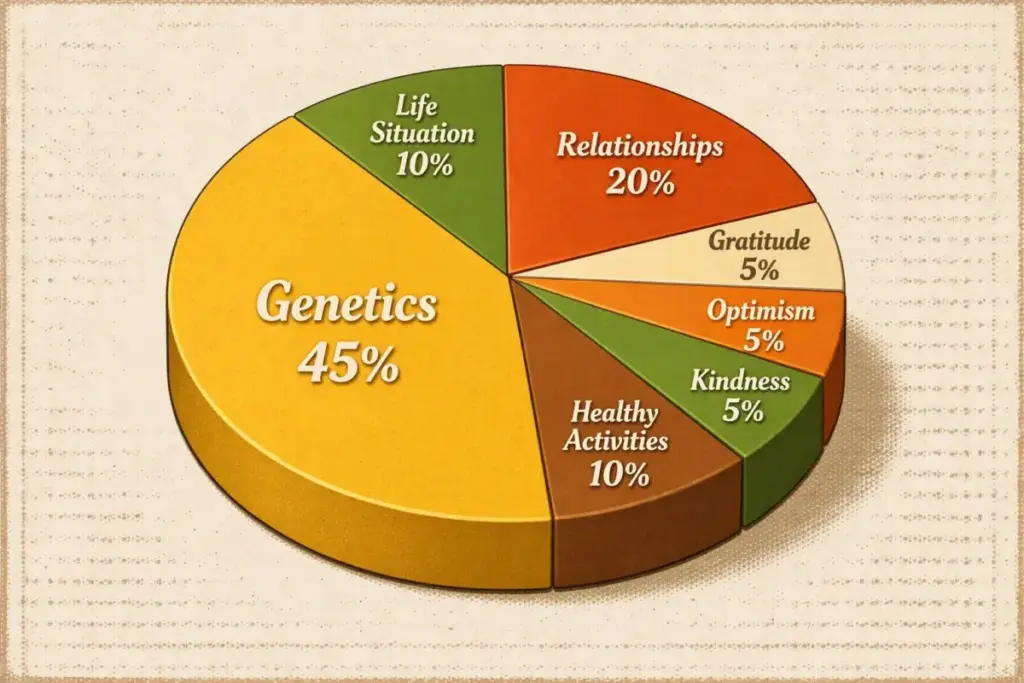
Beyond productivity and economic output, human well-being relies heavily on non-financial factors. Once societies achieve a certain baseline standard of living, overall happiness tends to plateau in the material dimension. Modern populations in developed nations surpassed those minimum economic thresholds decades ago, shifting the focus of long-term satisfaction toward other life factors. Psychological research suggests that human happiness is influenced by a combination of genetics, strong social relationships, personal kindness, gratitude, optimism, and regular engagement in healthy physical activities.
Despite the widespread availability of these foundational principles, persistent financial fear remains common even among experienced investors. This enduring anxiety is largely rooted in human evolution. Humans function effectively as biological danger-detection systems, utilizing background fear as an evolutionary trait designed to protect against environmental threats. However, a distinct glitch in this detection machinery causes individuals to continually seek out new sources of worry once immediate physical dangers are resolved. When scarcity, disease, and predators are successfully managed, the human mind pivots to social standing, resource accumulation, status competition, and complex tax strategies, shifting the goalposts of anxiety indefinitely.

Overcoming this pervasive background fear requires self-awareness and rational evaluation. Understanding personal history—such as growing up in an environment characterized by financial scarcity or navigating childhood trauma—helps illuminate why certain fears persist in adulthood, distinguishing past conditioning from current objective reality. Identifying specific fears by examining worst-case scenarios often reveals that perceived catastrophes are far more manageable than anticipated. Taking proactive measures further diminishes anxiety, as active problem-solving replaces unfamiliarity with confidence and builds long-term resilience.
Another crucial step in mitigating unnecessary anxiety involves altering daily information consumption habits, particularly regarding mainstream media diets that frequently prioritize sensationalized and alarming stories. Focusing time and energy on positive behaviors, physical health, outdoor activity, and constructive learning aligns human biology with its natural environment. Surrounding oneself with optimistic, productive peers further reinforces a balanced mindset, shifting the collective focus from speculative fear toward constructive living and mutual support.

Applying an experimental mindset to major life transitions—whether changing careers, relocating, or entering early retirement—transforms unknown variables from sources of dread into objects of fascination. This perspective is particularly relevant when evaluating the ongoing development of artificial intelligence. Rather than succumbing to doom-scrolling and generalized panic over technological displacement, understanding the mechanics behind modern AI reveals its potential as a powerful tool for cognitive efficiency.
Much like historical technological revolutions, artificial intelligence acts as a major productivity enhancer, promising to increase overall economic output while simultaneously displacing certain administrative and technical roles. While these shifts concentrate economic rewards among technology owners and corporate shareholders, they also follow a familiar historical pattern where cost reductions pave the way for entirely new industries, mirroring the long-term economic impacts of the internet and mobile computing.

Ultimately, artificial intelligence represents another opportunity for individual choice, distinguishing between a trigger for irrational fear and a catalyst for continuous learning and adaptation. Recognizing that fear often serves as a barrier to personal growth reinforces the idea that navigating future uncertainties requires addressing the root causes of anxiety rather than merely reacting to its external symptoms.