


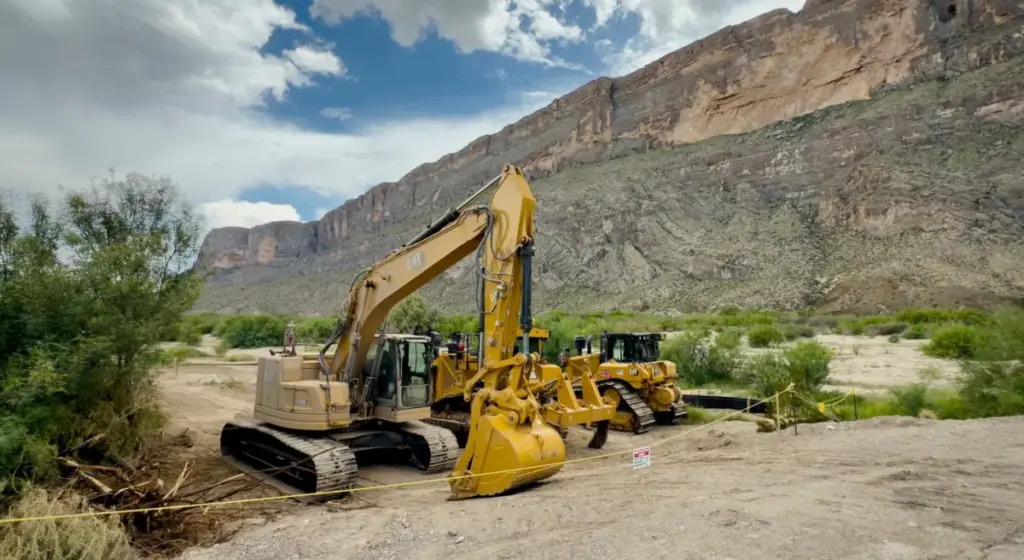
The high-stakes legal battle over border security infrastructure in the remote and fragile ecosystems of West Texas has officially escalated to the U.S. Supreme Court. The Trump administration is asking the nation’s highest judicial body to intervene and override a federal judge’s order that has temporarily halted the resumption of border wall, road, and barrier construction across a vast and ecologically sensitive landscape surrounding Big Bend National Park.
The petition before the Supreme Court represents the latest chapter in an ongoing, fiercely contested lawsuit centered on whether the federal government can bypass standard environmental reviews and statutory protections to rapidly deploy barriers along the southern border. On October 29, a coalition of plaintiffs—including the Center for Biological Diversity, Friends of the Ruidosa Church, and local Rio Grande river guide Billy Miller—submitted a comprehensive 50-page filing urging the justices to maintain the current freeze on construction.
In their legal brief, the plaintiffs warned that pushing forward with heavy infrastructure projects could permanently scar the fragile Chihuahuan Desert ecosystem, disrupt crucial river access, undermine local tourism-dependent economies, and destroy historic and cultural sites. The filing draws heavily upon prior testimony and evidence provided by local residents, regional environmental researchers, conservationists, and other community officials who have actively opposed the federal building plans.
For communities scattered across the vast expanse of West Texas, the stakes extend far beyond federal policy debates. Local outfitters, ranchers, and conservationists argue that the physical transformation of the landscape threatens a way of life deeply intertwined with the natural wilderness of the borderlands.
"If this actually occurred, I think it would destroy the tourism that Terlingua, Presidio, Marfa… all those towns depend on," Billy Miller, a local rafting guide who leads tourists through sections of the Rio Grande, stated in the court document. "I don’t think they’ll have an experience anymore. I think it will be a tour of the military-industrial complex, not a tour of the wilderness."
The impending decision by the Supreme Court could ultimately determine whether construction resumes across a massive swath of West Texas. The disputed region encompasses not only Big Bend National Park but also Big Bend Ranch State Park and heavily protected stretches of the Rio Grande, a vital lifeline and natural feature of the American Southwest.
The scope of the proposed construction varies considerably across the region. Inside Big Bend National Park itself, Customs and Border Protection (CBP) has put forward plans that include the development of new access roads, advanced surveillance technology, and approximately 17 miles of smaller vehicle barriers designed explicitly to prevent cars and trucks from traversing the international boundary. Elsewhere within the broader Big Bend Border Patrol sector, federal plans call for the erection of imposing 30-foot walls.
Security Claims Meet Judicial Pushback
At the core of the ongoing lawsuit is a fundamental legal question: whether the federal government possesses the legal authority to bypass mandatory environmental impact reviews and public consultation processes under the guise of border security exemptions.
The legal friction intensified on October 2, when U.S. District Judge Kathleen Cardone issued an order halting construction work in the sector. In her ruling, Judge Cardone pointed out significant discrepancies in the government’s security rationale, noting that while Border Patrol agents had recorded more than 89,000 apprehensions across the 517-mile sector over a five-year period, the Big Bend sector actually maintained the lowest apprehension rate per mile of any sector along the entire southern border.
Furthermore, the physical realities of the region have long served as a formidable deterrent. Towering 1,500-foot limestone canyons, the rugged Chisos Mountains, and vast expanses of waterless desert make travel through Big Bend exceptionally grueling and hazardous. The punishing terrain is so severe that even Customs and Border Protection acknowledged in May that the natural topography of the area inherently deters foot traffic across the border without the need for extensive physical barriers.
Despite these geographic realities, the Trump administration mounted a vigorous defense of the construction initiative. On October 21, Justice Department attorneys filed a petition with the Supreme Court arguing that maintaining a judicial freeze on the project directly imperils national security and leaves critical vulnerabilities open to transnational criminal organizations.
"The Sinaloa and Juarez cartels operate south of this sector across the Mexico border and seek to exploit any vulnerabilities in United States border protection to traffic humans, drugs, and weapons," Justice Department attorneys wrote in the filing. The government’s legal team cautioned that leaving what they described as a "300-plus-mile gap in border defenses" would continue to attract dangerous criminal enterprises.
In a subsequent reply filed on October 30, the administration reiterated its position, maintaining that Judge Cardone lacked the proper legal authority to halt the construction and asserting that the injunction poses an ongoing threat to national border security operations.
Centuries of Impact on Land and Lives
While federal authorities emphasize the imperative of operational security, environmental advocates and local residents maintain that allowing heavy construction machinery to operate before the lawsuit is fully resolved could trigger irreversible and generational damage to the desert landscape.
Jeffrey Renfrow, an ecologist and the director of Rio Bravo Restoration who has spent more than two decades working in the Big Bend region, provided sobering testimony to the court regarding the long-term ecological consequences of heavy construction activity.
"My opinion is that there’s been significant harm to hydrologic function, vegetation and soils and that that harm will probably persist for decades if not centuries, and, in some cases, never recover," Renfrow testified.
The deployment of bulldozers and other heavy machinery poses an acute threat to biological soil crusts, which are delicate, living mats of cyanobacteria, lichens, and mosses that bind the loose desert floor together and prevent severe wind and water erosion. According to research cited from a U.S. Forest Service report, certain foundational organisms within these biological soil crusts can take roughly a century to fully regenerate once crushed or disrupted.
Local landowners have also voiced deep anguish over the physical and psychological toll the project has inflicted on their communities. Bill Guerra-Addington, a local rancher, testified before the court that increased construction traffic has already led to a noticeable rise in wildlife mortalities along regional access roads. Beyond the ecological toll, he described the profound heartbreak of witnessing his lifelong home transform under the weight of heavy infrastructure development.
"I’ve cried a river of tears seeing what they’ve done to my home," Guerra-Addington told the court, capturing the deep sense of loss shared by many residents. "I just see this kind of like a dystopian nightmare in my very home, a place that I hold sacred."
Previously, the administration had invoked specialized legal exemptions to initiate construction activities rapidly, bypassing standard environmental reviews and statutory requirements that typically govern federal projects on public lands. Judge Cardone’s October injunction effectively blocked any further work from proceeding under those specific exemptions.
If the U.S. Supreme Court ultimately decides to lift the lower court’s order, construction crews will be permitted to resume work immediately while the underlying lawsuit continues to wind its way through the judicial system. Conversely, should the justices choose to leave the injunction in place, the federal government will be legally required to fully comply with applicable environmental and administrative laws before any disputed construction activities can restart in the region.