




The modern stock market has a persistent habit of surprising even the most seasoned observers. As markets continue to scale record heights and reach valuations that cause anxiety among conservative investors, the underlying question inevitably returns: Is this boom built on a frenzy that will ultimately lead to a catastrophic crash, particularly given the current excitement surrounding artificial intelligence?
For investors who have tuned out the daily financial drama, the contemporary artificial intelligence story is a familiar cultural touchstone. Driven by massive technological breakthroughs, soaring capital investments, and widespread speculation, AI has dominated corporate earnings calls, venture capital funding, and mainstream headlines alike. Yet, this rapid ascension has triggered deep-seated anxieties. Investors worry that while artificial intelligence is unquestionably a monumental innovation, the market mania surrounding it is moving too fast and reaching unsustainable valuations, setting the global economy up for an amplified version of the dot-com crash of the early 2000s.

For figures like early retirement advocate and financial commentator Mr. Money Mustache, this boom-and-bust cycle evokes memories of the turn of the millennium. The internet boom of the late 1990s and early 2000s helped launch his early career and path to financial independence, even as the subsequent market correction nearly derailed his professional trajectory and citizenship application. Addressing these cyclical anxieties, financial commentators are once again taking to conference stages—including recent addresses at Camp FI Midwest and upcoming appearances at the Bogleheads conference—to contextualize current market fears against historical precedents.
Will the AI Bubble Ruin Retirement?
Having navigated over two decades of retirement, long-term investors often encounter a recurring question from anxious peers: How is it possible to remain comfortable and sleep soundly at night given the state of the world?

A typical glance at contemporary news headlines reveals a familiar litany of global anxieties. Worries range from volatile geopolitical tensions involving major global leaders, persistent inflation eroding purchasing power, and towering national debt levels, to active conflicts in the Middle East and Eastern Europe that carry the constant threat of wider escalation. Compounding these worries is the fear of an impending AI-driven market correction or the specter of automation displacing human labor en masse.
Interestingly, these specific categories of anxiety are hardly unprecedented. Similar conversations dominated dinner tables and financial forums twenty years ago, during the mid-2000s. At that time, public discourse centered on different geopolitical figures, conflicts in Iraq, mounting national debt, and inflation concerns. Rather than an artificial intelligence bubble, investors fretted over an overvalued housing market that ultimately gave birth to the Great Financial Crisis. Instead of AI taking white-collar jobs, the prevailing narrative focused on corporate outsourcing to developing economies like India and China. Global markets were simultaneously gripped by debates over "Peak Oil," a theory predicting that soaring fossil fuel consumption would inevitably outstrip dwindling global supplies.

Looking back at the historical trajectory of those markets reveals a different reality. Even the Great Financial Crisis—fueled by irrational exuberance in real estate and excessive financial leverage—proved to be a temporary disruption within a much broader upward economic trend. Despite the unprecedented severity of the 2008 crash and subsequent market shocks like the 2020 pandemic downturn, long-term market indices continued an extraordinary upward trajectory over the subsequent two decades.
At the same time, global living standards experienced remarkable improvements. The proportion of the global population living in extreme poverty dropped significantly over a twenty-year span, while global infant mortality rates were cut in half. Clean energy adoption surged as solar panel manufacturing costs plummeted, allowing solar technology to become a dominant source of new electricity generation worldwide. Concurrently, electric vehicle adoption transitioned from a fringe concept into a substantial share of global automotive sales.

These historical parallels raise a fundamental question: Should individuals focus their energy on worrying about an unpredictable future, or should they approach economic cycles with historical perspective and optimism?
The Core of Economic Growth: Productivity Over Paper Wealth
Skeptics frequently question whether the current economic environment is fundamentally different. Concerns persist that the soaring United States national debt could finally trigger systemic instability, that the artificial intelligence bubble dwarfs the historical housing market bubble, or that advanced AI systems could eventually spiral out of control. Financial media outlets regularly amplify these fears to capture viewer attention, but such narratives often overlook a foundational economic truth: true societal prosperity does not originate from financial systems or stock market tickers, which ultimately represent numerical abstractions tracked on computers.

Instead, long-term prosperity is fundamentally driven by productivity. Capitalism is inherently volatile, characterized by cyclical waves of exuberance and correction. Beneath these surface-level financial fluctuations, however, real people continue to perform tangible labor, invent new technologies, and drive operational efficiency.
An economy and its underlying financial infrastructure are human-constructed systems. When financial markets experience severe corrections due to structural imbalances, systems are restructured, and economic activity resumes. Societies retain the fundamental tools required to enhance productivity, and higher productivity invariably supports rising living standards, economic growth, and the feasibility of early retirement.

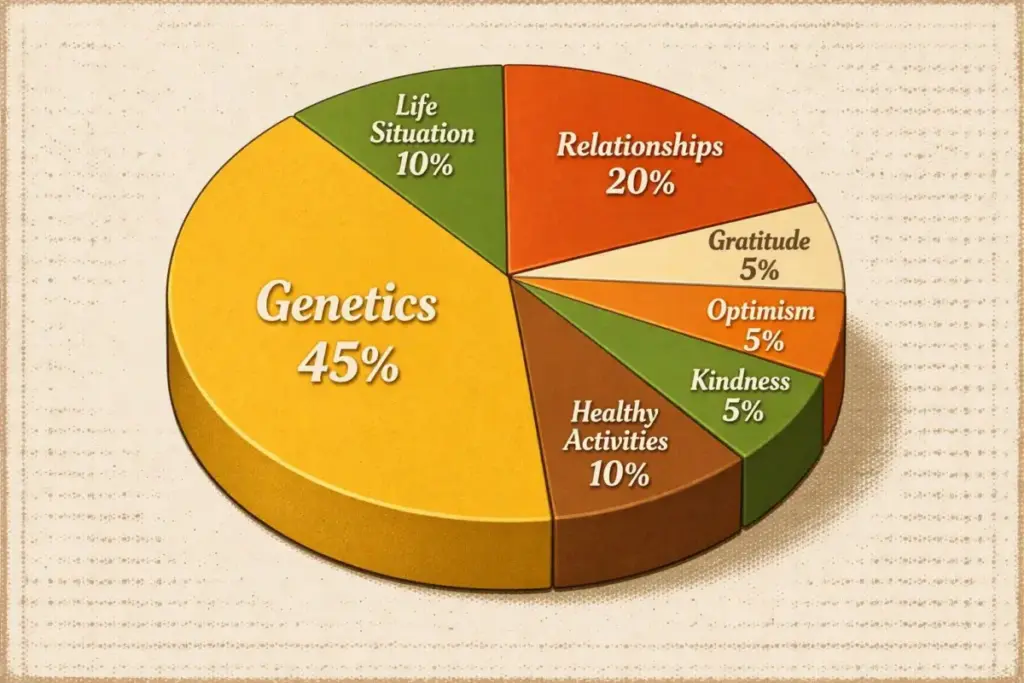
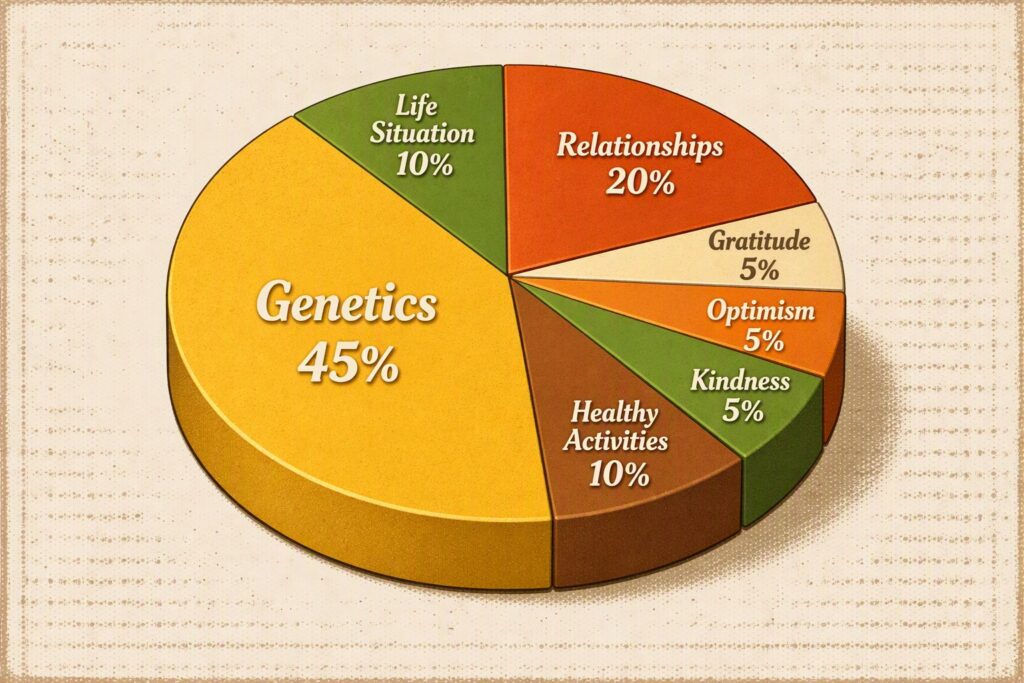
Beyond productivity and economic prosperity, human well-being relies heavily on non-financial factors. Psychological research suggests that human happiness tends to plateau after a certain threshold of material comfort is achieved. In developed nations, basic survival and comfort requirements were surpassed decades ago, shifting the primary determinants of life satisfaction toward interpersonal relationships, personal philosophy, community engagement, and physical health. While genetic predisposition plays a significant role in individual happiness, lifestyle choices such as maintaining strong social connections, practicing gratitude, and spending time outdoors remain firmly within individual control.
Confronting Fear and Uncertainty
Despite historical evidence demonstrating that long-term markets recover and adapt, financial anxiety remains widespread. Psychologists note that human beings evolved as specialized threat-detection machines, a biological trait designed to protect ancestral populations from immediate physical dangers. However, this evolutionary mechanism creates modern vulnerabilities. When tangible external dangers are mitigated, the human brain continues scanning the environment for potential threats, effectively shifting goalposts indefinitely.

Once physical safety and food security are secured, individuals transition to worrying about social acceptance, financial preservation, or abstract future scenarios. In extreme cases, affluent individuals focus their anxieties on complex tax strategies, estate planning logistics, or mandatory government retirement account distributions.
Overcoming this pervasive background fear requires self-awareness and rational evaluation. Examining personal and familial history often reveals the root causes of financial anxiety, whether stemming from childhood scarcity mindsets or past economic trauma. By identifying specific fears and evaluating their actual worst-case scenarios, individuals can demystify abstract worries. Taking deliberate action helps make the unfamiliar manageable, cultivating resilience and confidence.

Furthermore, managing media consumption plays a critical role in emotional stability. Modern news outlets frequently rely on sensationalized, fear-driven reporting to sustain engagement. Reducing exposure to daily panic-inducing headlines and replacing them with structured learning, physical activity, and constructive personal behaviors allows individuals to align more closely with natural human capabilities. Surrounding oneself with optimistic, productive peers further reinforces a balanced mindset focused on personal agency rather than passive worry.
Viewing Technological Change as an Experiment
Approaching major life transitions—whether changing careers, relocating, or navigating early retirement—benefits from framing changes as experimental processes. This mindset applies equally to the ongoing evolution of artificial intelligence, a technological shift that frequently generates widespread apprehension.
Rather than succumbing to cyclical doom-scrolling, examining the functional mechanics of artificial intelligence reveals its potential as a powerful productivity tool. Experts often characterize modern large language models and generative systems as a form of "cognitive nail gun"—an instrument designed to drastically enhance human efficiency and cognitive output.
Just as previous industrial revolutions automated manual labor and paved the way for entirely new industries, artificial intelligence is currently streamlining entry-level office workflows, administrative tasks, and specialized technical operations. While this technological transition inevitably causes labor displacement in specific sectors, it simultaneously reduces service costs and catalyzes the creation of novel commercial domains, mirroring the transformative economic impact of the internet and mobile computing revolutions.

Ultimately, technological advancements like artificial intelligence represent opportunities for adaptation and strategic decision-making. By recognizing fear as an internal emotional response rather than an objective reflection of reality, individuals can navigate market volatility and technological disruption with resilience, keeping focus on the broader sweep of human productivity and well-being.