

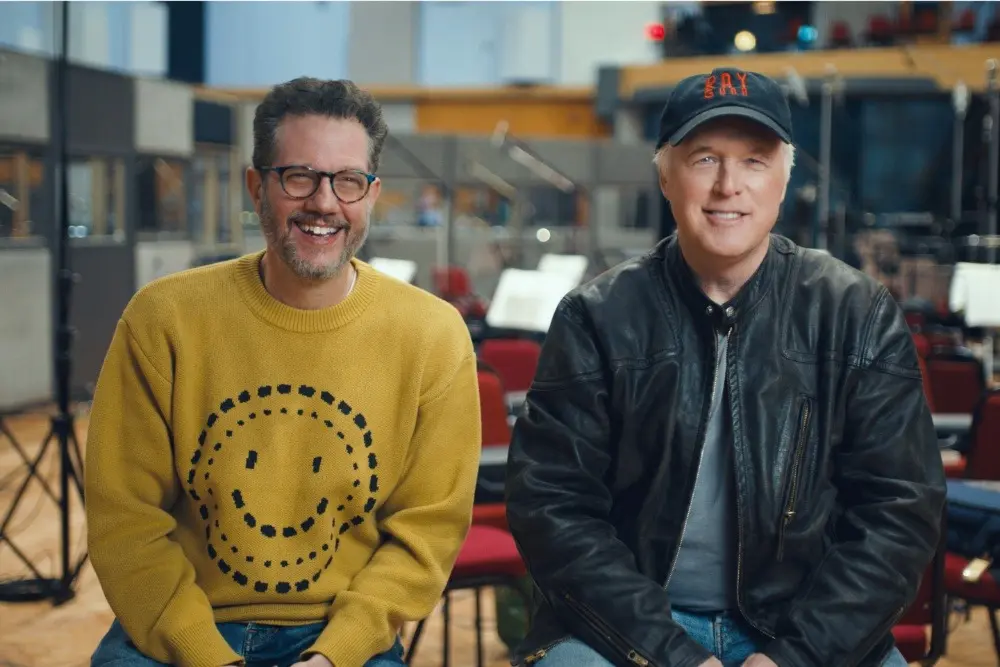
On a balmy April afternoon at London’s historic Abbey Road Studios, a 74-piece orchestra comprising violinists, cellists, flautists, and even an organist is tightly packed into the legendary Studio One. The iconic room, which over the decades has hosted musical legends ranging from classical composer Edward Elgar to modern pop icon Harry Styles, has been painted a vibrant “Toy Story” blue. It is a fitting color palette, given that the reason everyone has gathered today is to record the sweeping, atmospheric score for “Ray Gunn,” a major new feature animation from Pixar legend Brad Bird, the visionary creative mind behind beloved modern classics like “Ratatouille” and “The Incredibles.”
The film, which has been gestating inside Bird’s imagination for three decades, is not a Pixar or Disney project, however, but a Skydance Animation production. The feature is slated to hit Netflix on Dec. 18, following its high-profile premiere at the BFI London Film Festival on Oct. 10. Directing the massive orchestra at Abbey Road is Bird’s longtime creative collaborator, Oscar-winning composer Michael Giacchino. “Ray Gunn” marks the sixth major project the duo has tackled together since first teaming up for “The Incredibles” back in 2004. It is a cinematic endeavor that Giacchino, who secured an Academy Award for Pixar’s “Up” in 2010, has had more than two decades to anticipate. “We talked about this movie during ‘The Incredibles,’” the composer reveals when speaking in a subsequent interview. “I’ve known about this for a very long time.”
Fittingly, given the integral role that music plays in the fabric of the film, Bird first conceived the idea for “Ray Gunn”—a hard-boiled noir detective caper set within a “Jetsons”-style retro-future—after listening to The B-52s’ eclectic song “Planet Claire.” To Bird’s unique artistic sensibilities, the tune sounded like a fascinating musical mash-up between the iconic theme song to the 1960s television detective series “Peter Gunn” and a classic 1950s monster science-fiction movie. Recalling the moment of inspiration the day before the film’s festival premiere, Bird explains how the project’s identity crystallized. “I went, ‘This is not “Peter Gunn.” What is this?’ And then I went, ‘It’s Ray-Gun.’ And then I went, Ray Gunn: It’s a guy’s name. He’s a detective, but it’s in the future.”
Despite the sudden spark of inspiration, the ambitious idea was repeatedly shelved as other major professional commitments inevitably got in the way. Following his breakout success, Bird’s career steered toward his sophomore Pixar feature, “Ratatouille,” which was eventually followed years later by “Incredibles 2.” In between those monumental animated films, Bird successfully crossed over into live-action filmmaking, directing blockbusters like “Mission: Impossible – Ghost Protocol” and the sci-fi adventure “Tomorrowland,” alongside an ultimately abandoned attempt to adapt Will Eisner’s classic comic book “The Spirit.” Bird, who often describes his creative mind as a “big shop floor,” would frequently return to tinker with “Ray Gunn” every now and again, biding his time patiently until the right environment emerged to finally bring it to life after the concept had previously fallen through at several other major studios, including Warner Bros.

It was his tenure helming “Mission: Impossible” that ultimately paved the structural and professional way for what had effectively become Bird’s own real-life mission impossible. “It was [Skydance’s] second film and everybody was happy with how it turned out,” Bird says, reflecting on his successful turn at the helm of Tom Cruise’s lucrative action franchise. Therefore, when the opportunity organically arose to pitch the studio on another completely original idea, “Ray Gunn” stood out as the obvious choice. The move also served to happily reunite Bird with Pixar co-founder John Lasseter, who now serves as the head of Skydance Animation.
“I never pitched it at Pixar because I felt like it wasn’t in Pixar’s wheelhouse exactly,” Bird explains, directly addressing the studio’s long-standing reputation for catering primarily to younger family audiences rather than the older demographic he is purposefully aiming for with “Ray Gunn.” “If you put a Pixar label on it people would go, ‘Oh well, it’s meant for the same audience that these other films were meant for,’ and inevitably some of them would go, ‘Well, my little Jimmy would be unhappy at this.’”
Bird expands extensively upon this thematic critique, pointing out that while there are currently billions of animated films produced for children, there are far fewer options created specifically for teenagers and adults, despite that demographic comprising a significant majority of the overall theatrical movie-going audience. Making animated films for mature audiences “shouldn’t be a controversial decision,” Bird says, “and yet it was always treated that way by the ministers of resource allocation [at Pixar].” Notably, the director is returning to Pixar for his next subsequent project, a third installment in “The Incredibles” franchise.
Skydance, however, maintained a thoroughly different perspective on the venture. “My thought when [they] got involved was that they’ll go with me on this slightly different audience tangent,” Bird says. “And here it is.” Skydance CEO David Ellison serves as a producer on “Ray Gunn,” raising questions regarding whether his involvement was merely nominal or remarkably hands-on during production. “Well, he was more involved in the earlier days,” Bird says, before noting that the executive’s schedule quickly filled up. The director is obliquely referring to Ellison’s recent high-stakes corporate battle to successfully acquire Warner Bros. Discovery. When asked whether he believes Ellison will ultimately adhere to his ambitious public promise—made as part of his corporate bid—that Skydance will produce at least 30 theatrical films a year, Bird deftly sidesteps the query, stating simply that “all that stuff is beyond my pay grade.”
While Skydance may have recently become a central lightning rod within an increasingly polarized and financially pressured Hollywood landscape, Brad Bird remains a pragmatic veteran of the industry. Later in the conversation, he reflects on the period following the release of “The Iron Giant,” when he took his nascent idea for “The Incredibles” directly to Pixar. “The crew from ‘Iron Giant,’ a lot of them were mad at me initially because they felt like I was leaving hand-drawn [animation] and going to the sexy new CG,” Bird recalls. “And I said I don’t really care about the technology part. I’m going up to Pixar because they protect storytelling.”

As serendipity would have it, protecting art rather than exploiting it happens to be one of the central thematic pillars of “Ray Gunn.” The narrative follows the eponymous private detective, voiced by acclaimed actor Sam Rockwell, as he uncovers a dastardly, intricate corporate plot involving Venus Nova, a superstar singer voiced by Scarlett Johansson who harbors a massive and dangerous secret.
For composer Michael Giacchino, the primary artistic trick to scoring a mystery-filled film packed with narrative intrigue is carefully keeping the viewing audience guessing at every turn. “Probably the second toughest thing was just making sure everything was always in alignment thematically, so that I didn’t give the audience something that they shouldn’t be thinking about,” he notes. The actual hardest part of the scoring process, he reveals, involved crafting the music for an intimate scene between Gunn and Nova where the two central characters first open up to one another emotionally. “It needed to really hit every single emotional beat in this perfect way,” he explains.
Though Bird originally wrote the screenplay for “Ray Gunn” nearly three decades ago, its core themes exploring art, technology, and corporate greed resonate just as powerfully in the modern era as they did back in the late 1990s. He points out that the screenplay itself changed “less than you’d think” between that initial historical draft and the finalized motion picture hitting screens.
“A lot of the things that people are saying that [the film] is dealing with that are contemporary right now in the headlines were in there 30 years ago,” Bird observes, emphasizing the timeless nature of human behavior. “People are people and greed is greed and the flaws of people make good subject material for films. If that’s what’s driving the story, then the story’s not going to age because it’s about eternal things rather than things that were in the news last week.”