


The modern digital landscape has fundamentally transformed how readers discover obscure international media, offering unprecedented access to European bandes dessinées, science-fiction serials, and long-forgotten magazine anthologies. While breakthrough translated titles like Valerian or Yoko Tsuno manage to cross linguistic and geographic divides, countless other foreign comics remain out of print, preserved primarily online by dedicated communities of fan translators and digital archivists. For enthusiasts of sequential art, stumbling upon these hidden gems often feels akin to striking gold.
This dynamic is doubly true for newspaper comic strips, a medium historically treated as disposable in ways that traditional graphic novels rarely are. Consequently, very few newspaper strips ever manage to secure a sustainable international footprint. Notable exceptions include British exports like Andy Capp and Fred Basset, both of which have substantially outlived their original creators. Yet, these successes stand in stark contrast to other domestic icons, such as the British iteration of Dennis the Menace, which debuted in the UK publication Beano in 1951—just five days prior to Hank Ketcham launching his entirely separate American namesake strip.
Among the most glaring omissions from the American comics consciousness is Modesty Blaise, a celebrated British adventure strip created by the late writer Peter O’Donnell. Throughout its extensive original newspaper run—spanning from May 1963 to February 2001—the strip remained virtually unknown across the United States. While Modesty Blaise retained a passionate, dedicated readership throughout much of the international community for over 25 years after its publication ceased, it was only ever carried intermittently by a small handful of American newspapers. Industry watchers have long attributed this domestic aversion to the strip’s frequent depictions of nudity, which editors deemed too provocative for mainstream American audiences. The Detroit Free Press stood as a rare exception for years, though even its editors occasionally censored select panels.
For the small cohort of American fans who did discover the property, exposure usually came via O’Donnell’s accompanying line of pulp novels or through a pair of cinematic adaptations. The 1966 feature film Modesty Blaise, a campy box-office misfire starring Monica Vitti and Terence Stamp, managed to cultivate a dedicated cult following over the decades, ultimately paving the way for Quentin Tarantino to executive-produce the 2004 prequel My Name is Modesty.
For readers who grew up outside the reach of the original syndication, the Modesty Blaise newspaper strips remain quintessential classics of the adventure format. Although certain storylines inevitably show their age, the series stands tall as one of the definitive twentieth-century adventure comics. Contemporary readers discovering the archives today often do so through digital preservation efforts, but the complete original run is fully preserved in 27 paperback volumes published by Titan Books between 2004 and 2017. Though securing the entire collection may require some dedicated searching, every volume remains in print and features invaluable commentary from O’Donnell alongside extensive behind-the-scenes material. For aficionados of spy thrillers, crime dramas, or character-driven capers, Modesty Blaise offers a richly rewarding reading experience.

Magnets for trouble
The character’s narrative origin begins with a cinematic flair. Modesty Blaise was famously "born walking" as an orphaned refugee in the Middle East in the chaotic aftermath of the Second World War, possessing zero knowledge of her birth parents or national identity. Her survival instincts eventually led her to Tangier, where she seized control of a local street gang and methodically scaled it into an international organization of anti-heroic criminals known simply as "The Network." Under her pragmatic leadership, the Network operated with few qualms regarding grand larceny or corporate espionage, yet aggressively targeted and dismantled drug cartels and human trafficking rings operating within its spheres of influence.
After accumulating a vast personal fortune, Modesty successfully acquired British citizenship and retired to London alongside her fiercely loyal right-hand man, Willie Garvin. Both protagonists boast extensive backgrounds as globetrotting thieves, covert operatives, and martial arts experts. Modesty is a dead-eye marksman, while Willie is a master of the throwing knife. These formidable skill sets naturally drew the attention of British intelligence, which frequently tapped the duo as freelance troubleshooters for high-stakes national security crises.
Simultaneously, Modesty’s colorful criminal background, unique talents, and innate gravitational pull toward danger ensured that she and Willie were constantly thrust into perilous situations, both by design and by accident. Both characters embody a classic pulp-fiction archetype—a trope echoed in modern storytelling by figures like Jack Reacher—wherein protagonists consistently cross paths with old friends or imperiled strangers regardless of where they happen to be on the map. A prime example occurs in "The Stone Age Caper," when Willie finds himself stranded in the Australian outback and randomly encounters the one indigenous Australian he happens to personally know.
In its foundational years, Modesty Blaise operated as a quintessential Cold War-era pulp action strip. The narrative structure is cleanly partitioned into 95 distinct storylines, frequently pitting Modesty and Willie against sprawling communist conspiracies, as seen in arcs like "La Machine," "Top Traitor," and "The Wicked Gnomes." Other adventures pivot toward small-time con artists in stories like "The Girl From the Future" and "The Moon Man," vast criminal syndicates in "Death in Slow Motion" and "The Maori Contract," or vengeful personal rivals in "The Girl in the Iron Mask." Crucially, the stakes in Modesty Blaise are routinely kept intimate and personal rather than global; Modesty is typically motivated by a desire for vengeance, justice, or simple survival rather than the geopolitical fate of the Western world.
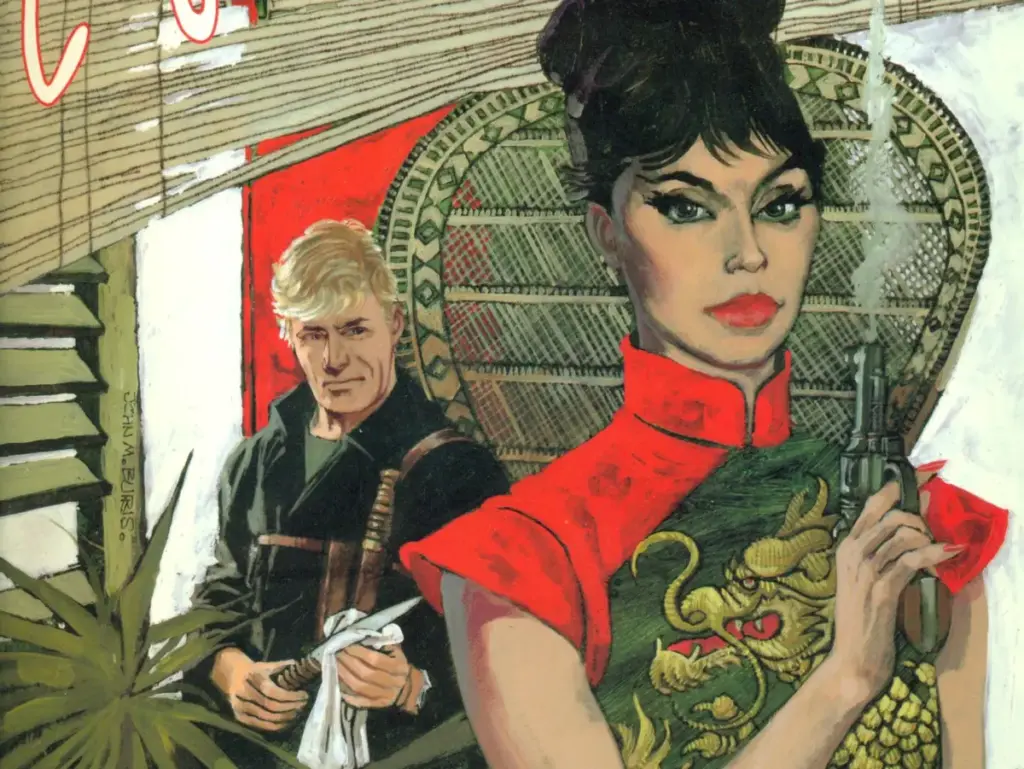
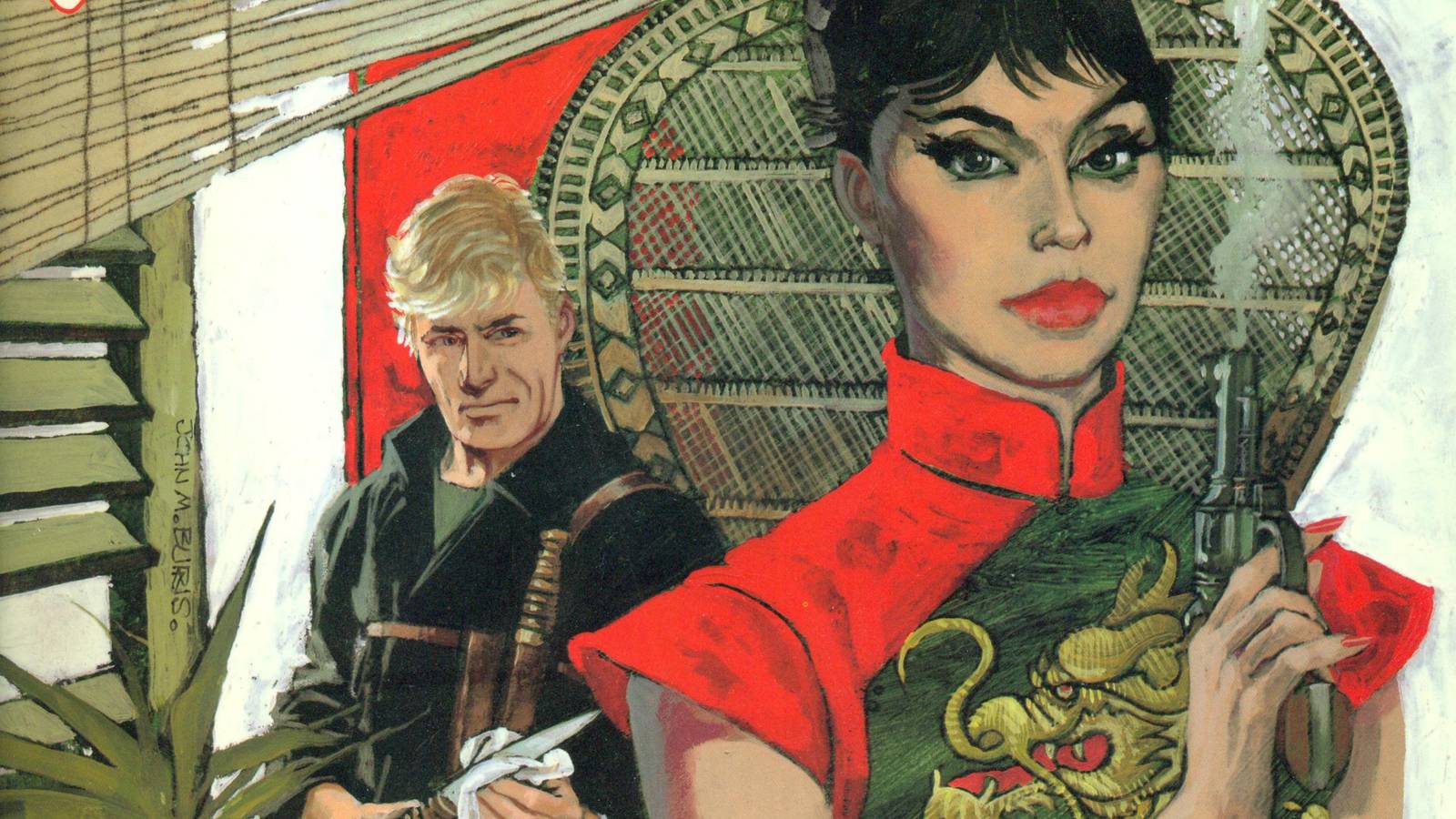
The visual identity of the strip was anchored by its original artist, Jim Holdaway, whose sudden death in 1970 marked a major turning point. The vast majority of the subsequent run was illustrated by Spanish artist Enrique Badia Romero, renowned for his work on Axa and Judge Dredd. Additional artistic contributions came from notable talents including John Burns of 2000 AD and Heavy Metal fame, newspaper cartoonist Neville Colvin—who illustrated fan-favorite arcs like "The Balloonatic"—and Pat Wright, who handled a brief stint in 1979 for Private Eye.
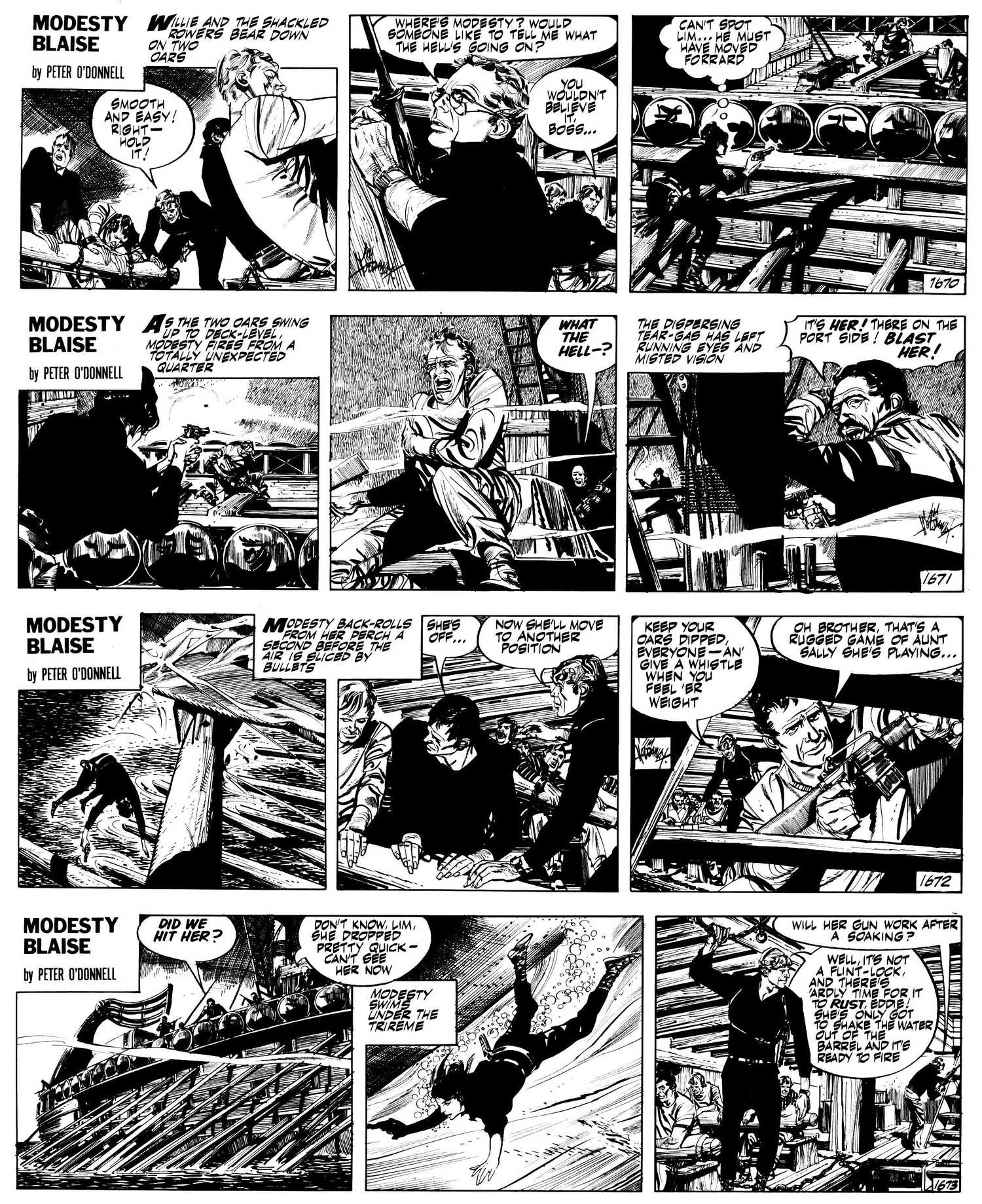
Both Holdaway and Romero, as the definitive artists of the series, demonstrated an astonishing mastery of economic visual storytelling. Each possessed the rare ability to convey complex narrative beats and dynamic motion within three panels that many subsequent pencilers struggled to achieve across an entire page. This craftsmanship transforms Modesty Blaise into a consistently thrilling read, capable of packing elaborate, cinematic action sequences inside the rigid spatial constraints of a traditional black-and-white newspaper strip. Combined with O’Donnell’s sharp plotting and naturalistic dialogue, the collaboration cemented the strip as one of the supreme adventure serials of the late twentieth century. For aspiring creators studying sequential art, the pacing and panel compositions of Holdaway and Romero remain essential study material.
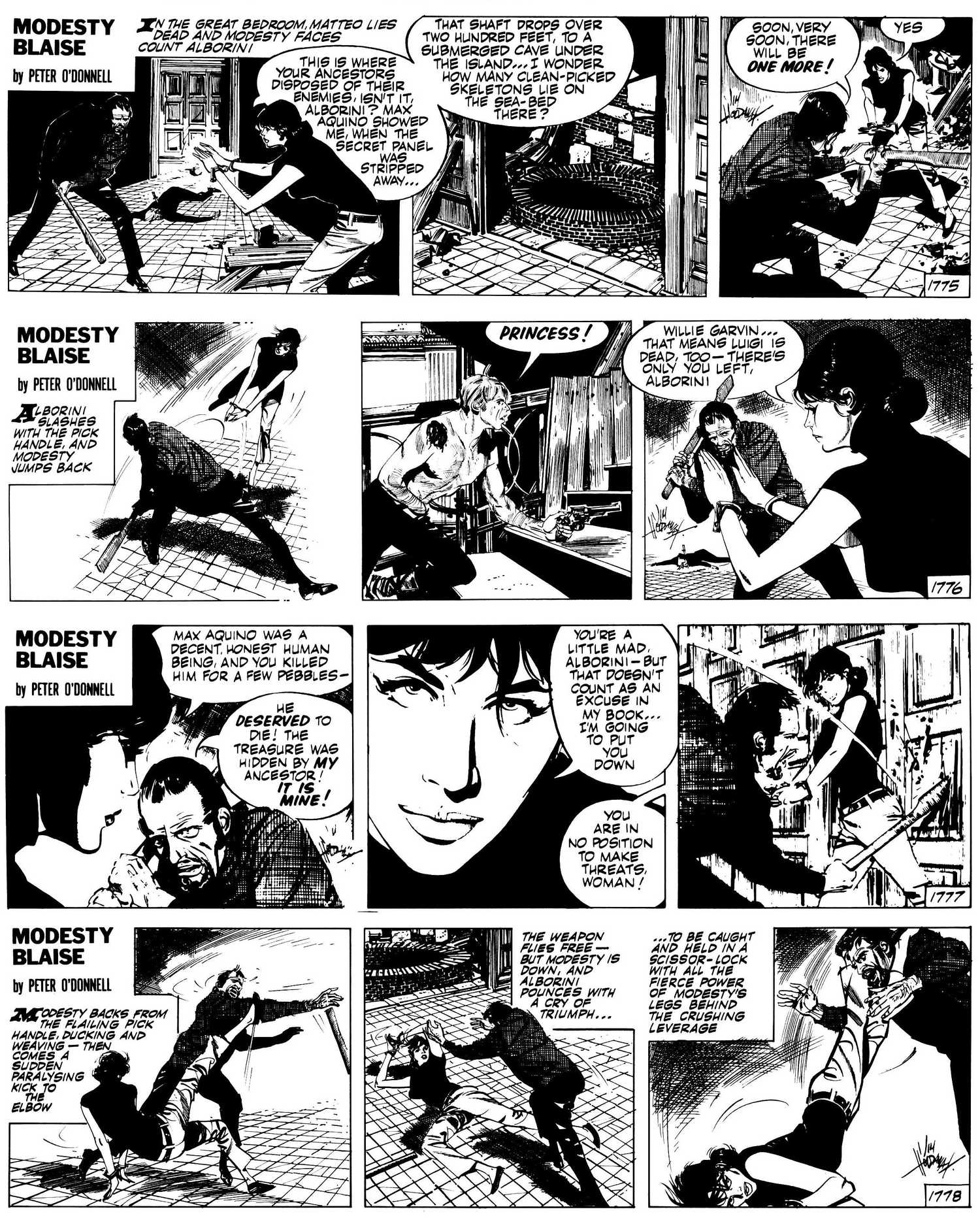
Naturally, not every element of Modesty Blaise has weathered the decades seamlessly. In some instances, the inevitable march of technology adds an unintended layer of nostalgic charm, such as when obsolete gadgets are deployed as high-tech trump cards. In "The Bluebeard Affair" from 1972, for example, Willie outsmarts a pair of armed thugs using a portable cassette player—a novel consumer device at the time. Similar narrative weight is frequently placed on ham radios, early VCRs, Mace spray, and industrial thermic lances.
In other respects, the strip remains an authentic artifact of its sociopolitical era. While Modesty Blaise was often ahead of its time regarding cultural progression—frequently depicting both Modesty and Willie defending marginalized populations against bigoted antagonists—the series has occasionally faced scrutiny from modern audiences over its dated phrasing and period-specific framing. Highlighting these sensitivities, as recently as 2020, a storyline featuring a villain’s overt racism toward indigenous Australians in "The Stone Age Caper" prompted the temporary withdrawal of Modesty Blaise reprints from an Australian newspaper syndicate.
Despite these historical caveats, Modesty Blaise firmly merits a spot on the bookshelves of any enthusiast who appreciates high-caliber serial adventure. For readers throughout the United States, it represents a towering classic of the medium that slipped largely under the radar, making Titan Books’ comprehensive archival collections an invaluable gateway to discovering a true milestone of comic strip history.