

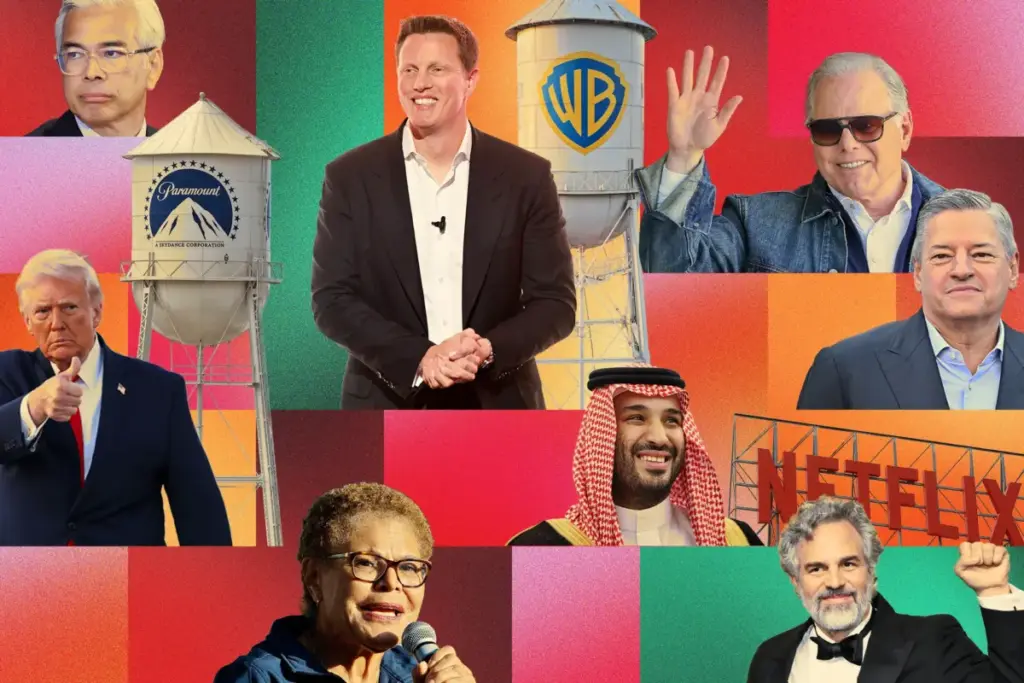
It has been a breathtaking and tumultuous ride. David Ellison’s relentless quest to control two of the most iconic and storied studios in Hollywood has finally reached its culmination, adding a rollicking, high-stakes new chapter to the modern history of media megamergers.
On the morning of Tuesday, October 6, the massive consolidation bringing together Paramount and Warner Bros. Discovery officially closed. The newly formed entity, christened Skydance Corp., unites a vast empire of legendary film and television assets under one corporate roof. However, this newly minted powerhouse enters the market weighed down by a staggering $80 billion in debt, instantly reshaping the global entertainment landscape and setting the stage for a dramatic new era in film, television, and streaming.
The storyline leading to this historic merger reads like a Hollywood blockbuster itself, featuring a colorful cast of characters that includes President Donald Trump, a coalition of 12 blue-state attorneys general, Netflix, deep-pocketed Middle Eastern sovereign wealth funds, the grassroots "Block the Merger" coalition, prominent Hollywood creatives like Mark Ruffalo, and media mogul David Zaslav. The path to finalization was fraught with fierce bidding wars, intense antitrust battles, high-profile threats of corporate relocation, and fierce opposition from Hollywood unions.

2025: The Bidding War Begins
The foundation for the megamerger was laid on August 7, 2025, when Skydance Media completed its landmark $8 billion acquisition of Paramount Global. That deal itself followed a grueling, yearlong closing process that tested the resolve of Wall Street and Hollywood alike.
Scarcely a month later, in September 2025, the first rumblings surfaced regarding David Ellison’s broader ambitions. Whispers emerged of overtures made to David Zaslav, the chief executive and president of Warner Bros. Discovery, as well as the company’s board of directors. By October 21, 2025, Warner Bros. Discovery formally bowed to the inevitable, initiating an open sale process "in light of unsolicited interest" from multiple aggressive suitors.
By November 2025, the race was fully underway. Industry titans Netflix, Comcast, and Skydance Media submitted formal offers to acquire either the entirety or lucrative portions of Warner Bros. Discovery. For a brief moment, it appeared streaming giant Netflix had secured the prize. On December 5, 2025, WBD announced it had reached an $82.7 billion cash and stock agreement to sell its premier assets—including the Warner Bros. film studio and HBO, while intentionally leaving behind traditional cable networks like CNN and TNT—to Netflix.

The celebration in Los Gatos was short-lived. Just three days later, on December 8, Paramount Skydance dramatically upped the ante. The studio launched a competing tender offer for Warner Bros. Discovery shares and launched an aggressive charm offensive to convince WBD shareholders to reject Netflix in favor of its own bid. "Our proposal is superior to Netflix’s in every dimension," David Ellison boldly declared to Wall Street analysts during a high-stakes conference call.
Despite Ellison’s aggressive posture, the Warner Bros. Discovery board initially held firm. On December 17, 2025, the board unanimously recommended that shareholders reject Paramount’s unsolicited tender offer. Yet, as the calendar neared the end of the year, Paramount refused to walk away, submitting an amended tender offer on December 22 that signaled the fight was far from over.
2026: Escalating Stakes, Antitrust Lawsuits, and Regulatory Hurdles
As 2026 dawned, the corporate warfare intensified. On January 7, the WBD board once again unanimously recommended that shareholders reject Paramount’s latest tender terms. Seeking to counter Paramount’s mounting pressure, Netflix pivoted on January 20, agreeing to revise its acquisition terms for Warner Bros. and HBO into an all-cash transaction.

Paramount responded in kind on February 10 by introducing a lucrative "ticking fee" to its offer. This financial sweetener promised to pay WBD shareholders $650 million per quarter for every quarter the transaction remained unclosed past December 31, 2026. The pressure worked. On February 17, WBD scheduled a special shareholder meeting for March 20 to vote on the Netflix deal, while simultaneously carving out a critical 10-day negotiating window to evaluate Paramount’s latest rich terms.
By February 24, WBD confirmed receipt of a heavily revised proposal from Paramount Skydance, officially acknowledging that the bid could "reasonably be expected to lead to a ‘Company Superior Proposal’" under the terms of its existing agreement with Netflix. Two days later, on February 26, Netflix formally bowed out of the chase, declining to match Paramount’s richer terms. "The deal is no longer financially attractive," Netflix bluntly told its investors.
The exit of Netflix cleared the runway for Paramount. On February 27, the studio formally sealed a massive $110 billion all-cash agreement to acquire all of Warner Bros. Discovery, amending the ticking fee structure to take effect starting October 1.

However, corporate triumph quickly met fierce public and regulatory pushback. As early as February 26, California Attorney General Rob Bonta signaled the looming antitrust battle by promising a "vigorous review" of the transaction. On April 13, a coalition of 1,000 prominent industry creatives—including Ben Stiller, Kristen Stewart, Joaquin Phoenix, Adam McKay, Alan Cumming, Alyssa Milano, Boots Riley, Bryan Cranston, Cynthia Nixon, Damon Lindelof, David Fincher, and Denis Villeneuve—signed an open letter calling on officials to "Block the Merger." Within ten days, the list of creative signatories swelled to 4,000.
Despite the creative community’s profound unease, major theatrical exhibition chains welcomed the consolidation. On April 16, AMC Theatres CEO Adam Aron endorsed the merger just ahead of the CinemaCon gathering in Las Vegas. Shortly thereafter, on April 23, WBD shareholders overwhelmingly voted to approve the historic sale to Paramount.
Complicating the political narrative further, Paramount disclosed in an April 27 regulatory filing that approximately 38.5% of the equity in the newly combined company would be held by sovereign wealth funds from Saudi Arabia, Qatar, and Abu Dhabi.

The Regulatory Gauntlet and State Resistance
The summer of 2026 brought a grueling gauntlet of regulatory approvals and legal challenges. On June 12, the U.S. Department of Justice closed its antitrust investigation into the merger without imposing any structural conditions or mandated asset divestitures.
However, state regulators refused to back down. On July 13, a formidable bipartisan coalition of 12 state attorneys general—anchored by California’s Rob Bonta and New York’s Letitia James—filed a formal lawsuit to block the transaction on antitrust grounds. They were swiftly joined on July 14 by the Writers Guild of America, which filed its own antitrust suit.
Seeking to halt momentum, a federal judge placed a temporary 14-day hold on the merger on July 20 while the states pursued a preliminary injunction. International regulators took a more accommodating view; the European Commission cleared the transaction on July 22.

Back in the United States, labor resistance solidified. On July 27, SAG-AFTRA issued a strong public statement opposing the merger, demanding it be blocked unless legally enforceable safeguards were implemented to protect jobs and working conditions. Exhibitors continued to pick sides, with Regal Cinemas CEO Eduardo Acuna throwing his support behind the merger on July 29.
Legal wrangling over the trial schedule dominated late summer. While Paramount pushed for a swift November trial start date, state attorneys general and the WGA successfully advocated for a much later timeline. On August 4, a federal judge set March 2, 2027, as the official start date for the states’ antitrust trial.
The conflict escalated dramatically on August 5 when David Ellison reportedly informed senior Paramount executives that he would relocate the company’s headquarters out of California as of October 1 if the state attorneys general refused to drop their lawsuit. The threat sent shockwaves through local government and labor circles.

International clearance milestones continued to fall, with the U.K.’s Competition and Markets Authority approving the deal on August 6, followed by Mexican regulators on August 14. Amid the mounting pressure, the Directors Guild of America and IATSE joined forces on August 12, sending an urgent letter to Rob Bonta and David Ellison pleading for a settlement or a faster judicial resolution to protect studio workers, outlining 10 proposed conditions to alleviate antitrust concerns. Los Angeles Mayor Karen Bass similarly urged Bonta to negotiate a settlement with Paramount on August 20.
Behind-the-scenes diplomacy hit a wall on August 23 when Bonta abruptly canceled a planned settlement meeting after details of the secret talks leaked to news outlets. As legal briefs flew through September, the Los Angeles Economic Development Corporation released a study on September 12 warning that the departure of Paramount from California would cost the state between $1 billion and $2 billion in economic output over four years.
The Final Countdown and Closing
As the legal battles neared a crescendo, the regulatory framework finally solidified. On September 15, the Department of Justice sided with Paramount in a dispute over a requested $1.88 billion bond, and on September 17, the FCC approved up to 49.5% foreign ownership for the newly structured entity in connection with its CBS owned-and-operated stations.

Public protests continued to draw headlines, including a fiery "Block the Merger" rally at Paramount Pictures Studios on September 3, and a fiery social media warning from actor Mark Ruffalo on September 19 telling Bonta, "Don’t You Dare Settle."
Despite the vocal opposition, the political and legal dam finally broke. On September 21, Paramount announced a formal settlement with the 12 state attorneys general. The agreement included numerous behavioral stipulations and oversight measures, but crucially required no structural divestitures or breakups of the combined studios.
Following a hearing where U.S. District Judge Araceli Martínez-Olguín questioned the litigating parties on the settlement terms, the judge officially approved the agreement on September 30. With the legal cloud lifted, Paramount immediately locked in October 6 as the official closing date.

In a surprise move that electrified Hollywood just days before the close, David Ellison recruited Mattel chief Ynon Kreiz to serve as co-CEO of the newly expanded corporate giant. On October 2, Ellison officially unveiled the new corporate identity: Skydance Corp., a direct nod to the independent film production company he founded two decades earlier in 2006.
On October 5, the eve of the merger, Ellison pulled back the curtain on the comprehensive leadership team that will steer Skydance Corp. Moving forward, Ellison and Kreiz will lead the enterprise together. The film business will be helmed by Dana Goldberg and Josh Greenstein, who previously served as co-chairs of Paramount Pictures, while James Gunn and Peter Safran will remain in place as co-heads of DC Studios.
On the television and streaming fronts, George Cheeks transitions from his role as chair of TV media at Paramount Skydance to serve as co-chair and chief content officer of Skydance TV. Casey Bloys, architect of HBO and HBO Max’s prestige era, steps into the role of co-chair and chief content officer for Skydance Direct-to-Consumer streaming. Warner Bros. Discovery executive JB Perrette takes on the vital dual role of co-chair and chief business officer for both Skydance TV and Skydance DTC, while Mark Thompson will continue running CNN as its CEO.

The long, winding, and contentious journey officially reached its destination on the morning of October 6. With the merger finalized, Warner Bros. Discovery shares permanently ceased trading on the Nasdaq, and shares of the newly minted Skydance Corp. officially commenced trading on the New York Stock Exchange under the ticker symbol "SKYD."