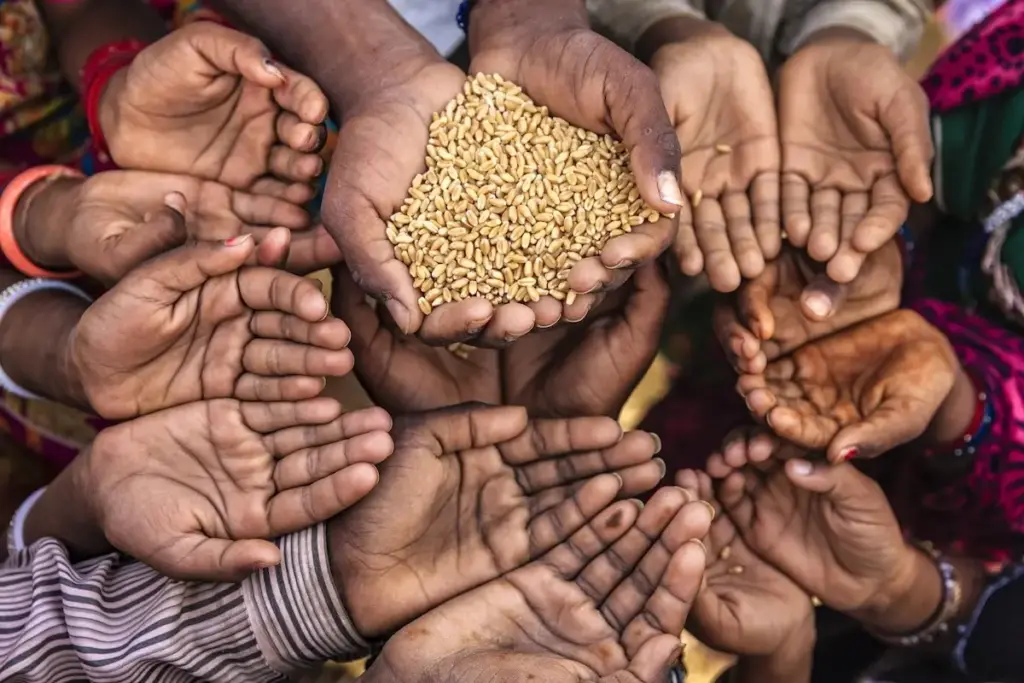
While world hunger fell overall last year, it continued to rise sharply across most of Africa and western Asia, according to a major new United Nations report. Released Monday by the Food and Agriculture Organization of the United Nations (FAO), the comprehensive study titled The State of Food Security and Nutrition in the World (SOFI) provides a sobering look at a global recovery that remains deeply uneven.
The report, published jointly by five specialized UN agencies, indicates that roughly 8.2 percent of the world’s population—about 673 million people—suffered from hunger in 2024. This figure represents a noticeable improvement from previous years, dropping down from 8.7 percent in 2022 and 8.5 percent in 2023.
Between 638 and 720 million people faced hunger last year, marking a decrease of approximately 15 million people compared to 2023 and 22 million fewer than in 2022.
Despite the encouraging global downward trend, leadership across the participating international organizations emphasized that immense challenges remain, particularly for vulnerable populations and low-income nations grappling with lingering economic shocks and extreme climate events.
“While it is encouraging to see a decrease in the global hunger rate, we must recognize that progress is uneven,” said FAO Director-General QU Dongyu in an official press release. “SOFI 2025 serves as a critical reminder that we need to intensify efforts to ensure that everyone has access to sufficient, safe, and nutritious food. To achieve this, we must work collaboratively and innovatively with governments, organizations, and communities to address the specific challenges faced by vulnerable populations, especially in regions where hunger remains persistent.”
A closer look at regional data reveals stark disparities in how different parts of the world are recovering from a confluence of global crises. In Asia, the number of undernourished individuals fell to 6.7 percent, a significant drop from 7.9 percent two years earlier. The Caribbean and Latin America also reported encouraging improvements, with undernourishment dropping to 5.1 percent of the population—representing roughly 34 million people—in 2024, following a notable peak of 6.1 percent in 2020.
However, these positive trends stand in stark contrast to the worsening conditions observed elsewhere.
“Unfortunately, this positive trend contrasts sharply with the steady rise in hunger across Africa and western Asia, including in many countries affected by prolonged food crises,” the FAO noted.
The proportion of the population facing hunger in Africa surpassed 20 percent in 2024, directly impacting 307 million people. Meanwhile, in western Asia, an estimated 12.7 percent of the population—amounting to more than 39 million people—faced hunger over the same period.
Beyond severe hunger, millions more continue to experience moderate or severe food insecurity, defined as facing constraints on adequate food access for part of the year. The global rate for moderate or severe food insecurity decreased to 28 percent in 2024, affecting 2.3 billion people, down slightly from 28.4 percent in 2023.
Public health officials emphasize that while some nutritional indicators are moving in the right direction, the broader crisis of malnutrition requires urgent, sustained intervention.
“In recent years, the world has made good progress in reducing stunting and supporting exclusive breastfeeding, but there is still much to be done to relieve millions of people from the burdens of food insecurity and malnutrition,” said WHO Director-General Dr. Tedros Adhanom Ghebreyesus.

The long-term outlook underscores the immense difficulty of meeting the international community’s Sustainable Development Goal of Zero Hunger. Current projections estimate that 512 million people could still experience chronic undernourishment by 2030, with nearly 60 percent of those individuals located in Africa.
This warning was issued jointly by the FAO, the International Fund for Agricultural Development (IFAD), the UN World Food Programme (WFP), the United Nations Children’s Fund (UNICEF), and the World Health Organization (WHO).
The persistent crisis is largely tied to the lingering economic fallout of the global food price surge that occurred between 2021 and 2023. The SOFI report examined the causes and consequences of this unprecedented inflationary wave, noting that food price inflation was driven by a combination of policy responses to the COVID-19 pandemic, the impacts of Russia’s war on Ukraine, and extreme weather events disrupting agricultural production worldwide. These compounding factors severely hindered global recovery in nutrition and food security.
Low-income nations bore the brunt of these market shocks. While median global food price inflation increased from 2.3 percent in December 2020 to 13.6 percent in early 2023, it climbed much higher in low-income countries, peaking at an alarming 30 percent in May 2023.
These soaring costs have directly affected families’ ability to purchase nutritious meals. Globally, the number of people unable to afford a healthy diet fell to 2.6 billion last year, down from 2.76 billion in 2019.
However, the trend moved in the opposite direction in vulnerable economies. In low-income countries, the number of people who could not afford a healthy diet rose to 545 million last year, up from 464 million five years earlier. In lower-middle-income nations excluding India, that figure increased from 791 million to 869 million over the same timeframe. According to the report, 544.7 million people—or 72 percent of the population—in low-income countries could not afford a healthy diet in 2024.
International leaders stressed that bolstering rural communities and agricultural systems is essential to reversing these trends and safeguarding global stability.
“In times of rising food prices and disrupted global value chains, we must step up our investments in rural and agricultural transformation,” said IFAD President Alvaro Lario. “These investments are not only essential for ensuring food and nutrition security—they are also critical for global stability.”
To address the ongoing crisis, the report outlines several key policy recommendations. These include implementing transparent and credible monetary policies designed to contain inflationary pressures; deploying time-bound and targeted fiscal measures, such as robust social protection programs, to shield vulnerable households; and making strategic investments in agrifood research, development, and market information systems to boost long-term resilience, productivity, and transportation infrastructure.
Children remain among the most vulnerable casualties of food insecurity and malnutrition. UNICEF highlighted the profound lifelong impacts that inadequate nutrition inflicts on the youngest populations.
“Every child deserves the chance to grow and thrive. Yet over 190 million children under the age of 5 are affected by undernutrition, which can have negative consequences for their physical and mental development. This robs them of the chance to live to their fullest potential,” said UNICEF Executive Director Catherine Russell.
Russell emphasized that collaborative action across governments, the private sector, and local communities is vital to guarantee that families have access to affordable, nutritious food. This includes strengthening social protection networks and educating parents on the importance of locally produced nutritious food and exclusive breastfeeding, which provides infants with the healthiest possible start in life.