

Makers have long occupied the vanguard of technological experimentation, serving as both inventors and early adopters who push hardware and software into uncharted creative territories. From the early-20th-century introduction of simple incandescent bulb displays to the current ubiquity of addressable light-emitting diodes, illumination technology has consistently captured the imagination of builders, engineers, and visual artists. While some creators focus on the energy-efficient properties of modern LEDs, others are drawn to their vivid color palettes and their seamless integration with microcontrollers, sensors, and other electronic ecosystems. At the upcoming Maker Faire Bay Area, these cutting-edge lighting projects will take center stage inside the event’s dedicated "Dark Room," a specialized exhibition space designed to maximize the visual impact of luminous creations. Set to take place at Mare Island from September 25th through 27th, the Dark Room offers attendees an immersive look at what happens when makers merge advanced optics, artificial intelligence, and physical computing with pure light.
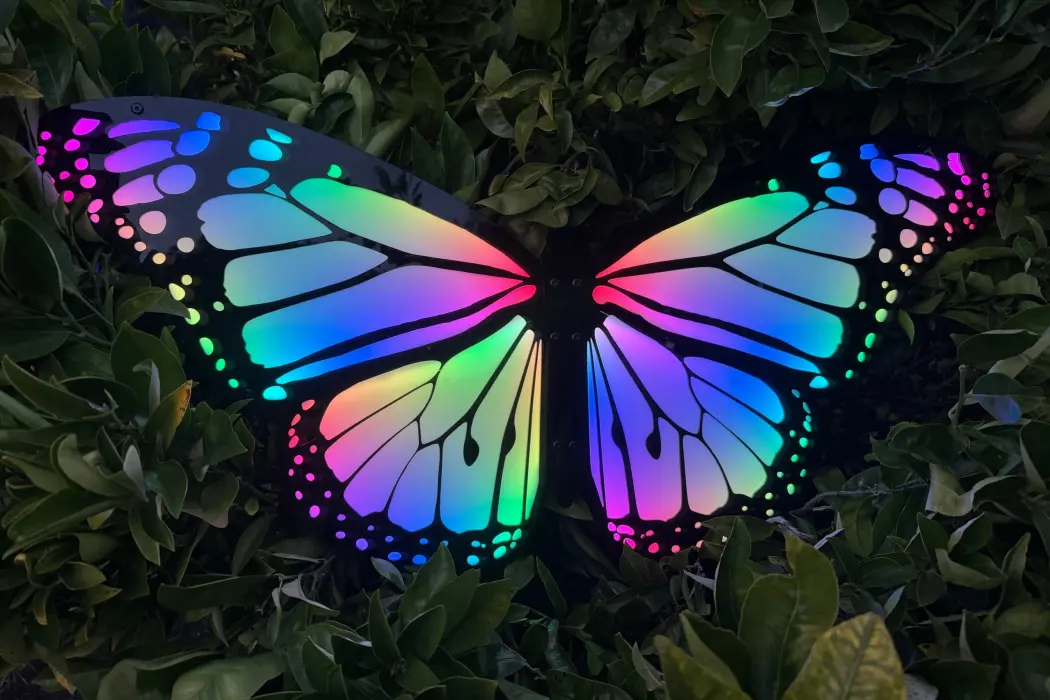
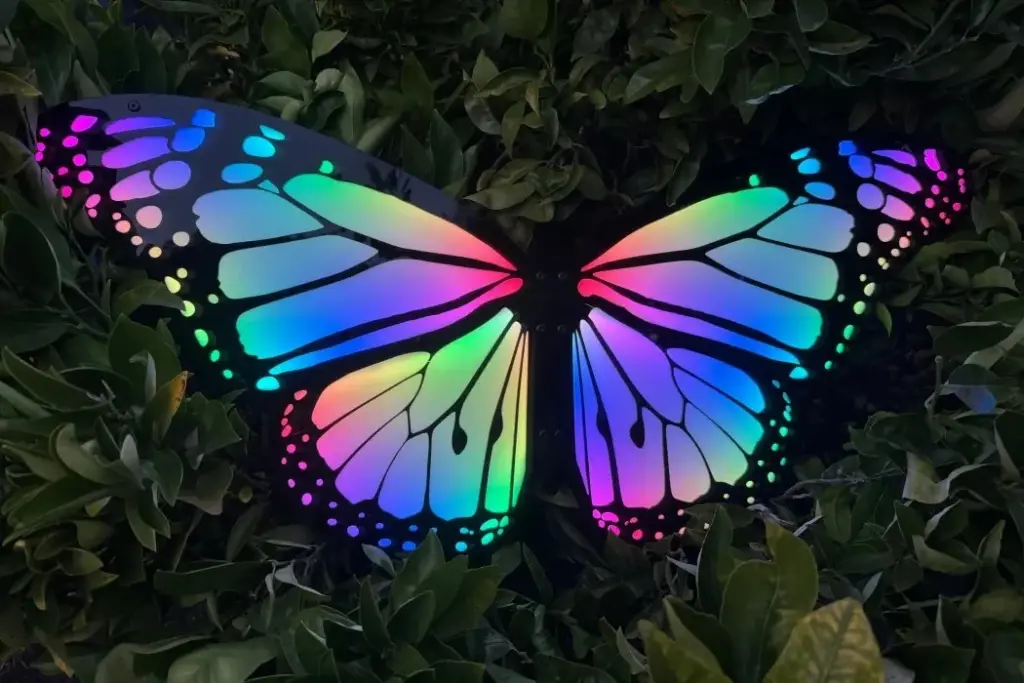
Among the standout installations headlining this year’s exhibition is Lepidoptera Imaginaria, a striking interactive light sculpture created by Grant Patterson, a Stanford-trained computer scientist with decades of professional experience spanning hardware, software, and Internet of Things (IoT) systems. Inspired by the endangered migratory monarch butterfly, Patterson’s piece utilizes 570 full-color LEDs to translate spoken words into dynamic visual patterns in real time. To engage with the sculpture, participants speak directly into a vintage microphone wired into the installation. In response, a localized large language model generates software code on the fly, instantly transforming the audio input into shifting waves of light. The project serves as a compelling physical manifestation of AI-generated code, making automated software creation visible to the naked eye while allowing anyone to become a real-time programmer without any prior coding experience. However, the installation also introduces a fascinating philosophical dilemma for the technologists and programmers in attendance: without access to the underlying code being generated instantly behind the scenes, participants cannot easily inspect, debug, or permanently alter what they have just created.
A recurring theme across many of the exhibits featured in this year’s Dark Room is the deep integration of light and sound. Numerous makers have engineered custom hardware devices and specialized printed circuit boards designed to synchronize complex visual lighting effects with audio signals, live musical performances, or standard MIDI inputs. This intersection of sensory mediums is exemplified by Night Canopy, a room-sized musical instrument designed and built by Bay Area maker, DJ, and software engineer Jenia Varavva. Visitors stepping inside the installation are greeted by hanging strands that respond directly to physical touch by generating distinct loops and short musical phrases. The fluorescent strands glow brilliantly under ultraviolet lighting suspended beneath a reflective ceiling, creating an ethereal, enclosed space that actively invites multiple attendees to collaborate and play music together.

Expanding further into the realm of audio-visual experimentation, several other installations explore how real-time human input can shape dynamic environments. Among these are an advanced agentic VJ system and a specialized theatrical lighting piece designed to alter the atmosphere of dramatic stage productions. The agentic VJ system is developed by Vrch.io, a compact art-tech studio founded by an architect-turned-computational artist and an AI engineer. The studio specializes in building real-time generative AI platforms that translate human sound, physical gestures, and emotional inputs into immersive spatial experiences, operating on the core philosophy that latent digital space represents an entirely new artistic medium worthy of alternative control mechanisms.
On the theatrical front, Bay Area artist Sydney Parcell presents Chromolume, a kinetic light-art piece originally commissioned for a production of Sunday in the Park with George staged by the Shotgun Players Theater in Berkeley. The sculpture is engineered to spin continuously while casting intricate patterns of light and shadow across its surrounding environment. Fully compatible with DMX lighting protocols, Chromolume allows theater sound and light designers to interface directly with the physical art piece, establishing a seamless technical collaboration between traditional stagecraft and modern sculpture.

Another ambitious exploration of audio-responsive lighting comes in the form of The Morphoresonator, a towering nine-foot chandelier that dominates the sensory landscape of the Dark Room. Visitors approaching the glowing sculpture will hear it humming softly with ambient music, its luminous forms meticulously hand-sculpted from common materials like cellophane and packing tape layered over internal light sources. The piece serves as a tangible demonstration that living, breathing light art does not require an industrial foundry or expensive manufacturing pipelines. When a visitor produces a sound—whether through a simple clap, a spoken word, or a musical note—the chandelier answers back, visibly shifting its illumination while absorbing the audio input and playing it back transformed through an integrated generative music system.
Similarly, Dynamandala offers an immersive, participatory environment that converts audience interactions into evolving visual displays and spatial audioscapes in real time. Utilizing a custom-built sculptural controller, visitors act as active co-creators, using movement and exploration to shape a living ecosystem of light and sound. By merging creative coding with real-time three-dimensional technology, the installation highlights the intricate relationship between human perception, physical agency, and shared collective experiences.

The exhibition’s geographical reach extends beyond the local Bay Area, drawing a contingent of seasoned makers traveling down from Portland, Oregon, many of whom are veterans of that city’s renowned winter light art festivals. Among them is the creative partnership known as Twisty Maurice, comprising artists Misty Post and Therese Gietler with technical guidance from Andy Batt. Their collective contribution to the Dark Room includes several intricate installations such as Oscillara, Vivarium, and Samyra Drift. Oscillara returns this year featuring a newly added interactive console, allowing visitors to place their hands near or inside a smaller control box and watch ripples of illumination propagate outward into a much larger, brightly lit display in real time. Another notable piece by the duo is Samyra Drift, a four-foot-long sculptural octopus constructed from folded paper and embedded LEDs, drifting alongside simulated sea stars and sea urchins that appear to expand and contract in a rhythmic breathing motion.
Bridging the gap between classical optics and interactive sculpture is Luxtriplicata, a project created by Swedish light artist Johan Fredrik Källman, whose professional practice investigates the boundaries where art, scientific inquiry, and public participation intersect. The installation utilizes the fundamental physics of optics and natural phenomena—including reflection, refraction, and chromatic dispersion—to create a tactile educational experience for attendees of all ages. At the core of the piece sits a rotatable metal plate embedded with precision glass prisms, illuminated by a concentrated beam of white light. By manually rotating the plate and rearranging the glass elements, participants directly manipulate how light bends and splits into vibrant, shifting spectrums of color.

While many exhibits in the Dark Room have been crafted specifically for gallery settings or maker exhibitions, the space also plays host to visionary works born out of the culture of Burning Man, an annual event that has historically served as a primary incubator for LED-heavy sculptures, massive interactive installations, and mobile art vehicles. While several large-scale mobile creations will roam the outdoor esplanade of Mare Island throughout the weekend, a few iconic pieces have found a temporary home inside the controlled darkness of Building 101.
Among these is Sepia Lux, featuring a massive thirty-five-foot-long animatronic inflatable cuttlefish accompanied by Flash, a companion mobile tortoise constructed from custom-formed high-density polyethylene (HDPE) panels and outfitted with extensive LED arrays. Attendees stepping into this section of the Dark Room are even invited to take control of the lighting systems directly by playing an integrated piano or drum set.

The convergence of these diverse projects highlights the rapid advancements in LED hardware and control protocols, which now allow for seamless, dynamic color shifting and instantaneous interactivity at a scale previously unimaginable outside of professional industrial productions. Organizers note that the combination of accessible microcontrollers, generative AI, and sophisticated sensor integration has fundamentally changed what makers can achieve in real time.
The Maker Faire Bay Area Dark Room will be open to the public from September 25th through 27th at Building 101 on Mare Island.