

When it comes to the world of creative fabrication, cosplay, and engineering wizardry, the maker community has consistently pushed the boundaries of what is possible with everyday materials and advanced digital manufacturing tools. Over the years, enthusiasts have successfully brought some truly astonishing concepts to life, transforming complex designs into wearable art. From intricate moving masks that mimic organic expressions and giant mechanical wings that span entire rooms to mesmerizing, flickering cathedral dresses that capture the imagination, having a diverse repertoire of technical skills at one’s disposal opens the door to truly original, one-of-a-kind ideas.
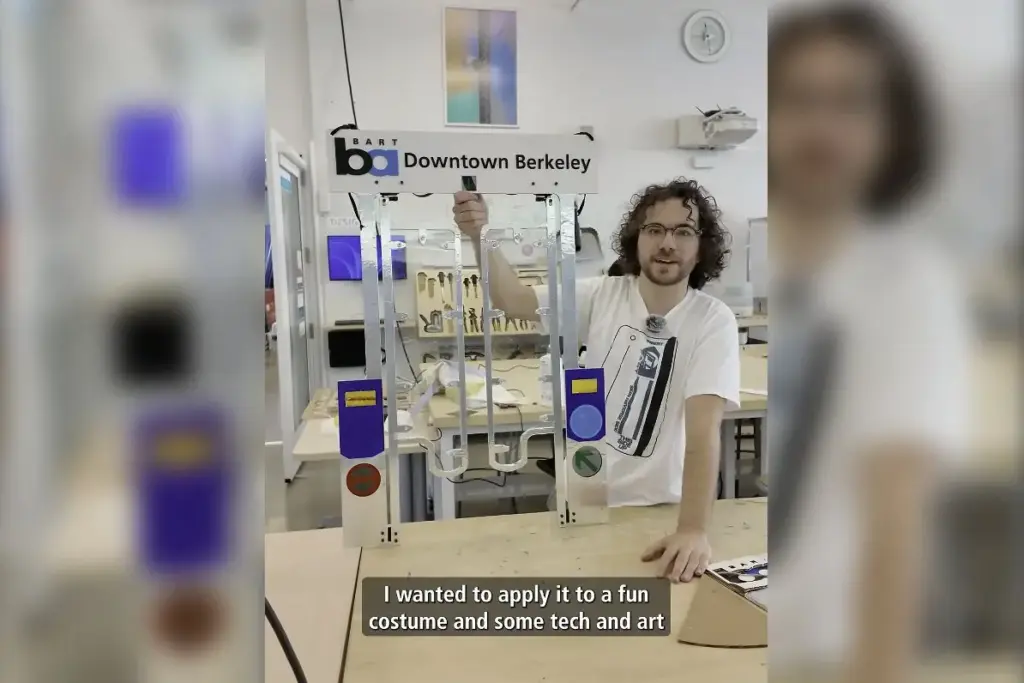
Yet, even within a community known for defying expectations and engineering the unexpected, certain creations manage to stand out purely for their novelty and ingenuity. Few observers would have ever anticipated seeing a fully realized public transit fare gate transformed into a wearable costume. Enter Taylor Waddell, a talented maker and engineer whose previous engineering feats include the innovative OpenCAL layerless 3D printer. When Waddell encountered a standard Bay Area Rapid Transit (BART) fare gate, he did not simply walk past it like thousands of daily commuters. Instead, he looked at the iconic piece of urban infrastructure and asked a simple, defining question: why not?
The result of that curiosity is a remarkable, highly detailed replica of a Downtown Berkeley BART fare gate constructed primarily as a wearable costume. This ambitious project relied heavily on digital fabrication techniques, making extensive use of a laser cutter housed at Jacob’s Makerspace at the University of California, Berkeley. Rather than serving as a static, passive cardboard cutout, Waddell’s creation boasts interactive, functional mechanics that elevate it far beyond conventional cosplay. The costume features motorized doors that open and close dynamically, alongside a working card reader that completes the authentic transit station experience.

Remarkably, this engineering marvel is actually Waddell’s second iteration of a BART fare gate costume. He constructed the new version specifically to reflect and incorporate the modern design changes, aesthetic updates, and technological evolution that have occurred in regional transit architecture since his earlier prototype. By updating the design to match contemporary station infrastructure, Waddell demonstrated a meticulous attention to detail that bridges the gap between mechanical engineering, civic design, and pop-culture fandom.
The debut of the costume taps into a broader cultural affinity for regional public transportation within the San Francisco Bay Area, where the transit system holds a distinct place in local identity. As it happens, the agency even features multiple official mascots for the public to emulate and celebrate. These range from Baylee, an online influencer mascot with a distinct fondness for boba tea, to Barty, described affectionately by transit officials as the reincarnated bunny spirit of a legacy rail car who has seen it all across decades of regional service. For residents and transit enthusiasts throughout the SF Bay Area who are eager to showcase their local public transportation pride during Halloween, conventions, or community events, Waddell has just unleashed one more exceptionally creative idea to choose from.
For those inspired by Waddell’s transit-themed engineering feat and looking to dive into the world of complex fabrication, resources from professional cosplayers offer valuable guidance on structural integrity, weight distribution, and mechanical integration in wearable builds. Whether working with laser-cut wood, acrylics, microcontrollers, or motors, the intersection of maker technology and costume design continues to yield breathtaking surprises across the maker community.