



The stock market has once again proved its capacity to surprise, leaving investors grappling with a familiar mix of awe and anxiety. As equities scale record-breaking valuations, driven largely by the explosive and frenzied artificial intelligence boom, many market participants are questioning whether an unprecedented correction is inevitable. Investors worry that while AI is undoubtedly a major technological leap, the financial mania surrounding it is moving too fast, threatening to trigger a modern, amplified version of the early 2000s dot-com crash.
This dynamic has prompted widespread discussions across financial and retirement communities. Veteran financial commentators, drawing parallels to historical market cycles, note that the current anxiety mirrors the existential dread felt during previous economic transitions. Addressing these concerns requires looking past the daily noise of the financial media and examining the fundamental drivers of economic growth, human psychology, and the nature of risk itself.

Will the AI Bubble Ruin Our Retirement?
For individuals who have successfully transitioned into retirement, the prevailing sense of comfort is frequently challenged by external anxieties. Friends, family members, and observers watching the daily news cycle often question how anyone can remain retired and sleep peacefully amid a backdrop of geopolitical tensions, inflationary pressures, towering national debt, and the looming threat of asset bubbles.
Yet, this brand of pervasive anxiety is hardly new. Looking back two decades to 2006, the worries of the day felt equally catastrophic to those experiencing them. At that time, society fixated on geopolitical conflicts in the Middle East, escalating national debt, inflation, and a notoriously overvalued housing market. Observers worried that the housing bubble would permanently derail the economy, just as concerns mounted over jobs being outsourced overseas and dire warnings about peak oil threatening global stability.

What followed, of course, was the Great Financial Crisis—a severe economic downturn sparked by irrational exuberance over real estate prices and excessive financial leverage. Yet, viewed through the lens of a multi-decade timeline, even that historic crash appears as a temporary dip in a broader trajectory of long-term economic growth. Portfolios that endured the volatility of the mid-2000s and subsequent shocks, such as the 2020 pandemic-induced crash, ultimately experienced substantial growth over the long run.
Simultaneously, the broader world experienced remarkable systemic improvements. Global extreme poverty rates plummeted significantly over the span of twenty years, and infant mortality rates were drastically reduced. Concurrently, the proliferation of clean energy drastically altered global power generation, with solar power becoming exponentially cheaper and accounting for the vast majority of newly added electrical capacity. Electric vehicle adoption similarly surged from negligible levels to a substantial share of global automotive sales.

Prosperity Comes from Productivity
Despite these historical precedents, skeptics frequently ask whether the current era is fundamentally different. Concerns persist that the scale of the artificial intelligence boom, combined with sovereign debt levels, could prevent a traditional market recovery, or that AI could evolve in unpredictable directions.
However, financial doomsayers consistently overlook a fundamental economic truth: true long-term prosperity does not originate from the financial system or the stock market, which ultimately represent numerical abstractions tracked on computers. Instead, prosperity stems directly from productivity.

The fundamental mechanics of capitalism are inherently choppy, characterized by cyclical booms and busts. Beneath the turbulent waves of the financial markets, however, real people perform tangible work and develop genuine innovations. The financial system itself is a human construct; if parts of the architecture fail due to unsustainable valuations, societies have repeatedly demonstrated the capacity to restructure the framework and resume productive labor, much as they did following the disruptions of 2008.
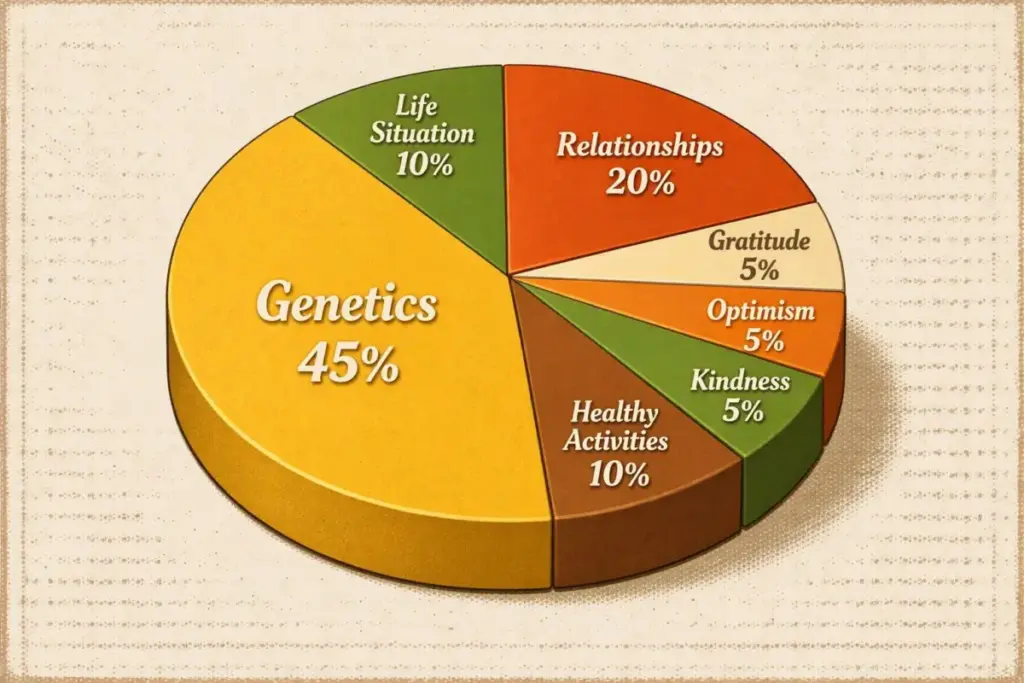
Standard of living, economic growth, and the viability of long-term financial independence rely entirely on productivity gains. Once a society achieves a certain baseline standard of living, human happiness plateaus in terms of material wealth, shifting focus toward interpersonal relationships, health, and personal fulfillment.

Understanding and Combating Fear
The persistence of financial anxiety despite favorable long-term data points to a deeper psychological phenomenon: the human brain functions fundamentally as a danger-detection mechanism. Evolutionary biology equipped humans with background fear to protect against immediate physical threats. However, in modern environments where physical scarcity and predators have largely been mitigated, this detection machinery often continues functioning, shifting goalposts to new targets.
Once basic survival needs are met, human anxiety frequently pivots toward social standing, wealth accumulation, tax strategies, and future uncertainties. This perpetual state of apprehension can be exacerbated by constant exposure to sensationalized news media, which systematically highlights the most alarming stories of any given day.

Combatting this cycle requires a conscious shift in mental diet and behavior. Recognizing the root causes of anxiety—whether rooted in personal history, past trauma, or cultural conditioning—allows individuals to evaluate threats rationally rather than emotionally. By focusing on active problem-solving, physical health, outdoor activity, and cultivating relationships with optimistic and productive peers, individuals can build genuine resilience.
Viewing life transitions through the lens of experimentation rather than existential threat further neutralizes anxiety. Whether approaching career changes, lifestyle shifts, or retirement, treating life events as manageable experiments transforms the unknown from a source of dread into an opportunity for adaptation.

The AI Era as a Technological Experiment
Applying this experimental mindset to the artificial intelligence boom reframes the technology from a looming catastrophe into an era of profound technological evolution. While AI introduces genuine unknowns and workforce displacement—impacting entry-level office roles, administrative functions, and eventually transportation sectors—it simultaneously functions as a powerful cognitive tool designed to enhance human efficiency.
Historically, major technological breakthroughs—ranging from the industrial machinery of the past to the internet and mobile computing—have consistently boosted productivity while reshaping labor markets. Although productivity gains often concentrate initial rewards among capital owners and shareholders, they ultimately reduce costs and lay the groundwork for entirely new industries and economic opportunities.

Ultimately, artificial intelligence represents another transitional phase in human history, offering choices rather than predetermined outcomes. By understanding the psychological roots of fear, filtering out unnecessary sensationalism, and focusing on productivity, resilience, and positive human behavior, individuals can navigate market volatility and technological shifts with confidence.