


The modern stock market has a persistent habit of surprising investors, repeatedly pushing past record valuations and leaving many wondering how long the momentum can last. As markets surge on the back of the current artificial intelligence boom, a familiar sense of anxiety has gripped portions of the financial world. Investors and retirees frequently look at sky-high valuations and wonder if an unprecedented crash is just around the corner, mirroring the dot-com bust of the early 2000s or the housing market collapse of 2008.

Yet, looking past the day-to-day headlines reveals a broader narrative about human history, economic productivity, and the psychological trap of fear itself. Financial commentators and long-term observers note that anxiety about the future is a constant feature of human psychology, regardless of the specific crisis dominating the news cycle at any given moment.
Looking Back at Two Decades of Market Worries
To understand contemporary anxieties surrounding the artificial intelligence boom, it helps to examine the historical parallels. Financial observers who have spent decades navigating market cycles note that the specific objects of fear change constantly, while the underlying emotional response remains remarkably consistent.

Two decades ago, in 2006, investors faced a different set of terrifying prospects. The media was filled with warnings about soaring national debt, escalating inflation, geopolitical instability in the Middle East, and the looming threat of the housing bubble. At the time, economists and pundits debated whether the stock market was dangerously overvalued and whether globalization and the outsourcing of jobs to countries like India and China would permanently cripple Western economies. There was even widespread panic over "Peak Oil," a theory suggesting that global fossil fuel supplies would inevitably plummet while demand surged, leading to societal collapse.
None of those specific apocalyptic scenarios played out in the exact manner predicted. While the subsequent Great Financial Crisis did trigger the most severe economic downturn since the Great Depression, the long-term trajectory of the stock market continued upward. A hypothetical investment made during those anxious years of 2006 would have grown significantly over the following two decades, easily absorbing subsequent market shocks, including the economic disruption caused by the COVID-19 pandemic in 2020.

At the same time, global living standards improved dramatically across several measurable metrics. Over a twenty-year period, the proportion of the global population living in extreme poverty dropped from approximately 20 percent to single digits. Infant mortality rates were cut in half, clean energy technologies advanced rapidly as solar panels became a fraction of their previous cost, and electric vehicle adoption expanded from a niche concept to a substantial share of the global automotive market.
Prosperity Rises from Productivity
The persistent disconnect between gloomy economic forecasts and actual human progress stems from a fundamental misunderstanding of where prosperity originates. Financial panic often treats the stock market and abstract financial systems as the foundation of modern society. In reality, financial systems are merely human-invented tracking mechanisms built on computers.

True economic prosperity and rising standards of living are rooted in productivity. Throughout history, whenever financial systems have experienced severe crashes, societies have adjusted, updated their metrics, and returned to work utilizing the tools and inventions at their disposal. The fundamental capacity of human beings to innovate, build, and solve practical problems remains the primary driver of economic growth.
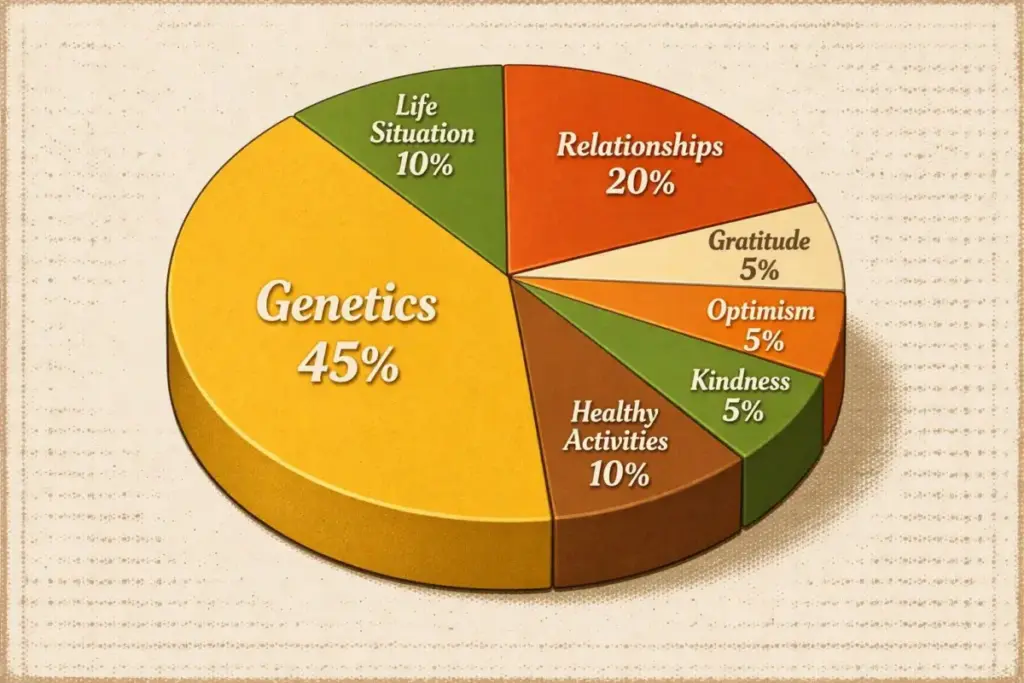
While financial media outlets thrive on generating alarming narratives to capture audience attention, human happiness and well-being are ultimately multi-dimensional. Research into life satisfaction suggests that once a society surpasses a certain threshold of material wealth and basic security, additional financial gains have a diminishing impact on overall happiness. Factors such as personal relationships, physical health, community engagement, and a generally optimistic outlook play a far more significant role in determining an individual’s quality of life than short-term market fluctuations.

Understanding and Managing Financial Fear
The persistence of anxiety among investors, even those who have successfully achieved financial independence, points to a deeper psychological mechanism. Human beings evolved as sophisticated danger-detection machines. In ancestral environments, maintaining a constant state of hyper-vigilance was essential for survival against predators, disease, and starvation.
However, this evolutionary trait creates modern complications. When physical survival needs are fully met and acute dangers are eliminated, the human brain does not simply turn off its detection machinery. Instead, it moves the goalposts. Once individuals secure enough food and shelter, they begin worrying about social belonging, then about accumulating wealth, and eventually about hyper-specific issues like tax strategies, estate planning, or neighborhood property regulations.

Psychologists and financial educators emphasize that overcoming this pervasive background fear requires self-awareness. Examining one’s personal history, identifying childhood influences or past traumas related to scarcity, and confronting worst-case scenarios rationally can help dismantle irrational anxieties. When individuals analyze what would actually happen if their worst financial fears materialized, they frequently discover that the reality would be far less catastrophic than imagined.
Furthermore, taking proactive steps and engaging in direct action tends to dissolve abstract worries. Familiarity breeds confidence, and developing personal resilience—the capacity to adapt to changing circumstances—transforms intimidating unknowns into manageable challenges. Tuning out the daily stream of sensationalized news and focusing instead on positive behaviors, physical health, and constructive personal projects helps realign human habits with the environments humans were built to inhabit.

The AI Era as a Technological Experiment
Applying this perspective to the current artificial intelligence boom reframes the technology from an existential threat into an ongoing global experiment. Change naturally induces uncertainty, and uncertainty triggers fear for those accustomed to stability. Yet, viewing artificial intelligence through the lens of economic history reveals that it functions primarily as a powerful tool for cognitive efficiency.
Much like the introduction of automated machinery, personal computers, and the internet before it, artificial intelligence acts as a catalyst for productivity. While it inevitably disrupts specific job sectors and displaces certain administrative or entry-level roles, it simultaneously lowers the cost of valuable services and paves the way for entirely new industries.

Historically, the economic rewards of major technological shifts have tended to concentrate among the owners of capital and businesses that successfully integrate those tools. Consequently, shareholders and forward-thinking enterprises often benefit from the resulting productivity gains. At the same time, the broader economy adapts as goods and services become more efficient and accessible.
Ultimately, artificial intelligence represents another choice point for society. Rather than succumbing to doomsday narratives, individuals can choose to view technological advancements as triggers for continuous learning, adaptation, and personal growth. As many financial independence advocates note, confronting and moving past deeply ingrained fears is often the only pathway to achieving lasting fulfillment and security in an ever-changing world.