


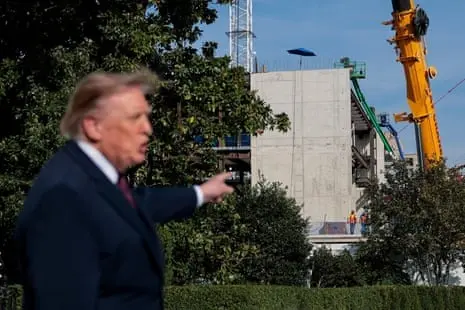
As he departed the White House for a high-stakes campaign rally in Mobile, Alabama, Donald Trump doubled down on a contentious international trade ultimatum, threatening to double import tariffs on South Korea if the nation fails to finance a massive $54 billion natural gas pipeline project in Alaska.
The escalating trade standoff began earlier in the week when the president made a surprise announcement during an Oval Office ceremony, claiming that South Korea had officially agreed to fund the multi-billion-dollar energy infrastructure project. According to the president, the foreign investment was meant to serve as a cornerstone of a trade agreement struck in 2025, which saw the United States lower tariffs on South Korean imports in exchange for significant economic investments within American borders.

However, those claims were quickly called into question. Just a day after the Oval Office announcement, a senior South Korean official publicly contradicted the White House, clarifying that Seoul had only agreed to "initiate a review" regarding a potential investment in the Alaska pipeline, stopping well short of a binding financial commitment.
When questioned by reporters on Friday about whether he had prematurely declared victory on the deal, Trump rejected the notion outright.
"No, I didn’t jump the gun," Trump told reporters outside the White House before boarding Marine One. "Let’s see if they don’t want to do it. That’s okay with me. I’ll just charge them more."

When informed that South Korean officials insisted they had not yet signed any formal agreement, the president issued a direct warning.
"They said they didn’t sign it?" Trump asked. "Tell them if they don’t sign shortly, I’m going to double it up, okay?"
The public dispute over the Alaska natural gas pipeline forms part of a turbulent broader news cycle as the Trump administration navigates a difficult economic landscape and prepares for the upcoming November midterm elections. The president’s remarks on South Korea came amidst a flurry of domestic and foreign policy developments, including questions over federal spending, environmental rules, and a sluggish national jobs report.

Earlier on Friday, newly released figures from the Bureau of Labor Statistics revealed that the U.S. economy added just 29,000 jobs in September—significantly trailing the roughly 90,000 jobs forecasted by economists. At the same time, the national unemployment rate ticked upward to 4.2%, adding to growing anxieties over the cost of living and the broader economic trajectory under the current administration.
Despite the cooling economic indicators, the White House maintained an optimistic tone regarding its industrial policies. Spokesperson Taylor Rogers pointed to recent manufacturing and factory construction job gains as evidence that the administration’s reindustrialization agenda is successfully taking root, even as critics and opposition lawmakers argued that inflation and rising energy costs continue to squeeze American households.
As the administration campaigns aggressively across the country ahead of the crucial congressional elections, the intersection of international trade policy, domestic energy prices, and foreign relations remains a central flashpoint. Whether South Korea will alter its stance on the Alaska pipeline project in response to the renewed tariff threats remains to be seen, but the administration has made it clear that economic leverage will remain a primary tool in its foreign policy approach.