


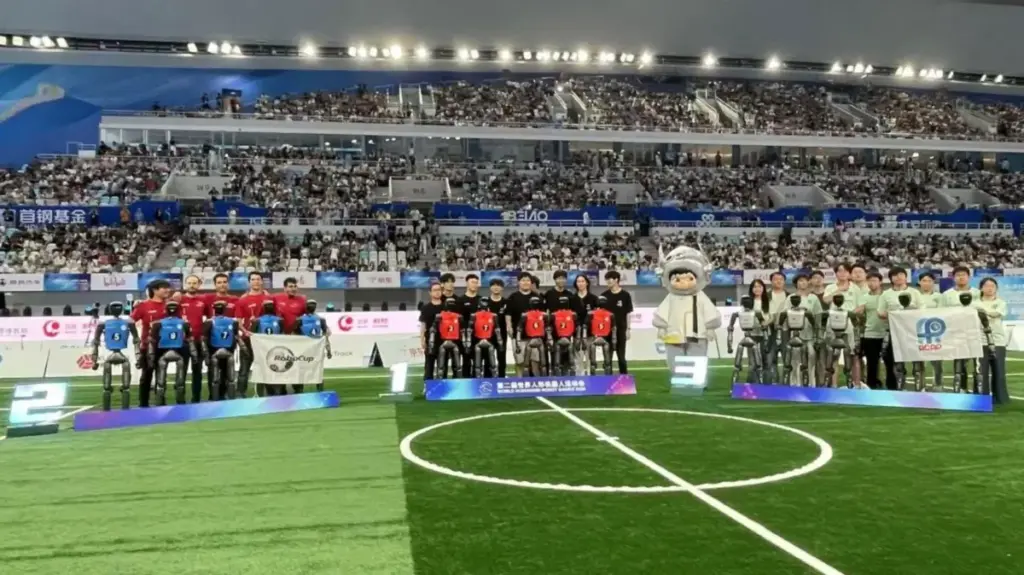
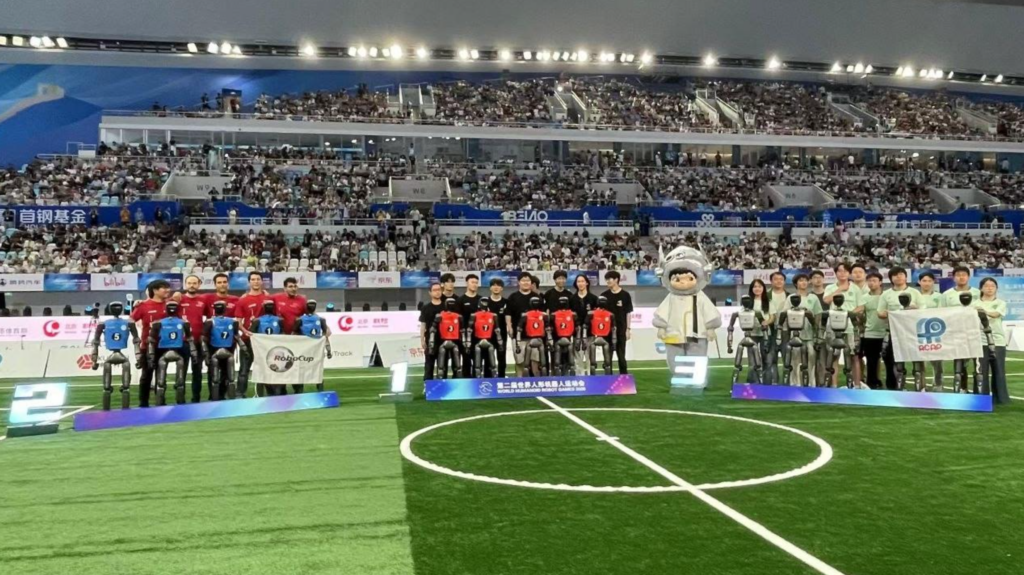
The world of robotics has crossed a major threshold. This past summer, twenty-two humanoid robots walked onto a football pitch in Incheon, South Korea, to play the first 11-a-side match in RoboCup history. Operating entirely without remote controls, elite autonomous machines from Germany tested the limits of balance, machine vision, and real-time coordination on a regulation-sized field. Now, the complex challenges that defined that landmark fixture—ranging from bipedal locomotion to rapid debugging—are heading to Europe, taking center stage at the upcoming Maker Faire Rome.
On July 5, 2026, the robotics community witnessed a watershed moment when B-Human from the University of Bremen and HTWK Robots from Leipzig squared off in an 11-a-side humanoid football match. Played as an exhibition fixture immediately following the official tournament, the game lasted for a single half on an expanded pitch. When the final whistle blew, B-Human claimed a 4–0 victory. While the scoreline captured initial attention, the deeper engineering achievement lay in the simple fact that the match took place at all.
When RoboCup first introduced its humanoid competition back in Fukuoka, Japan, in 2002, the participating robots tackled tightly constrained, incremental challenges rather than full-scale association football. Over the subsequent twenty-four years, relentless engineering breakthroughs have bridged the gap between basic mobility and dynamic team sports. Today, a robot playing soccer must continuously process kinematic vectors, wheel and joint velocities, and directional forces to navigate a complex environment, track a fast-moving ball, and execute precise kicks under pressure.
Why Make a Robot Play Football?
RoboCup was established in 1997 with a remarkably ambitious long-term objective: by the middle of the twenty-first century, a team of fully autonomous humanoid robots should be capable of defeating the reigning human FIFA World Cup champions under standard rules. While the target still sounds wildly improbable to outsiders, that high bar is precisely the point. Football serves as an ideal benchmark for robotics because the game is defined by perpetual motion and unpredictability. The ball shifts constantly, opposing players alter the landscape by the second, and the robot itself must maintain precarious balance on two legs while simultaneously calculating its location on the pitch and determining its next tactical move.
Unlike industrial assembly lines or scripted automation, football offers no fixed sequence of movements that can guarantee success. A successful robotic player must locate the ball, determine its own relative position on the field, recognize teammates and adversaries, select an optimal course of action, move dynamically without tipping over, and instantly adapt when an opponent disrupts its trajectory. Furthermore, all of these intricate systems must operate in seamless harmony. Superior computer vision provides little advantage if the mechanical frame cannot turn quickly enough to intercept a pass. A meticulously trained kicking motion is rendered useless if the robot misjudges the precise location of the ball by even a few centimeters.
Optimizing one subsystem frequently introduces complications elsewhere. Enhancing a walking gait can disrupt localization algorithms, while a minor hardware adjustment can force engineers to completely retune software that functioned flawlessly just hours earlier. For builders and developers, robot football provides the ultimate diagnostic arena, subjecting an entire integrated network of hardware and software to real-world stress tests.

The Evolution of Platforms and Software
The 2026 competitive season introduced a structural evolution to RoboCup by merging the former Standard Platform League and Humanoid League into the unified Humanoid Soccer League. Within the Middle Division, prominent contenders such as B-Human and HTWK Robots competed using standardized Booster Robotics K1 humanoid platforms. However, utilizing identical hardware foundations did not translate to identical performance on the pitch.
B-Human engineered proprietary motion systems for the K1 platform, developing custom routines for running, shooting, and recovering after falls. Rather than relying exclusively on the manufacturer’s default movement presets, the team utilized deep reinforcement learning to train these complex behaviors. This distinction highlights a crucial reality of modern robotics: acquiring an off-the-shelf humanoid platform eliminates the monumental engineering hurdle of designing every individual joint, gearbox, and structural component from scratch, but it does not instantly produce a functional athlete.
Transforming hardware into a competitive footballer demands sophisticated software, rigorous training regimens, continuous control tuning, and countless hours spent discovering that behaviors optimized in computer simulations often behave quite differently once subjected to real-world motors, batteries, friction, and gravity. Following their exhibition 11-a-side match, B-Human secured the RoboCup 2026 Middle Division title by defeating HTWK Robots 6–0 in the official tournament final before returning to the pitch for their historic experimental showcase.

For spectators, the true fascination of robot football extends far beyond the scoreboard. Observing the critical seconds immediately preceding a robot’s interaction with the ball reveals layers of complex computation. Analysts watch to see how a machine detected the ball, how it calibrated its spatial awareness, why it selected a specific approach vector, and how swiftly it adjusted its course when an opponent crossed its path. Even falls—which remain a frequent occurrence—offer valuable insights into how autonomous systems evaluate damage, select a recovery routine, and reintegrate themselves into the flow of the match.
RoboCup Comes to Maker Faire Rome
A competitive robot football match encapsulates nearly every major challenge in modern engineering, fusing computer vision, localization, motion planning, bipedal locomotion, machine learning, and multi-agent coordination into a single high-pressure event. More importantly, it exposes a fundamental truth that every hardware developer eventually learns: the physical world possesses its own unpredictable agenda. Software simulations rarely account for a connector that works loose under vibration, a battery pack that loses charge prematurely, or a playing surface that offers slightly less traction than the testing laboratory. Real machines encounter all of these variables, making observed failures just as educational as successful goals.
From October 23 to 25, Maker Faire Rome will host the inaugural Italian Open RoboCup Humanoid Soccer Tournament as an official RoboCup Regional Event at the Gazometro Ostiense. The upcoming Roman exhibition will showcase Middle and Large Divisions, featuring dynamic 3-v-3 and 5-v-5 matches depending on the participating teams and robot platforms. In addition to competitive fixtures, the event will offer technical evaluations, public demonstrations, and specialized workshops focused on humanoid soccer development.

This environment offers visitors an unfiltered look at robotics in action, far removed from polished promotional videos. The competing robots must autonomously locate the ball, navigate into formation, maintain balance, execute tactical decisions, cooperate with peers, and react to opposing strategies in real time. Moments of seamless execution will inevitably alternate with instances of engineers hastily reaching for diagnostic laptops, with both outcomes forming an integral part of the narrative.
Equally valuable is the opportunity for attendees to engage directly with the creators behind the machines. At Maker Faire Rome, the hardware represents only half of the exhibit; the other half consists of researchers, students, and engineers standing nearby, eager to discuss why a particular iteration failed or why the latest prototype features an entirely redesigned knee joint. These multidisciplinary teams draw on expertise across mechanics, electronics, artificial intelligence, computer vision, and control systems, turning what appears to be a simple movement on the pitch into the culmination of weeks spent refining gaits and retraining behaviors.
This collaborative, iterative ethos makes RoboCup a natural fit for Maker Faire Rome. Beneath the competitive framework lies the familiar cycle shared by makers worldwide: build the prototype, test its limits, identify the flaws, implement modifications, and try again. While RoboCup’s ultimate objective of challenging human World Cup champions remains decades away, the journey itself offers a compelling spectacle. Visitors in Rome will have a front-row seat to observe how engineers are steadily building their way toward the future of robotics.

Maker Faire Rome – The European Edition runs from October 23 to 25, 2026, at the Gazometro Ostiense in Rome.