




The stock market has a persistent habit of defying expectations, leaving investors to repeatedly dust off the phrase, “How about that stock market?” When major indices crash, retirement portfolios shrink, triggering immediate anxiety. Yet, even when the market scales record highs and hits unprecedented valuations, a different kind of worry sets in—the lingering dread that an even larger crash is just around the corner. Today, that prevailing market anxiety is heavily fueled by the frenzied boom surrounding Artificial Intelligence.
For those who have managed to tune out the financial drama and simply enjoy their lives, the current AI narrative can be broken down into a few core points: rapid technological advancements, massive capital expenditure by major tech players, and widespread speculation about how deeply the technology will transform the global workforce. But for investors watching closely, the core fear is that the AI mania is moving too fast and growing too large, potentially setting the stage for a magnified replay of the dot-com crash of the early 2000s.

That historical parallel carries personal resonance for early retirement advocates and internet financial commentators who cut their teeth during the late-90s tech boom. That exact market cycle initially propelled early careers and paved the way for early retirement, only for the subsequent crash to nearly derail job security and immigration status. As questions mount regarding the current investment cycle, financial educators are finding themselves regularly addressing whether today’s speculative fervor will ultimately upend long-term financial security.
Will the AI Bubble Ruin Our Retirement?
Having spent over two decades in retirement, veteran financial commentators have grown comfortable with the concept, yet they still encounter probing questions from anxious peers. A common refrain among cautious observers is asking how anyone can remain retired and sleep soundly given the state of the world. Posing questions about whether retirees harbor deep worries usually brings to mind a laundry list of modern geopolitical and economic anxieties.

Today’s news cycle offers no shortage of alarming headlines: tense political landscapes involving prominent global figures, persistent inflation eroding purchasing power, the burgeoning AI bubble, towering national debt levels, and simmering international conflicts threatening wider escalation. Yet, these contemporary anxieties mirror concerns raised decades ago.
Looking back twenty years to the mid-2000s, investors wrestled with entirely different sets of catastrophic predictions. Back then, the anxiety centered on geopolitical conflicts in the Middle East, surging national debt, inflation, and an overvalued stock market driven by a dangerous housing bubble rather than an AI bubble. Fears about job security were tied to the outsourcing boom toward Asia, while economists fiercely debated “Peak Oil” and whether rising fossil fuel demand would outstrip finite supplies, dooming global industrialization.

Despite the heavy pessimism of 2006, the subsequent decades revealed a vastly different trajectory. The world did experience the Great Financial Crisis—triggered by irrational exuberance over housing prices and overly complex financial leverage—which marked the most severe economic downturn since the Great Depression. However, viewed through the lens of a multi-decade horizon, even that historic crash appears modest within the broader scope of long-term market growth. A hypothetical investment made prior to the downturn expanded significantly over the following twenty years, absorbing subsequent shocks like the 2020 pandemic-era market drop.
Beyond financial charts, global living standards improved dramatically across several measurable metrics. The proportion of the global population living in extreme poverty dropped sharply over a twenty-year span, and global infant mortality rates were cut in half. Clean energy adoption surged as the cost of solar panels plummeted, allowing solar generation to dominate new energy additions worldwide. Meanwhile, electric vehicle adoption transitioned from a nascent concept into a major share of global auto sales.

These historical shifts highlight a fundamental question about human forecasting: whether energy is better spent worrying about an uncertain future or focusing on productivity and adaptation. Skeptics today question whether current conditions are fundamentally different—pointing to the sheer scale of national debt, the velocity of the AI boom, or dystopian scenarios involving runaway machine intelligence. Financial media outlets frequently amplify these narratives, but such pessimistic views often overlook a foundational economic principle: true prosperity stems from productivity, not financial market indices.
Understanding the Core Drivers of Prosperity and Human Happiness
Economic prosperity is built upon real human effort, practical inventions, and productivity gains rather than the abstract numbers flickering across computer screens in the financial system. Capitalism is inherently volatile, prone to cyclical booms and sharp corrections. Beneath the turbulence of the markets, however, real people continue to perform tangible work and develop useful innovations.

The concept of an economy is ultimately a human construct. If financial systems experience severe disruptions due to distorted metrics or speculative excesses, societies have historically adapted by restructuring financial frameworks and returning to productive labor. The fundamental tools required to drive economic growth, raise living standards, and achieve early financial independence rely entirely on sustained improvements in productivity.
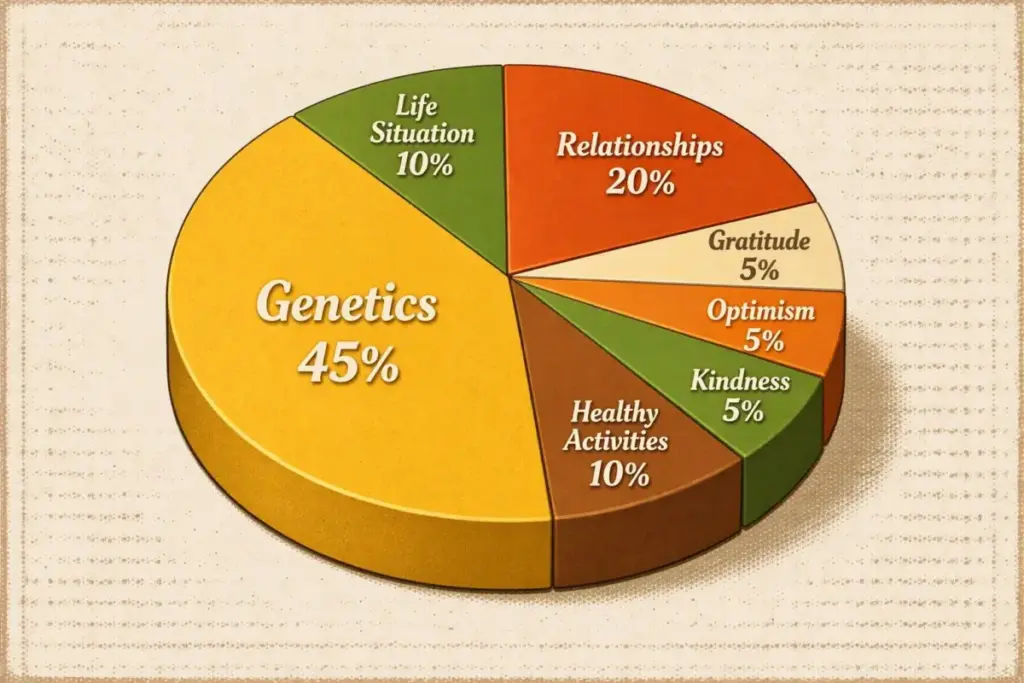
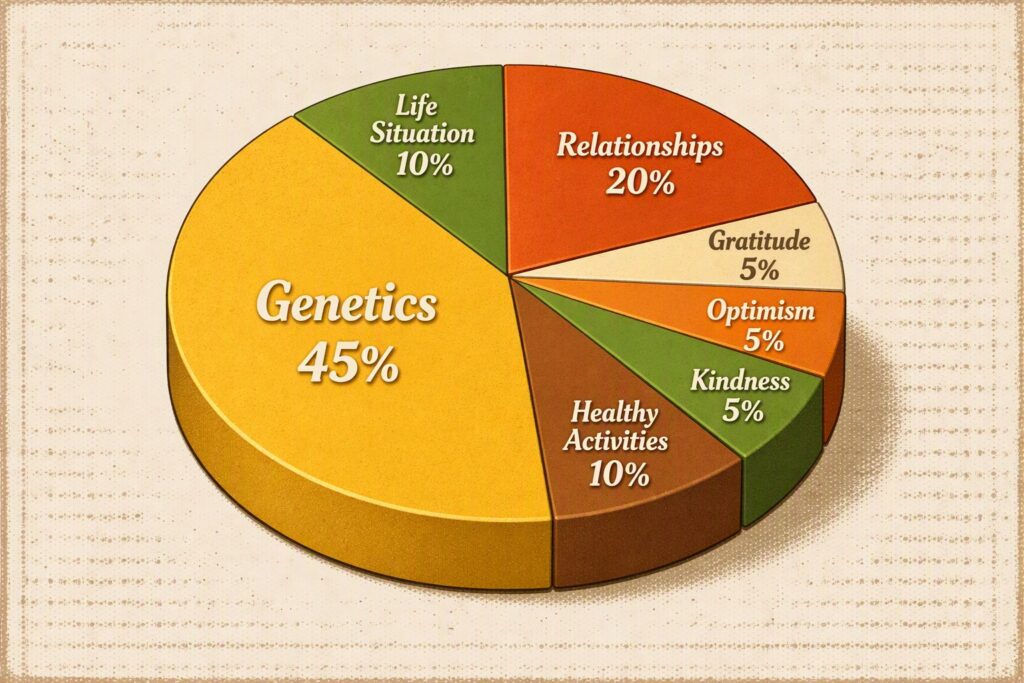
Yet, beyond productivity and material wealth, human happiness tends to plateau once a baseline standard of living is achieved. In developed nations, societies surpassed those minimum physical requirements decades ago, prompting individuals to seek other qualitative factors to maximize their overall life satisfaction. Wealth ultimately serves as one component of a broader life situation, which interacts with genetics, interpersonal relationships, personal mindset, and physical health.

While genetic predisposition heavily influences baseline happiness, individuals retain significant control over their daily choices. Cultivating strong social connections, practicing gratitude, maintaining an optimistic outlook, and engaging in regular physical activity outdoors consistently rank among the most reliable contributors to well-being. Despite widespread access to these foundational truths, underlying financial anxiety persists even among experienced investors and early retirees.
Confronting the Psychology of Fear
The persistence of anxiety often traces back to evolutionary biology. Human beings evolved as sophisticated danger detection machines designed to identify and react to environmental threats. While this trait successfully protected early humans from predators and disease, modern environments lack those immediate physical perils, causing the brain’s detection machinery to shift its focus toward abstract worries.

When immediate physical survival needs are met, the human mind pivots to new anxieties regarding food scarcity, social exclusion, or financial stability. Even among individuals who achieve comfortable upper-middle-class lifestyles, worry often manifests in hyper-specific concerns, ranging from neighborhood property regulations to complex tax strategies and required minimum distributions on retirement accounts.
Combating this persistent cycle of fear requires a degree of self-awareness and rational evaluation. Examining personal history often reveals the root causes of scarcity mindsets or anxiety, which may stem from childhood experiences or generational attitudes shaped by historical economic hardships. Identifying the specific nature of a fear—such as mapping out the realistic worst-case scenario of financial loss—frequently demonstrates that the feared outcome is far less catastrophic than anticipated.

Taking concrete action remains one of the most effective antidotes to anxiety. Action transforms the unfamiliar into the familiar, building resilience and confidence in one’s ability to adapt to changing circumstances. Furthermore, reducing exposure to sensationalized daily news cycles helps clear mental clutter, allowing individuals to focus their energy on positive behaviors, physical health, and productive problem-solving. Surrounding oneself with optimistic, forward-thinking peers further reinforces a constructive mental outlook.
Viewing Technological Shifts Through the Lens of Experimentation
Adopting an experimental mindset toward major life transitions—whether changing careers, relocating, or entering retirement—helps reframe uncertainty from a source of dread into a subject of curiosity. This same perspective applies directly to the current expansion of Artificial Intelligence.
Rather than succumbing to doom-scrolling and pessimistic media narratives, examining the underlying mechanics of AI reveals why technologists view it as a transformative tool. AI functions largely as a powerful cognitive accelerator, boosting efficiency and productivity across numerous industries. Just like past technological revolutions, it will inevitably displace certain entry-level office and administrative roles while simultaneously reducing service costs and catalyzing entirely new economic sectors.
At the same time, the distribution of economic benefits from new technologies tends to favor asset owners and shareholders, contributing to broader wealth concentration dynamics that mirror previous technological shifts, such as the rise of the internet and mobile computing. Ultimately, artificial intelligence represents another major technological evolution that requires individuals to make deliberate choices regarding how they engage with the changing world.

By addressing the root causes of anxiety and focusing on practical action, individuals can navigate market volatility and technological disruption with greater resilience, ensuring that fear does not dictate their financial or personal futures.